

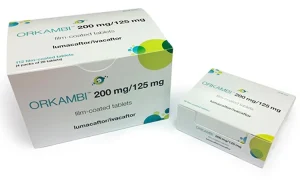
TM Owner Vertex Pharmaceuticals
Orkambi 200mg + 125mg Tablet
Global Shipping : Reliable Global Distribution Network
Express Delivery : Priority Shipping for Every Order
Secure Payments : Trusted Payment Protection System
 Disclaimer

Secure Handling
24/7 Worldwide Support

Global Access
Worldwide Access to Health

Cold-Chain Expert
Excellence in Cold-Chain

Trusted Supply
Certified Medical Supply
Indications & Clinical Uses
- Orkambi 200 mg/125 mg tablets combine lumacaftor and ivacaftor, two CFTR modulators, used to treat cystic fibrosis (CF) in patients aged 1 year and older who have two copies of the F508del mutation in the CFTR gene (homozygous), confirmed by genetic testing.
- Lumacaftor helps the faulty CFTR protein fold and reach the cell surface, while ivacaftor helps it work once there, together improving the salt and water transport that is defective in CF.
- Orkambi is approved in the United States by Vertex Pharmaceuticals and, under the same brand name, in the European Union.
- It has not been shown to work in CF patients with other CFTR mutations, and its safety and efficacy have not been established outside the F508del-homozygous population, so genetic confirmation is required before starting.
Side Effects
- There is no boxed warning for Orkambi.
- The most common effects, each affecting more than 1 in 10 patients, include shortness of breath, cough, nasal congestion, nausea, diarrhoea, tiredness, and a runny nose, and breathing-related reactions are more likely in the first days of treatment, especially in patients with more severely reduced lung function.
- Elevated liver enzymes and, rarely, serious liver injury including liver failure have occurred, mainly in patients with pre-existing advanced liver disease; liver blood tests are checked before starting and periodically during treatment.
- Serious allergic reactions, including rash and, rarely, anaphylaxis, and reports of high blood pressure and non-congenital lens opacities (cataracts) in children have also occurred.
- Seek urgent medical care for yellowing of the skin or eyes, unusual tiredness, swelling of the face or throat, or sudden breathing difficulty.
Precautions & Warnings
- Orkambi has no formal contraindications, but it should be used with caution and at a reduced frequency in patients with advanced liver disease, since liver decompensation and liver failure leading to death have been reported in CF patients with pre-existing cirrhosis and portal hypertension.
- Liver enzymes and bilirubin are measured before starting Orkambi, every 3 months for the first year, and annually thereafter; dosing is interrupted for significant abnormalities.
- Blood pressure should be monitored periodically, and eye examinations are recommended at baseline and during treatment in children because of reports of cataracts.
- Orkambi can make hormonal contraceptives unreliable, so an additional non-hormonal method should be used.
- Respiratory symptoms should be monitored closely when starting treatment, particularly in patients with a forced expiratory volume (ppFEV1) below 40%.
Avoid Interactions
- Orkambi is a strong CYP3A inducer, so it substantially reduces the effectiveness of hormonal contraceptives (pills, patches, rings) as well as many other CYP3A-metabolised medicines; use a non-hormonal contraceptive method instead.
- Strong CYP3A inducers such as rifampin, phenobarbital, carbamazepine, phenytoin and St John's Wort are not recommended with Orkambi because they substantially reduce ivacaftor levels and can reduce Orkambi's effect.
- Starting Orkambi in a patient already taking a strong CYP3A inhibitor, such as itraconazole, requires a lower starting dose for the first week because ivacaftor exposure can increase more than four-fold.
- Tell your healthcare provider and pharmacist about all prescription medicines, over-the-counter products, herbal remedies and supplements you take, since dose adjustments may be needed for several other CYP3A-metabolised drugs.
References
Frequently Asked Questions
Orkambi (lumacaftor/ivacaftor) treats cystic fibrosis in patients aged 1 and older who have two copies of the F508del CFTR gene mutation. The two medicines work together to help the faulty CFTR protein form and function better at the cell surface.
Orkambi tablets or oral granules are taken by mouth every 12 hours with fat-containing food, which helps the body absorb the medicine properly. The strength and dose depend on age and body weight.
Breathing difficulty, cough, nausea, diarrhoea and tiredness are common, especially in the first days of treatment. Orkambi can also raise liver enzymes or, rarely, cause serious liver injury, so report yellowing skin, dark urine or unusual tiredness right away.
Avoid strong CYP3A inducers such as rifampin, carbamazepine, phenytoin and St John's Wort, which reduce Orkambi's effect. Orkambi also makes hormonal birth control unreliable, so use a non-hormonal method, and tell your care team about all other medicines.
Your healthcare provider checks liver enzymes and bilirubin before starting Orkambi, every 3 months during the first year, and yearly after that. Treatment may be paused if results show significant liver changes, particularly in patients with pre-existing liver disease.
Yes, Orkambi is approved from age 1 for patients homozygous for the F508del mutation, using oral granules for younger children and tablets for older ones. Eye examinations are recommended in children because cataracts have been reported.

Trusted & Reliable – Your Partner in Global Distribution.
We provide comprehensive lines of pharmaceutical products to support all your healthcare distribution needs.


