

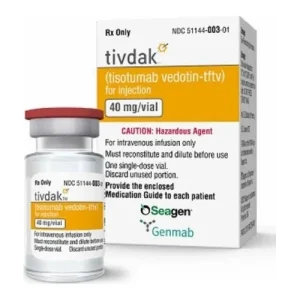
TM Owner Pfizer (Seagen)
Tivdak 40mg Injection
Global Shipping : Reliable Global Distribution Network
Express Delivery : Priority Shipping for Every Order
Secure Payments : Trusted Payment Protection System
 Disclaimer

Secure Handling
24/7 Worldwide Support

Global Access
Worldwide Access to Health

Cold-Chain Expert
Excellence in Cold-Chain

Trusted Supply
Certified Medical Supply
Indications & Clinical Uses
- Tivdak 40 mg (tisotumab vedotin-tftv) is an antibody-drug conjugate that targets tissue factor on tumour cells and delivers the cytotoxic agent monomethyl auristatin E (MMAE).
- It is approved in the US for adult patients with recurrent or metastatic cervical cancer whose disease has progressed on or after prior systemic therapy, and it received European Commission approval in March 2025 under the same brand name Tivdak for previously treated recurrent or metastatic cervical cancer.
- Tivdak is given only as a hospital or oncology-clinic intravenous infusion, once every three weeks, by trained healthcare staff; it is never self-administered.
- It is co-marketed by Pfizer, via its acquisition of Seagen, and Genmab.
- Safety and effectiveness in children have not been established.
Side Effects
- TIVDAK carries a boxed warning for ocular toxicity: it can cause severe eye problems, including changes in vision, severe vision loss and corneal ulceration, so an eye specialist must examine you before treatment starts, before each of the first nine cycles, and whenever you have eye symptoms.
- Very common effects, affecting more than 1 in 10 people, include low haemoglobin, peripheral nerve damage causing numbness, tingling or weakness, conjunctivitis and dry or watery eyes, nausea, tiredness, raised liver enzymes, nosebleeds and other bleeding, and hair loss.
- Report severe eye pain or vision changes, new or worsening numbness or weakness, unusual bleeding, new cough or breathlessness, which can signal lung inflammation, or severe skin reactions to your care team at once rather than waiting for your next infusion appointment.
Precautions & Warnings
- Do not start Tivdak until an eye specialist has examined you, and keep every scheduled eye check during the first nine cycles; use the prescribed preventive eye care, including lubricating drops, corticosteroid eye drops and cooling of the eyes during infusion, exactly as instructed.
- Peripheral neuropathy and bleeding are monitored closely, and the dose is withheld, reduced or stopped if these or eye toxicity become severe.
- Tell your care team about any new breathlessness or cough, which may signal lung inflammation called pneumonitis.
- Tivdak can harm an unborn baby: women must use effective contraception during treatment and for 2 months after the last dose, and men with partners who could become pregnant for 4 months after; it is not recommended during breastfeeding.
Avoid Interactions
- Tell your healthcare provider about every prescription and over-the-counter medicine, herbal remedy and supplement you take, since Tivdak is often combined with other cancer therapies under close specialist supervision.
- Strong CYP3A4 inhibitor drugs, such as ketoconazole, clarithromycin, ritonavir and some other antifungal or antiviral medicines, can raise exposure to the active MMAE component of Tivdak and increase the risk of side effects, so these combinations are used cautiously and monitored closely.
- No specific food restriction applies to this intravenous medicine.
- Because Tivdak can affect wound healing and blood counts, mention any planned surgery, dental work or vaccination to your oncology team well before it is scheduled.
References
Frequently Asked Questions
Tivdak (tisotumab vedotin) treats adults with recurrent or metastatic cervical cancer that has progressed after prior chemotherapy. It is an antibody-drug conjugate given as a hospital infusion, approved in the US since 2021 and in Europe since March 2025.
Tivdak is given as an intravenous infusion at a hospital or cancer clinic once every three weeks. A trained healthcare provider gives each dose; you do not inject it yourself or take any home.
Tivdak carries a boxed warning for severe eye problems, including vision loss and corneal ulceration, so eye exams are required before treatment. Very common effects include nerve numbness or tingling, low haemoglobin, nausea, tiredness, bleeding and hair loss.
Avoid strong CYP3A4 inhibitor drugs like ketoconazole or clarithromycin, which can raise Tivdak's active component and side-effect risk. Tell your oncology team about all your medicines, and use effective contraception, since Tivdak can harm an unborn baby.
Because of the boxed warning for ocular toxicity, an eye specialist must check you before starting Tivdak, before each of the first nine cycles, and if symptoms occur. You will use prescribed eye drops and cooling measures around each infusion to lower vision loss risk.
No. Tivdak can harm an unborn baby, so women need effective contraception during treatment and for 2 months after the last dose, and male partners for 4 months after. It is not recommended while breastfeeding; discuss family planning with your oncology team first.

Trusted & Reliable – Your Partner in Global Distribution.
We provide comprehensive lines of pharmaceutical products to support all your healthcare distribution needs.


