

TM Owner Alnylam Pharmaceuticals
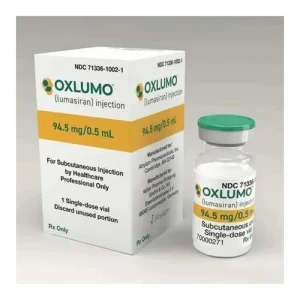
Oxlumo 94.5mg/0.5ml Vial
Global Shipping : Reliable Global Distribution Network
Express Delivery : Priority Shipping for Every Order
Secure Payments : Trusted Payment Protection System
 Disclaimer

Secure Handling
24/7 Worldwide Support

Global Access
Worldwide Access to Health

Cold-Chain Expert
Excellence in Cold-Chain

Trusted Supply
Certified Medical Supply
Indications & Clinical Uses
- Oxlumo 94.5 mg/0.5 mL (lumasiran) is a small interfering RNA (siRNA) therapy that lowers the liver's production of oxalate.
- It is approved in the United States and the European Union for the treatment of primary hyperoxaluria type 1 (PH1), a rare inherited disease in which oxalate build-up damages the kidneys, to lower urinary and plasma oxalate levels in both children and adults, including newborns.
- Oxlumo does not treat PH2 or PH3, the other genetic subtypes of primary hyperoxaluria, since it targets an enzyme specific to the PH1 pathway; using it in those subtypes would not be expected to work.
- It is given as a subcutaneous injection by a healthcare professional, not usually self-injected, following an initial once-monthly loading phase and then ongoing maintenance dosing spaced from monthly to quarterly depending on the patient's body weight, manufactured by Alnylam Pharmaceuticals.
Side Effects
- The most common side effect, occurring in one in five or more patients, is a reaction at the injection site — redness, swelling, pain, bruising, itching, or discoloration — which typically settles within a day and rarely leads to stopping treatment.
- Abdominal pain was also more frequent with Oxlumo than with placebo in trials.
- Oxlumo carries no boxed warning.
- Seek prompt medical advice for an injection-site reaction that spreads, becomes severe, or does not settle, or for any signs of a wider allergic reaction such as facial swelling, rash, or difficulty breathing after a dose.
- Because Oxlumo is normally given in a clinic or hospital setting, most reactions are noticed and managed by the healthcare team at the time of the injection.
Precautions & Warnings
- Oxlumo is for subcutaneous injection only and should not be given by any other route.
- There are no known contraindications on the current label.
- It has not been specifically studied in patients with severe hepatic impairment, so caution and closer monitoring are advised in that group, while no dose adjustment is needed for mild-to-moderate liver impairment or for kidney impairment, including patients on haemodialysis.
- Animal studies have shown no evidence of harm to a developing baby, but there is no human pregnancy data, so use during pregnancy should be discussed with the treating specialist; it is not known whether lumasiran passes into human breast milk, so the benefits of treatment should be weighed against any potential risk while breastfeeding.
- Oxlumo does not treat PH2 or PH3, so an accurate genetic diagnosis of PH1 is needed before starting.
Avoid Interactions
- Laboratory studies show lumasiran is not broken down by, and does not affect, the liver's cytochrome P450 enzyme system, so it is not expected to interact with medicines metabolised through that pathway.
- Vitamin B6 (pyridoxine) is sometimes used alongside treatment for primary hyperoxaluria, and studies specifically combining it with Oxlumo found no change in how either medicine works.
- Even so, tell the treating specialist about every other medicine, supplement, and vitamin being taken, since primary hyperoxaluria is often managed with several supportive treatments together (such as high fluid intake, citrate, or pyridoxine), and the overall plan needs to be coordinated.
- Oxlumo should not be mixed with any other medicine in the same syringe or injection.
References
Frequently Asked Questions
Oxlumo (lumasiran) treats primary hyperoxaluria type 1 (PH1), a rare inherited disease that causes oxalate to build up and damage the kidneys. It lowers urinary and plasma oxalate levels in children, including newborns, and adults. It does not treat PH2 or PH3.
Oxlumo is given as a subcutaneous injection by a healthcare professional, not usually at home. Treatment starts with monthly loading doses for three months, then continues as maintenance doses ranging from monthly to every three months, depending on your body weight.
The most common side effect is a reaction at the injection site, such as redness, swelling, pain, or bruising, which usually clears within a day. Abdominal pain has also been reported. Tell your care team about any reaction that spreads or does not settle.
Tell your doctor about pregnancy, breastfeeding, or any liver disease, especially severe liver impairment, since Oxlumo has not been specifically studied in that group. No dose change is needed for kidney problems, including dialysis, or mild-to-moderate liver disease.
Your doctor will check your urine and blood oxalate levels periodically to see how well Oxlumo is working, and confirm your PH1 diagnosis before starting, since Oxlumo does not work for the other genetic subtypes, PH2 and PH3.
Yes. Oxlumo is approved for primary hyperoxaluria type 1 in patients of any age, including newborns, as well as adults. Dosing is based on body weight, with more frequent injections generally needed for babies at lower weights.

Trusted & Reliable – Your Partner in Global Distribution.
We provide comprehensive lines of pharmaceutical products to support all your healthcare distribution needs.


