

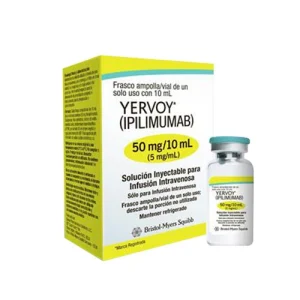
TM Owner Bristol Myers Squibb
Yervoy 200mg/40ml Injection
Global Shipping : Reliable Global Distribution Network
Express Delivery : Priority Shipping for Every Order
Secure Payments : Trusted Payment Protection System
 Disclaimer

Secure Handling
24/7 Worldwide Support

Global Access
Worldwide Access to Health

Cold-Chain Expert
Excellence in Cold-Chain

Trusted Supply
Certified Medical Supply
Indications & Clinical Uses
- Yervoy 200mg/40ml is a single-dose vial of ipilimumab (5 mg/mL), a CTLA-4 blocking monoclonal antibody that boosts the immune system's attack on cancer.
- Yervoy is given only by a healthcare provider as an intravenous infusion over 30 minutes, in a hospital or specialist clinic.
- In the US label it is used for unresectable or metastatic melanoma (alone or with nivolumab), adjuvant treatment of melanoma, advanced renal cell carcinoma, MSI-H or dMMR colorectal cancer, hepatocellular carcinoma, metastatic non-small cell lung cancer, malignant pleural mesothelioma and oesophageal squamous cell carcinoma, mostly combined with nivolumab.
- The EU label lists a similar set.
- Dose and schedule depend on the cancer type, and a 50 mg/10 mL vial also exists.
Side Effects
- In the US label, the most common reactions (20% or more) with Yervoy alone were fatigue, diarrhoea, itching, rash, nausea and headache.
- With nivolumab they were fatigue, diarrhoea, rash, itching, nausea, muscle and joint pain, fever, cough and reduced appetite.
- The most important risk is severe and sometimes fatal immune-mediated reactions that can affect any organ, including bowel (colitis), liver, skin, hormone glands, lungs and nerves, and can appear during treatment or after it has stopped.
- Infusion-related reactions can also occur.
- Report severe diarrhoea, blood in stools, yellow skin, new rash, persistent cough, marked tiredness or headache promptly.
- The current US label has no boxed warning.
Precautions & Warnings
- Yervoy is given under specialist supervision, with blood tests for liver, kidney and thyroid function checked before and during treatment so immune-mediated reactions are caught early; they are usually managed with corticosteroids and by pausing or stopping Yervoy.
- The US label lists no contraindications; the EU label contraindicates hypersensitivity to ipilimumab or its excipients.
- Yervoy can harm an unborn baby: use effective contraception during treatment and for 3 months after the last dose, and do not breastfeed.
- Complications can arise if allogeneic stem cell transplant follows treatment.
- Do not mix other medicines in the same infusion line.
- The infusion is given through a sterile low-protein-binding in-line filter.
Avoid Interactions
- Increase risk: anticoagulants may raise the risk of gastrointestinal bleeding, and vemurafenib given before or with Yervoy is not recommended because of severe skin and liver reactions (EU label).
- Reduce efficacy: systemic corticosteroids or other immunosuppressants at the start of treatment should be avoided because they may interfere with Yervoy, although they are used afterwards to treat immune-related side effects.
- Other medicines must not be infused through the same line.
- The US label has no separate drug interaction section.
- Tell your healthcare team about every medicine and supplement you use, including those bought without a prescription.
References
Frequently Asked Questions
Yervoy (ipilimumab) is an immunotherapy given by infusion for advanced melanoma, kidney cancer, colorectal cancer, liver cancer, lung cancer, mesothelioma and oesophageal cancer, usually together with nivolumab. It is also used after surgery for melanoma. Your cancer team chooses the combination and schedule.
Yervoy (ipilimumab) is given by a healthcare provider as an intravenous infusion over 30 minutes, in a hospital or clinic. For melanoma alone, the usual dose is 3 mg/kg every 3 weeks for up to 4 doses. With nivolumab, dose and schedule differ by cancer type.
Common Yervoy side effects include tiredness, diarrhoea, rash, itching, nausea and fever. Serious immune reactions can affect the bowel, liver, skin, hormone glands and lungs, and can be fatal. Tell your team straight away about severe diarrhoea, yellow skin, breathlessness or a new rash.
Avoid becoming pregnant during Yervoy (ipilimumab) treatment and for 3 months after the last dose, and do not breastfeed. Tell your team about anticoagulants, corticosteroids and vemurafenib before treatment. Do not delay reporting symptoms, because immune reactions can start after your last dose.
During a Yervoy (ipilimumab) infusion, a nurse gives the drug through a vein over 30 minutes using an in-line filter. The team watches for infusion reactions such as fever, chills or breathing problems. Blood tests for liver, kidney and thyroid function are done before and during treatment.
Yes. Yervoy (ipilimumab) can cause serious, even fatal, immune-mediated reactions during treatment or after it has stopped. Keep reporting new diarrhoea, rash, yellow skin, cough, headaches or unusual tiredness to your healthcare team, even months later, and keep your follow-up blood tests.

Trusted & Reliable – Your Partner in Global Distribution.
We provide comprehensive lines of pharmaceutical products to support all your healthcare distribution needs.


