

TM Owner Vertex Pharmaceuticals
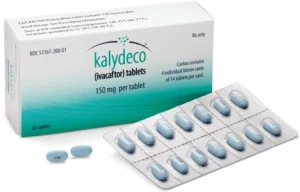
Kalydeco 150mg Tablet
Global Shipping : Reliable Global Distribution Network
Express Delivery : Priority Shipping for Every Order
Secure Payments : Trusted Payment Protection System
 Disclaimer

Secure Handling
24/7 Worldwide Support

Global Access
Worldwide Access to Health

Cold-Chain Expert
Excellence in Cold-Chain

Trusted Supply
Certified Medical Supply
Indications & Clinical Uses
- Kalydeco 150 mg film-coated tablets contain ivacaftor, a CFTR potentiator that holds the chloride channel open so salt and water move normally across cell surfaces.
- Kalydeco treats cystic fibrosis in people who have at least one CFTR gene mutation responsive to ivacaftor; the US label covers patients from 1 month of age, while the 150 mg tablet itself is used in patients aged 6 years and over weighing 25 kg or more, with a 75 mg tablet and oral granule sachets for younger or smaller patients.
- The usual dose is one 150 mg tablet every 12 hours with fat-containing food.
- The same ivacaftor 150 mg tablet is also the evening dose taken alongside combination CFTR modulators such as Kaftrio, Trikafta and Symkevi.
- Tablets and granule sachets are different presentations chosen by age and weight and must not be swapped for one another.
- Treatment is long term and supervised by a cystic fibrosis centre.
Side Effects
- The most common ivacaftor side effects seen in Kalydeco studies were headache (about 24 in 100 people), throat pain (22 in 100), upper respiratory tract infection (22 in 100), blocked nose (20 in 100), abdominal pain (16 in 100), diarrhoea, rash and raised liver enzymes (each about 13 in 100); dizziness and bacteria in the sputum were also reported.
- Kalydeco has NO boxed warning.
- Transaminase (liver enzyme) rises are common and occasionally severe, so report yellowing of the skin or eyes, dark urine, pale stools, loss of appetite, persistent nausea or pain under the right ribs straight away.
- Non-congenital lens opacities (cataracts) have been seen in children taking ivacaftor.
- The US label also warns about serious neuropsychiatric events, including anxiety, depression, suicidal thoughts or behaviour and sleep disturbance; seek urgent help for thoughts of self-harm.
Precautions & Warnings
- Blood tests for ALT, AST and bilirubin are needed before starting Kalydeco, every three months during the first year and yearly afterwards, with more frequent testing if you have had liver problems; dosing is interrupted if transaminases exceed five times the upper limit of normal.
- Children should have eye examinations before and during treatment to check for lens opacities.
- The dose is reduced in moderate hepatic impairment, and Kalydeco is not recommended in severe hepatic impairment unless the benefit clearly outweighs the risk.
- Dizziness has been reported, so take care driving or using machines until you know how ivacaftor affects you.
- Discuss pregnancy and breastfeeding with your specialist, as experience is limited.
- Always take the tablet with fat-containing food such as eggs, butter, peanut butter, cheese or whole-milk products, which raises absorption roughly 2.5 to 4 fold; without it the medicine may not work properly.
Avoid Interactions
- Ivacaftor levels rise with moderate and strong CYP3A inhibitors, so the Kalydeco dose must be reduced when it is taken with fluconazole, erythromycin, ketoconazole, itraconazole, posaconazole, voriconazole, clarithromycin, telithromycin or ritonavir-boosted regimens.
- Grapefruit and Seville oranges have the same effect, and food or drink containing them should be avoided completely.
- Ivacaftor levels fall sharply, with loss of effect, when taken with strong CYP3A inducers such as rifampicin, rifabutin, phenobarbital, carbamazepine, phenytoin and St John's wort, and these combinations are not recommended.
- Ivacaftor can increase levels of sensitive CYP3A and P-glycoprotein substrates, so caution is needed with midazolam, digoxin, ciclosporin, tacrolimus, sirolimus and everolimus.
- Tell your cystic fibrosis team about every prescription medicine, over-the-counter product, herbal remedy and supplement, and check before starting any new antibiotic or antifungal.
References
Frequently Asked Questions
Kalydeco 150 mg (ivacaftor) treats cystic fibrosis in people with at least one CFTR gene mutation that responds to ivacaftor. It is a CFTR potentiator that helps the chloride channel stay open. The 150 mg tablet is used from 6 years of age in patients weighing 25 kg or more.
Take one Kalydeco 150 mg tablet every 12 hours, twice a day, with fat-containing food such as eggs, butter, peanut butter, cheese or whole milk. Fat increases ivacaftor absorption about 2.5 to 4 times. Swallow the tablet whole and do not crush or chew it.
Common Kalydeco side effects are headache, sore throat, blocked nose, upper airway infections, stomach pain, diarrhoea, rash and raised liver enzymes. Kalydeco has no boxed warning. Report yellow skin or eyes, dark urine or right-sided tummy pain urgently, and tell your team about any new depression or anxiety.
Avoid grapefruit and Seville oranges entirely while taking Kalydeco (ivacaftor), as they raise drug levels. Rifampicin, carbamazepine, phenytoin, phenobarbital and St John's wort make ivacaftor much less effective and are not recommended. Antifungals such as fluconazole and ketoconazole need a reduced Kalydeco dose.
Kalydeco needs liver blood tests (ALT, AST and bilirubin) before starting, every three months during the first year, then yearly. Dosing is stopped if enzymes rise above five times the upper limit of normal. Children also need eye examinations before and during treatment to check for lens opacities.
No. Kalydeco comes as 150 mg and 75 mg tablets and as oral granule sachets of 5.8 mg, 13.4 mg, 25 mg, 50 mg and 75 mg. The prescriber chooses the form and strength by age and weight, so never swap a tablet for a sachet yourself. Both need fat-containing food.

Trusted & Reliable – Your Partner in Global Distribution.
We provide comprehensive lines of pharmaceutical products to support all your healthcare distribution needs.


