

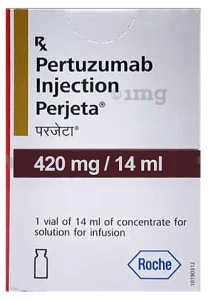
TM Owner Roche
Perjeta 420mg Injection
Global Shipping : Reliable Global Distribution Network
Express Delivery : Priority Shipping for Every Order
Secure Payments : Trusted Payment Protection System
 Disclaimer

Secure Handling
24/7 Worldwide Support

Global Access
Worldwide Access to Health

Cold-Chain Expert
Excellence in Cold-Chain

Trusted Supply
Certified Medical Supply
Indications & Clinical Uses
- Perjeta 420 mg (pertuzumab) is a HER2/neu receptor antagonist monoclonal antibody used to treat HER2-positive breast cancer, always given together with trastuzumab and chemotherapy, never alone.
- In metastatic disease, Perjeta is combined with trastuzumab and docetaxel in adults who have not received prior anti-HER2 therapy or chemotherapy for their metastatic cancer.
- It is also used, with trastuzumab and chemotherapy, as neoadjuvant treatment before surgery for locally advanced, inflammatory or early-stage HER2-positive breast cancer, and as adjuvant treatment with trastuzumab after surgery in adults whose early breast cancer carries a high risk of recurrence.
- Perjeta is given only by intravenous infusion in a hospital or specialist cancer clinic — it is never a self-administered or take-home medicine.
- HER2-positive status must be confirmed by a validated test before treatment starts, since Perjeta only works against tumours that overexpress the HER2 protein.
Side Effects
- Perjeta (pertuzumab) carries a boxed warning for two serious risks.
- First, Perjeta can cause left ventricular dysfunction — a weakening of the heart's pumping ability that can lead to clinical heart failure; heart function (LVEF) is checked before treatment starts and monitored regularly during it.
- Second, exposure to Perjeta during pregnancy can cause embryo-fetal death and birth defects, so pregnancy must be excluded before treatment and effective contraception used throughout and for months afterward.
- Perjeta can also cause serious, occasionally fatal, infusion reactions and severe allergic (anaphylactic) reactions, most likely during or shortly after the first infusion, so patients are observed closely for at least 60 minutes after that dose.
- Very common side effects (more than 1 in 10 people) include diarrhoea, hair loss, low white blood cell counts with or without fever, nausea, fatigue, rash and nerve tingling or numbness in the hands and feet.
- Report chest pain, swelling, breathlessness, fever, or signs of an allergic reaction to your care team immediately.
Precautions & Warnings
- Perjeta must only be given as an intravenous infusion under the supervision of a healthcare provider experienced in cancer chemotherapy — never as an injection or bolus — with an initial 60-minute loading infusion followed by 30-to-60-minute infusions every three weeks.
- Left ventricular ejection fraction (LVEF) must be assessed before starting treatment and monitored during it; Perjeta is withheld or permanently stopped if heart function drops significantly or symptomatic heart failure develops.
- Because of the risk of embryo-fetal death and birth defects, a pregnancy test is required before starting treatment, and effective contraception is needed during treatment and for at least 7 months after the last dose; breastfeeding is not recommended during treatment and for 7 months afterward.
- Patients are monitored closely during and for at least 60 minutes after the first infusion for signs of an infusion or hypersensitivity reaction.
- Perjeta is contraindicated in known hypersensitivity to pertuzumab or its components.
Avoid Interactions
- Tell your cancer care team about every medicine you take before and during Perjeta (pertuzumab) treatment.
- Perjeta is always given together with trastuzumab and a taxane chemotherapy (docetaxel or paclitaxel), and this combination itself increases the risk of heart problems and low white blood cell counts, so blood counts and heart function are monitored throughout.
- No formal drug-interaction studies have identified specific medicines that must be avoided with Perjeta, but any drug that can also affect heart function or increase infection risk, including other chemotherapy agents, should be used only under close specialist supervision.
- Live vaccines should generally be avoided during and shortly after chemotherapy because of a weakened immune response; discuss vaccination timing with your care team.
- Perjeta must not be mixed or diluted with other medicines in the same infusion bag or line, and must be given via a dedicated infusion set.
- Always disclose supplements and over-the-counter medicines, since these are not systematically studied with Perjeta.
References
Frequently Asked Questions
Perjeta (pertuzumab) treats HER2-positive breast cancer, always combined with trastuzumab and chemotherapy. It is used for metastatic disease, before surgery (neoadjuvant) for locally advanced or early-stage HER2-positive breast cancer, and after surgery (adjuvant) in early breast cancer with a high risk of recurrence.
Perjeta is given only as an intravenous infusion in a hospital or cancer clinic, never at home or by injection. The first dose is a 60-minute loading infusion; later doses are 30-to-60-minute infusions every three weeks, always given together with trastuzumab and chemotherapy.
Very common effects include diarrhoea, hair loss, low white blood cell counts, nausea, fatigue and rash. Perjeta carries a boxed warning for heart failure (reduced pumping ability) and for embryo-fetal death and birth defects, so heart function is monitored and pregnancy must be avoided.
Avoid becoming pregnant during Perjeta treatment and for at least 7 months after the last dose, since it can seriously harm a developing baby; use effective contraception. Breastfeeding is not recommended during this time. Tell your team about every other medicine you take.
You'll be monitored closely during the infusion and for at least 60 minutes afterward for signs of an infusion or allergic reaction, such as fever, chills, or breathing difficulty. Perjeta is always given with trastuzumab and chemotherapy on the same treatment day, every three weeks.
Yes. Perjeta carries a boxed warning because it can weaken the heart's pumping ability (reduced LVEF) and cause heart failure. Your heart function is checked with a scan before treatment starts and monitored regularly during it, and Perjeta is stopped if a significant decline occurs.

Trusted & Reliable – Your Partner in Global Distribution.
We provide comprehensive lines of pharmaceutical products to support all your healthcare distribution needs.


