

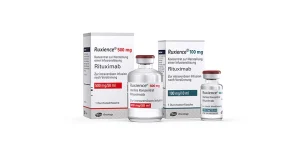
TM Owner Pfizer
Ruxience 100mg/10ml Injection
Global Shipping : Reliable Global Distribution Network
Express Delivery : Priority Shipping for Every Order
Secure Payments : Trusted Payment Protection System
 Disclaimer

Secure Handling
24/7 Worldwide Support

Global Access
Worldwide Access to Health

Cold-Chain Expert
Excellence in Cold-Chain

Trusted Supply
Certified Medical Supply
Indications & Clinical Uses
- Ruxience 100 mg/10 mL (rituximab-pvvr) is a biosimilar of the reference product Rituxan, a CD20-directed cytolytic monoclonal antibody given only by intravenous infusion in a hospital or clinic setting.
- It is approved for adults with CD20-positive non-Hodgkin's lymphoma (as a single agent or combined with chemotherapy), chronic lymphocytic leukemia in combination with fludarabine and cyclophosphamide, moderately to severely active rheumatoid arthritis after inadequate response to one or more TNF-antagonist therapies (with methotrexate), granulomatosis with polyangiitis and microscopic polyangiitis (with glucocorticoids), and moderate to severe pemphigus vulgaris.
- As a biosimilar, Ruxience has been shown to have no clinically meaningful differences from the reference rituximab product in safety, purity and potency, though it is not automatically interchangeable in every jurisdiction.
- It is not approved for pediatric use.
- Being biosimilar and used off-label in some settings does not change its FDA-approved on-label indications above.
Side Effects
- Very common reactions (affecting more than 1 in 10 people) include infusion-related reactions, fever, chills, low white blood cell counts, and infections; these are most frequent with the first infusion.
- Ruxience carries a boxed warning for fatal infusion-related reactions (about 80% of fatal reactions occur with the first infusion), severe mucocutaneous reactions including Stevens-Johnson syndrome, hepatitis B virus reactivation that can cause liver failure or death, and progressive multifocal leukoencephalopathy (PML), a rare but fatal brain infection.
- Report immediately any difficulty breathing, swelling of the face or throat, severe rash or blistering, unexplained confusion, weakness or vision changes, yellowing of the skin or eyes, dark urine, or signs of infection such as fever.
- Infusions are given slowly by trained staff who monitor you throughout and for a period afterward.
Precautions & Warnings
- Before starting, you will be screened for hepatitis B infection, since reactivation can occur even years later; active hepatitis B is a reason to delay or avoid treatment.
- Blood counts are monitored regularly during and after therapy.
- Tumor lysis syndrome can occur in patients with a high tumor burden, and cardiac monitoring is needed in those with pre-existing heart disease, since arrhythmias can occur during infusion.
- Do not receive live or live-attenuated vaccines while on Ruxience; discuss vaccination timing with your healthcare provider well before starting treatment.
- Ruxience is for intravenous infusion only and must never be given as an intravenous push or bolus.
- Effective contraception is required during treatment and for 12 months after the last dose, because of a risk to a developing baby; discuss pregnancy planning and breastfeeding with your care team.
Avoid Interactions
- Tell your healthcare provider about every prescription medicine, over-the-counter product, herbal remedy and supplement you use.
- Combining Ruxience with cisplatin has been associated with an increased risk of kidney toxicity, so this combination requires careful monitoring.
- Live and live-attenuated vaccines should be avoided during and for a period after treatment because the immune response may be reduced and infection risk increased; non-live vaccines may also produce a weaker immune response.
- Other immunosuppressive or disease-modifying antirheumatic drugs used alongside Ruxience for rheumatoid arthritis can add to infection risk and should be used with caution and monitoring.
- Ruxience is diluted only in 0.9% sodium chloride or 5% dextrose solution for infusion; it should not be mixed with other medicines in the same infusion line.
References
Frequently Asked Questions
Ruxience (rituximab-pvvr) is a biosimilar antibody used to treat certain B-cell non-Hodgkin's lymphomas, chronic lymphocytic leukemia, moderate-to-severe rheumatoid arthritis, granulomatosis with polyangiitis, microscopic polyangiitis, and pemphigus vulgaris in adults. It is usually combined with other cancer or immune-suppressing medicines, and given only by hospital infusion.
Ruxience is given only as a slow intravenous infusion by trained healthcare staff in a clinic or hospital, never at home and never as a quick injection. Each infusion can take 90 minutes or longer, and you are monitored closely, especially during your first dose.
Very common effects include infusion reactions, fever, chills, low blood counts and infections, most likely with the first dose. Ruxience has a boxed warning for fatal infusion reactions, severe skin reactions, hepatitis B reactivation and PML brain infection. Report breathing trouble, swelling or confusion urgently.
Avoid live or live-attenuated vaccines during and after Ruxience treatment, since your immune response may be reduced. Tell your provider about cisplatin use, as it raises kidney toxicity risk with rituximab products. You will be tested for hepatitis B before starting, since it can reactivate.
Ruxience is an FDA-approved biosimilar of Rituxan (rituximab), the reference product. Studies show no clinically meaningful difference in safety or effectiveness from Rituxan. It works the same way and is used for the same approved conditions, given by the same infusion route.
Before treatment you are screened for hepatitis B. During and after infusions your blood counts, vital signs and heart rhythm are monitored, since reactions and low blood cell counts can occur. You should use effective contraception during treatment and for 12 months afterward.

Trusted & Reliable – Your Partner in Global Distribution.
We provide comprehensive lines of pharmaceutical products to support all your healthcare distribution needs.


