

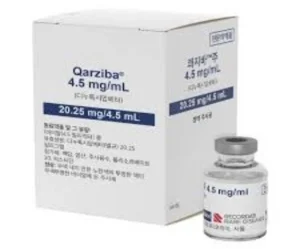
TM Owner Recordati Netherlands B.V.
Qarziba 4.5mg/mL (20mg/4.5mL vial) Injection
Global Shipping : Reliable Global Distribution Network
Express Delivery : Priority Shipping for Every Order
Secure Payments : Trusted Payment Protection System
 Disclaimer

Secure Handling
24/7 Worldwide Support

Global Access
Worldwide Access to Health

Cold-Chain Expert
Excellence in Cold-Chain

Trusted Supply
Certified Medical Supply
Indications & Clinical Uses
- Qarziba (dinutuximab beta) 4.5 mg/mL concentrate for solution for infusion, an anti-GD2 monoclonal antibody, is authorised in the EU and UK for high-risk neuroblastoma, a childhood cancer, in patients aged 12 months and older who have previously had induction chemotherapy with at least a partial response followed by myeloablative therapy and stem-cell transplantation, and in patients with relapsed or refractory neuroblastoma.
- In first-line high-risk use it is combined with interleukin-2 (IL-2); the same combination is used in relapsed/refractory disease.
- Qarziba is not FDA-approved in the United States, where a related but distinct anti-GD2 antibody, Unituxin (dinutuximab), is used instead - the two are different products and are not interchangeable.
- Qarziba is given only as a hospital intravenous infusion by specialist paediatric oncology staff over repeated 35-day treatment courses.
Side Effects
- Very common reactions, affecting more than 1 in 10 patients, include fever (up to 86%) and significant pain despite preventive pain relief (57%), hypersensitivity/allergic reactions, vomiting, diarrhoea, capillary leak syndrome (fluid leaking from blood vessels, causing swelling and low blood pressure), anaemia, and low white cell and platelet counts.
- There is no formal boxed warning on the EU label, but Qarziba carries additional-monitoring status because it is a newer biological medicine, and each infusion needs intensive supportive care with combined non-opioid, gabapentin and opioid pain relief.
- Serious neurological effects on vision and nerves, systemic infections, and rare atypical haemolytic uraemic syndrome can occur - report sudden breathlessness, swelling, vision change or reduced urine output to hospital staff immediately.
Precautions & Warnings
- Qarziba is contraindicated in known hypersensitivity to dinutuximab beta and in patients with acute grade 3-4 or extensive chronic graft-versus-host disease.
- Because of the risk of capillary leak syndrome, low blood pressure and hypersensitivity, it is given only in hospital with continuous monitoring, resuscitation facilities on hand, and pre-medication; infusions are slowed or interrupted if reactions occur.
- Corticosteroids should be avoided from 2 weeks before to 1 week after each course, as they may blunt the antibody's effect, and live or inactivated vaccines should be avoided during treatment and for at least 10 weeks afterwards.
- Intravenous immunoglobulin is not recommended during therapy.
- Fertility, pregnancy and breastfeeding should be discussed with the oncology team, and regular eye checks may be performed because of a risk of visual disturbance.
Avoid Interactions
- No formal drug interaction studies have been performed with dinutuximab beta.
- Corticosteroids can weaken the antibody's immune-based mechanism and should be avoided from 2 weeks before to 1 week after each course, except when used specifically to treat an acute hypersensitivity reaction.
- Live and inactivated vaccines must be avoided during treatment and for at least 10 weeks after the last dose, since the immune system is affected by therapy.
- Intravenous immunoglobulin is not recommended alongside Qarziba, as it may interfere with its activity.
- Because strong pain relief - combining a non-opioid, gabapentin and an opioid - is planned around each infusion, tell the treating team about every other medicine, including over-the-counter products and supplements, before each course begins.
References
Frequently Asked Questions
Qarziba (dinutuximab beta) treats high-risk neuroblastoma, a childhood cancer, in children aged 12 months and older. It's used after stem-cell transplant in newly diagnosed high-risk disease, and also when neuroblastoma has come back or not responded to earlier treatment. It targets a marker called GD2 on neuroblastoma cells.
Qarziba is given only in hospital, as an intravenous infusion by specialist cancer nurses, over repeated 35-day treatment cycles combined with interleukin-2. Strong pain relief is given alongside each infusion, since pain is a very common reaction. Qarziba cannot be given at home.
The most common effects are fever, significant pain, allergic reactions, vomiting, diarrhoea, and capillary leak syndrome - fluid leaking from blood vessels, causing swelling and low blood pressure. Low blood counts are also common. Tell hospital staff immediately about sudden breathlessness, swelling, or reduced urine output during or after an infusion.
Corticosteroids should be avoided from 2 weeks before to 1 week after each Qarziba course, as they can reduce its effect. Live and inactivated vaccines must be avoided during treatment and for at least 10 weeks afterward. Tell the care team about every other medicine your child takes.
Each Qarziba infusion is given in hospital with continuous monitoring for allergic reactions, low blood pressure and capillary leak syndrome. Strong pain control, combining a non-opioid, gabapentin and an opioid, is given throughout, since pain affects more than half of patients. Treatment is repeated over five 35-day courses.
No. Qarziba (dinutuximab beta) and Unituxin (dinutuximab) are related but distinct anti-GD2 antibodies for neuroblastoma. Qarziba is approved in the EU and UK; Unituxin is the equivalent product used in the United States. They are not interchangeable, and dosing regimens differ between the two.

Trusted & Reliable – Your Partner in Global Distribution.
We provide comprehensive lines of pharmaceutical products to support all your healthcare distribution needs.


