

TM Owner Takeda
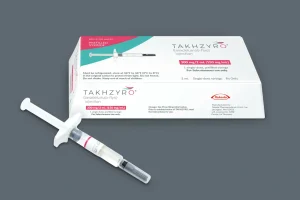
Takhzyro 300mg/2ml Injection
Global Shipping : Reliable Global Distribution Network
Express Delivery : Priority Shipping for Every Order
Secure Payments : Trusted Payment Protection System
 Disclaimer

Secure Handling
24/7 Worldwide Support

Global Access
Worldwide Access to Health

Cold-Chain Expert
Excellence in Cold-Chain

Trusted Supply
Certified Medical Supply
Indications & Clinical Uses
- Takhzyro 300mg/2mL is a prefilled syringe or vial of lanadelumab-flyo, a monoclonal antibody made by Takeda that blocks plasma kallikrein.
- It is approved to prevent attacks of hereditary angioedema (HAE), a rare genetic condition causing sudden swelling of the face, throat, limbs or abdomen, in patients aged 2 years and older.
- Takhzyro is a prophylactic (preventive) treatment given regularly by subcutaneous injection; it is not used to treat an acute HAE attack that has already started, and a separate on-demand medicine is still needed for that.
- The usual adult dose is 300mg every two weeks, with an option to extend to every four weeks if attacks are well controlled.
- Takhzyro is self-administered at home after training, or given by a caregiver, not typically in a clinic once the patient is established on treatment.
Side Effects
- The most common side effect of Takhzyro, affecting about half of patients, is injection site reaction - pain, redness, bruising or swelling where the needle enters the skin, which usually resolves on its own.
- Other common effects include upper respiratory infections, headache, rash, dizziness, diarrhoea and muscle aches.
- There is no boxed warning for Takhzyro.
- Hypersensitivity reactions, including symptoms such as wheezing, chest tightness, difficulty breathing or hives, have been reported; if a severe reaction occurs, stop the injection and seek urgent medical help.
- Because Takhzyro can affect certain clotting-test results (activated partial thromboplastin time, or aPTT) without a true bleeding risk, tell any healthcare provider ordering blood tests that you take Takhzyro.
Precautions & Warnings
- Takhzyro is for subcutaneous injection only and must never be given intravenously.
- It does not treat an acute HAE attack already in progress, so patients must keep a separate rescue medicine available at all times.
- Before starting, patients or caregivers are trained in proper injection technique and site rotation (abdomen, thigh or upper arm, avoiding scars or bruised skin).
- There is no dedicated pregnancy contraindication, but use during pregnancy or breastfeeding should be discussed with a healthcare provider, since data are limited.
- No dose adjustment is established for hepatic or renal impairment based on available data.
- Tell your laboratory or healthcare provider that you use Takhzyro before any blood clotting test, since it can prolong aPTT results without increasing actual bleeding risk.
Avoid Interactions
- No formal drug-drug interaction studies have been conducted for Takhzyro, and no specific medicines, foods or supplements are named on the label as needing to be avoided.
- The main interaction of practical importance is with laboratory testing rather than other drugs: lanadelumab can artificially prolong the activated partial thromboplastin time (aPTT) blood test, so results should be interpreted with this in mind and not mistaken for a true clotting problem.
- Because Takhzyro is a preventive treatment, patients should still tell their healthcare provider about all other prescription medicines, over-the-counter products, herbal remedies and any on-demand HAE treatment they use, so overall care can be coordinated safely.
References
Frequently Asked Questions
Takhzyro (lanadelumab) prevents attacks of hereditary angioedema (HAE), a genetic condition causing sudden swelling of the face, throat, limbs or abdomen. It is used in people aged 2 and older as regular preventive treatment, not to treat an attack that has already started.
Takhzyro 300mg is injected under the skin every two weeks, and some patients who stay attack-free may switch to every four weeks. You or a caregiver can give the injection at home after training, rotating sites between the abdomen, thigh and upper arm.
The most common side effect is a reaction at the injection site - pain, redness or bruising - affecting about half of patients. Other effects include headache, rash and upper respiratory infections. Seek urgent help for wheezing, chest tightness or hives, which can signal an allergic reaction.
No specific drugs, foods or supplements must be avoided with Takhzyro, and no interaction studies raised concerns. It should only be injected under the skin, never into a vein. Tell any healthcare provider ordering a blood clotting test (aPTT) that you use Takhzyro, since it can affect the result.
Keep Takhzyro refrigerated at 2°C to 8°C in its original carton, protected from light, and do not freeze or shake it. If needed, it can be kept at room temperature for a limited time before use - check the leaflet for the exact allowed period, then discard if unused.
No. Takhzyro is a preventive treatment that lowers how often attacks happen; it does not stop an attack already in progress. You must keep a separate on-demand rescue medicine on hand at all times for breakthrough attacks, even while using Takhzyro regularly.

Trusted & Reliable – Your Partner in Global Distribution.
We provide comprehensive lines of pharmaceutical products to support all your healthcare distribution needs.


