
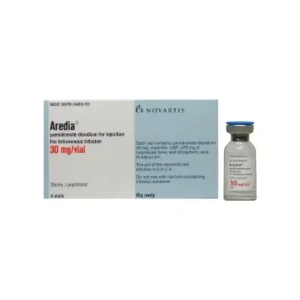
TM Owner Novartis
Aredia 30mg Vial
Global Shipping : Reliable Global Distribution Network
Express Delivery : Priority Shipping for Every Order
Secure Payments : Trusted Payment Protection System
 Disclaimer

Secure Handling
24/7 Worldwide Support

Global Access
Worldwide Access to Health

Cold-Chain Expert
Excellence in Cold-Chain

Trusted Supply
Certified Medical Supply
Indications & Clinical Uses
- Aredia (pamidronate disodium) has been discontinued: all Aredia strengths under Novartis's FDA application NDA 020036 are listed as Discontinued in Drugs@FDA, and no current Aredia label appears on DailyMed.
- The FDA record states the withdrawal was not for reasons of safety or effectiveness, which is a manufacturer discontinuation rather than a revoked approval, and generic pamidronate disodium injection remains widely available, so the information below is taken from current generic pamidronate disodium labels.
- Pamidronate is a nitrogen-containing bisphosphonate that blocks bone breakdown by osteoclasts.
- It is given by intravenous infusion in a hospital or clinic for moderate to severe hypercalcaemia of malignancy, with or without bone metastases; for moderate to severe Paget's disease of bone; and for osteolytic bone metastases of breast cancer and osteolytic lesions of multiple myeloma, alongside standard anticancer therapy.
- It is not self-administered and there is no oral form.
Side Effects
- In treatment of hypercalcaemia, fever occurs in 15 per cent or more of people, often with flu-like aches and fatigue in the first 24 to 48 hours after the first infusion.
- Nausea, vomiting, infusion-site redness or pain, low calcium, low phosphate, low magnesium, low potassium, anaemia and headache are also common.
- In people treated for bone metastases or myeloma, bone and skeletal pain, fatigue, nausea, vomiting and anaemia predominate.
- Pamidronate does not carry a boxed warning.
- Serious risks include deterioration of kidney function that can progress to renal failure, particularly if a single dose exceeds 90 mg or the infusion is given too quickly; osteonecrosis of the jaw, presenting as jaw pain, loose teeth, gum swelling, numbness or exposed bone and most often triggered by dental extraction; symptomatic low calcium causing tingling, cramps or spasms; and atypical thigh-bone fractures after minimal trauma.
- Report new thigh or groin pain, jaw pain or reduced urine output promptly.
Precautions & Warnings
- Pamidronate is for intravenous infusion only and must never be given as a bolus or rapid injection; each dose is diluted and infused over at least 2 hours, and up to 24 hours for hypercalcaemia, and single doses must not exceed 90 mg.
- Serum creatinine is checked before each dose and treatment is withheld if kidney function has worsened; calcium, phosphate, magnesium, potassium and blood counts are monitored.
- Adequate saline hydration is given for hypercalcaemia while avoiding fluid overload.
- Because of the risk of osteonecrosis of the jaw, have a dental examination and any needed dental work completed before starting, maintain good oral hygiene, and avoid invasive dental procedures during treatment; tell any dentist you receive bisphosphonates.
- Calcium and vitamin D supplements are usually given in Paget's disease, myeloma and bone metastases, but not while hypercalcaemia is being treated.
- Pamidronate can cause fetal harm, so it should be avoided in pregnancy and effective contraception is advised.
Avoid Interactions
- Tell your healthcare provider about all medicines and supplements you take.
- Risks that may be increased: other nephrotoxic medicines, including aminoglycoside antibiotics, amphotericin B, ciclosporin, NSAIDs and iodinated contrast media, add to the risk of kidney injury; aminoglycosides also lower serum calcium further and can prolong hypocalcaemia; thalidomide combined with pamidronate in multiple myeloma increased renal deterioration; other bisphosphonates or antiresorptive agents such as denosumab should not be given at the same time, as the risks of hypocalcaemia and osteonecrosis of the jaw add together; loop diuretics may worsen electrolyte loss.
- Effects that may be reduced: calcium and vitamin D supplements taken during treatment of hypercalcaemia work against the purpose of the infusion.
- At pharmacy level, pamidronate must not be mixed with, or infused through the same line as, calcium or other divalent-cation-containing solutions such as Lactated Ringer's; dilute only in a recommended fluid and use a separate intravenous line.
References
Frequently Asked Questions
No. Aredia (pamidronate disodium) is discontinued: all strengths under Novartis's FDA application NDA 020036 are listed as Discontinued, and no Aredia label is current on DailyMed. FDA records show the withdrawal was not for safety or effectiveness reasons, and generic pamidronate disodium injection is still widely supplied.
Pamidronate disodium, the medicine formerly branded Aredia, treats high blood calcium caused by cancer, moderate to severe Paget's disease of bone, and bone damage from breast cancer metastases or multiple myeloma. The 30 mg vial is most often used for Paget's disease, given on three consecutive days.
Pamidronate, formerly Aredia, is given only as a slow drip into a vein in a hospital or clinic, never as a quick injection. A dose is diluted and infused over at least 2 hours, and up to 24 hours for high blood calcium. Single doses must not exceed 90 mg.
Fever affects 15 per cent or more of people after the first pamidronate (Aredia) infusion, often with flu-like aches lasting a day or two. Nausea, low calcium, infusion-site pain and anaemia are common. Serious risks are kidney damage, osteonecrosis of the jaw and unusual thigh-bone fractures.
Pamidronate, formerly Aredia, can cause osteonecrosis of the jaw, where jawbone fails to heal, most often after a tooth extraction. Have a dental examination and any needed dental work completed before starting, keep up good oral hygiene, and avoid invasive dental procedures during treatment. Report jaw pain or loose teeth.
Serum creatinine is checked before every pamidronate (Aredia) dose, and treatment is withheld if kidney function has worsened. Calcium, phosphate, magnesium, potassium and blood counts are also monitored. The infusion must never be mixed with, or run through a line containing, calcium solutions such as Lactated Ringer's.

Trusted & Reliable – Your Partner in Global Distribution.
We provide comprehensive lines of pharmaceutical products to support all your healthcare distribution needs.