

TM Owner Takeda
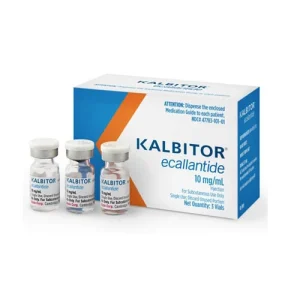
Kalbitor 30mg/3mL Injection
Global Shipping : Reliable Global Distribution Network
Express Delivery : Priority Shipping for Every Order
Secure Payments : Trusted Payment Protection System
 Disclaimer

Secure Handling
24/7 Worldwide Support

Global Access
Worldwide Access to Health

Cold-Chain Expert
Excellence in Cold-Chain

Trusted Supply
Certified Medical Supply
Indications & Clinical Uses
- Kalbitor 30 mg/3 mL is ecallantide, a plasma kallikrein inhibitor given by subcutaneous injection to treat acute attacks of hereditary angioedema (HAE) in adults and children aged 12 years and over.
- It is a rescue treatment for an attack that has already started, not a medicine taken to prevent attacks.
- The 30 mg dose is given as three separate 10 mg (1 mL) subcutaneous injections drawn from three single-dose vials of 10 mg/mL solution; a further 30 mg dose may be given within 24 hours if the attack persists.
- Because of the risk of anaphylaxis, Kalbitor must be given by a healthcare professional with the training and equipment to manage anaphylaxis and hereditary angioedema - it is not a self-injected medicine.
- Kalbitor is approved in the United States; the European application was withdrawn by the applicant in November 2011, so it has never been authorised in the EU.
Side Effects
- The most common Kalbitor side effects, reported more often than with placebo, are headache (about 8 in 100 people), nausea (5 in 100), diarrhoea (4 in 100), fever (4 in 100), injection site reactions such as redness, rash, swelling, bruising or itching (3 in 100) and nasopharyngitis (3 in 100).
- Kalbitor carries a BOXED WARNING for anaphylaxis, which occurred in about 4 in 100 treated patients, usually within the first hour after dosing.
- Because the symptoms of anaphylaxis - throat tightness, wheeze, hives, flushing, chest discomfort, faintness and low blood pressure - can look like a worsening hereditary angioedema attack, a healthcare professional must observe you after every dose.
- About one in five patients develops antibodies to ecallantide, which may raise the chance of a hypersensitivity reaction later.
- Report any new rash, breathing difficulty or dizziness at once.
Precautions & Warnings
- Kalbitor must not be given to anyone with known clinical hypersensitivity to ecallantide.
- It is given only where adrenaline (epinephrine), resuscitation equipment and staff trained to manage anaphylaxis are immediately available, and you should be observed for an appropriate period after each dose.
- Injections are subcutaneous only, into the abdomen, thigh or upper arm, with each 1 mL injection at least 5 cm from the others and away from the site of the angioedema attack; Kalbitor is never given intravenously.
- Discuss pregnancy or breastfeeding with your specialist, as experience is limited.
- Anti-ecallantide antibodies can develop with repeated use.
- Vials are kept refrigerated at 2°C to 8°C in the original carton to protect them from light; a vial removed from the fridge may be kept below 30°C and must be used within 14 days or returned to refrigeration.
- Each vial is for single use only.
Avoid Interactions
- No formal drug interaction studies have been carried out with Kalbitor, and no specific medicines, foods or drinks are listed as interacting with ecallantide.
- Tell your specialist if you also use other hereditary angioedema treatments such as C1-esterase inhibitor concentrates, icatibant, lanadelumab, berotralstat or danazol, so that treatment for a single attack is not duplicated.
- Medicines that can trigger or worsen hereditary angioedema attacks, in particular ACE inhibitors such as ramipril, lisinopril and enalapril, and oestrogen-containing contraceptives or hormone replacement therapy, should be reviewed with your specialist.
- Kalbitor must not be mixed in the same syringe or diluted with any other medicine, and the three 10 mg injections that make up one dose are given separately.
- Give your care team a full list of every prescription and over-the-counter medicine, herbal product and supplement you use.
References
Frequently Asked Questions
Kalbitor (ecallantide) treats sudden attacks of hereditary angioedema in people aged 12 years and over. It blocks plasma kallikrein to stop the swelling of an attack that has already begun. It is a rescue treatment, not a medicine taken regularly to prevent attacks.
Kalbitor is given as three separate 10 mg subcutaneous injections, 30 mg in total, into the abdomen, thigh or upper arm. A healthcare professional must give it. A second 30 mg dose can follow within 24 hours if the attack continues. It is never injected into a vein.
The most common Kalbitor side effects are headache, nausea, diarrhoea, fever, injection site redness or itching, and cold-like symptoms. Kalbitor has a boxed warning for anaphylaxis, which affected about 4 in 100 patients, usually within the first hour. Report throat tightness, wheeze, hives or faintness immediately.
Do not use Kalbitor (ecallantide) if you have had a hypersensitivity reaction to it. Do not self-inject; it must be given where anaphylaxis can be treated. Review ACE inhibitors and oestrogen-containing contraceptives with your specialist, as these can trigger hereditary angioedema attacks. Never mix Kalbitor with another medicine.
Yes. If a hereditary angioedema attack continues after the first 30 mg dose of Kalbitor (ecallantide), a healthcare professional may give a second 30 mg dose within 24 hours. Each dose is three 10 mg injections. You are observed after every dose for signs of anaphylaxis.
Kalbitor carries a boxed warning because anaphylaxis has occurred after dosing, often within the first hour, and its symptoms can be mistaken for the hereditary angioedema attack itself. A healthcare professional with adrenaline and resuscitation equipment must give ecallantide and watch you afterwards.

Trusted & Reliable – Your Partner in Global Distribution.
We provide comprehensive lines of pharmaceutical products to support all your healthcare distribution needs.


