

TM Owner Bayer
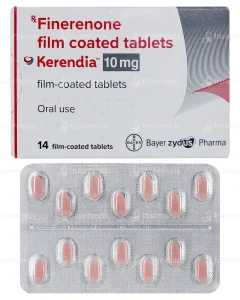
Kerendia 10mg Tablet
Global Shipping : Reliable Global Distribution Network
Express Delivery : Priority Shipping for Every Order
Secure Payments : Trusted Payment Protection System
 Disclaimer

Secure Handling
24/7 Worldwide Support

Global Access
Worldwide Access to Health

Cold-Chain Expert
Excellence in Cold-Chain

Trusted Supply
Certified Medical Supply
Indications & Clinical Uses
- Kerendia 10 mg film-coated tablets contain finerenone, a non-steroidal mineralocorticoid receptor antagonist.
- It is approved for adults with chronic kidney disease associated with type 2 diabetes, where it reduces the risk of a sustained decline in kidney function, kidney failure, cardiovascular death, non-fatal heart attack and hospitalisation for heart failure, and for adults with heart failure with a left ventricular ejection fraction of 40% or above.
- The 10 mg tablet is the starting dose for people whose estimated glomerular filtration rate (eGFR) is 25 to under 60 mL/min/1.73 m2; those with an eGFR of 60 or above usually start at 20 mg, with the dose reviewed after four weeks.
- Kerendia is taken by mouth once daily, with or without food, and is added to standard care rather than replacing it.
- It is for adults only.
Side Effects
- Hyperkalaemia, a high blood potassium level, is the most frequent side effect: it was reported in 14% of people taking Kerendia compared with 6.9% on placebo, and it often causes no symptoms at all, which is why blood tests matter.
- Low blood pressure (4.6% versus 3.0%) and low blood sodium (1.3% versus 0.7%) also occur, and some people notice itching, a rise in uric acid or a fall in kidney function.
- The Kerendia label carries no boxed warning.
- Because a high potassium level can disturb the heart rhythm, get urgent medical help for muscle weakness, numbness or tingling, nausea, a slow or irregular heartbeat, chest discomfort or fainting.
- Do not skip the scheduled blood tests even when you feel completely well.
Precautions & Warnings
- Kerendia must not be started if your serum potassium is above 5.0 mEq/L, and it is contraindicated alongside strong CYP3A4 inhibitors and in people with adrenal insufficiency (Addison's disease) or hypersensitivity to finerenone.
- It is not recommended when eGFR is below 25 mL/min/1.73 m2, and it has not been studied in severe liver impairment.
- Potassium and kidney function are checked before starting, again about four weeks after starting or after any dose change, and periodically thereafter; the dose is reduced or paused if potassium rises above 5.5 mEq/L and may be restarted once it falls back.
- Tablets may be taken with or without food and, if swallowing is difficult, crushed and mixed with water or soft food.
- Breastfeeding is not recommended during treatment and for one day after the last dose; discuss any pregnancy plans first.
Avoid Interactions
- Medicines that increase finerenone levels or toxicity: strong CYP3A4 inhibitors are contraindicated, including itraconazole, ketoconazole, ritonavir and other HIV protease inhibitors, clarithromycin and telithromycin.
- Moderate or weak CYP3A4 inhibitors such as erythromycin, verapamil, diltiazem, fluconazole and amiodarone call for closer potassium monitoring, and grapefruit and grapefruit juice must be avoided completely.
- Things that push potassium higher: potassium supplements, potassium-containing salt substitutes, potassium-sparing diuretics such as amiloride or triamterene, trimethoprim, and other mineralocorticoid receptor antagonists such as spironolactone or eplerenone, which should not be combined with Kerendia.
- Medicines that reduce its effect: strong and moderate CYP3A4 inducers including rifampicin, carbamazepine, phenytoin, phenobarbital and St John's wort should be avoided.
- Tell your healthcare provider about every medicine and supplement you take.
References
Frequently Asked Questions
Kerendia (finerenone) treats chronic kidney disease linked to type 2 diabetes in adults, slowing kidney decline and lowering the risk of kidney failure, cardiovascular death, heart attack and heart failure hospitalisation. It is also approved for adults with heart failure with an ejection fraction of 40% or above.
Take one Kerendia (finerenone) tablet once daily, with or without food, at about the same time each day. The 10 mg tablet is the starting dose when eGFR is 25 to under 60 mL/min/1.73 m2. If swallowing is hard, the tablet may be crushed and mixed with water or soft food.
High blood potassium is the main side effect of Kerendia (finerenone), affecting 14% of users versus 6.9% on placebo, and it often causes no symptoms. Low blood pressure and low sodium also occur. Seek urgent help for muscle weakness, numbness, nausea or a slow or irregular heartbeat.
Avoid grapefruit and grapefruit juice completely with Kerendia (finerenone). Strong CYP3A4 inhibitors such as itraconazole, ketoconazole, ritonavir and clarithromycin are contraindicated. Do not take potassium supplements, potassium-based salt substitutes or another mineralocorticoid receptor antagonist such as spironolactone unless your prescriber agrees.
Serum potassium and kidney function (eGFR) are checked before you start Kerendia (finerenone), about four weeks after starting or after any dose change, and regularly afterwards. Treatment is not started if potassium is above 5.0 mEq/L, and the dose is paused or reduced if it rises above 5.5 mEq/L.
Breastfeeding is not recommended during Kerendia (finerenone) treatment or for one day after the last dose. Discuss any pregnancy or pregnancy plans with your healthcare provider before starting, as safety in pregnancy has not been established. Kerendia is approved for adults only.

Trusted & Reliable – Your Partner in Global Distribution.
We provide comprehensive lines of pharmaceutical products to support all your healthcare distribution needs.


