

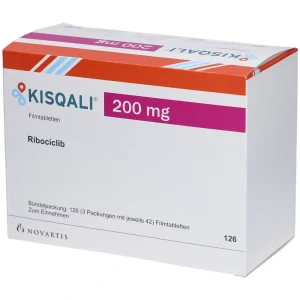
TM Owner Novartis
Kisqali 200mg Tablet
Global Shipping : Reliable Global Distribution Network
Express Delivery : Priority Shipping for Every Order
Secure Payments : Trusted Payment Protection System
 Disclaimer

Secure Handling
24/7 Worldwide Support

Global Access
Worldwide Access to Health

Cold-Chain Expert
Excellence in Cold-Chain

Trusted Supply
Certified Medical Supply
Indications & Clinical Uses
- Kisqali 200 mg film-coated tablets contain ribociclib, an oral cyclin-dependent kinase 4 and 6 (CDK4/6) inhibitor that stops breast cancer cells dividing.
- It is indicated in adults with hormone receptor-positive, HER2-negative breast cancer.
- For stage II or III early breast cancer at high risk of recurrence it is given as adjuvant treatment with an aromatase inhibitor at 400 mg once daily, which is two tablets.
- For locally advanced or metastatic disease it is given at 600 mg once daily, which is three tablets, with an aromatase inhibitor or with fulvestrant, either as initial endocrine-based therapy or after disease progression on endocrine therapy.
- Pre-menopausal and peri-menopausal women, and men, also receive an LHRH agonist.
- Each cycle is 21 days of tablets followed by 7 days off, repeating every 28 days.
- Kisqali Femara Co-Pack is a separate presentation packaging ribociclib together with letrozole 2.5 mg tablets.
Side Effects
- Very common effects include falls in white cell, neutrophil, lymphocyte, haemoglobin and platelet counts, raised liver enzymes, infections, raised creatinine, nausea, vomiting, diarrhoea, constipation, tiredness, headache, hair thinning, rash, cough and back pain.
- Kisqali has NO boxed warning, but its label carries serious warnings.
- Ribociclib can prolong the QT interval and cause dangerous heart rhythms, so an ECG is required before the first dose, on day 14 of the first cycle and at the start of the second cycle.
- Liver injury can occur, and neutropenia can lead to serious infection.
- Severe skin reactions including Stevens-Johnson syndrome, toxic epidermal necrolysis and DRESS have been reported, as has interstitial lung disease or pneumonitis.
- Get urgent help for fainting, palpitations, fever or chills, yellow eyes or skin, dark urine, a spreading or blistering rash, mouth ulcers, or new breathlessness or a persistent dry cough.
Precautions & Warnings
- An ECG must be done before the first dose and Kisqali started only if the QTcF interval is below 450 ms, with repeat ECGs on day 14 of cycle 1 and at the start of cycle 2.
- Potassium, magnesium, calcium, sodium and phosphate are measured at the beginning of the first six cycles and corrected before and during treatment.
- Full blood counts and liver function tests are checked before starting, every two weeks for the first two cycles, then at the start of each of the next four cycles, and the dose is interrupted or reduced if results worsen.
- Kisqali can harm an unborn baby: pregnancy must be excluded before starting, and women who can become pregnant must use effective contraception during treatment and for at least 3 weeks after the last dose.
- Breastfeeding is not advised.
- The EU tablets are contraindicated in people allergic to peanuts or soya.
- Swallow the tablets whole at the same time each day, with or without food.
Avoid Interactions
- Ribociclib levels are INCREASED by strong CYP3A4 inhibitors such as clarithromycin, ketoconazole, itraconazole, ritonavir, indinavir, nefazodone and posaconazole, and by grapefruit and grapefruit juice, which should be avoided; if a strong inhibitor cannot be avoided, the Kisqali dose is reduced to 400 mg in advanced disease or 200 mg in the early breast cancer setting.
- Levels are REDUCED, risking loss of efficacy, by strong CYP3A4 inducers including rifampicin, carbamazepine, phenytoin, phenobarbital and St John's wort, which should not be taken with Kisqali.
- Do not combine Kisqali with other medicines that prolong the QT interval, such as amiodarone, sotalol, methadone, certain antipsychotics and some antibiotics; tamoxifen in particular must not be used with it.
- Ribociclib can also raise levels of sensitive CYP3A4 substrates.
- Tell your healthcare provider about every medicine and supplement you take.
References
Frequently Asked Questions
Kisqali (ribociclib) treats hormone receptor-positive, HER2-negative breast cancer in adults. It is used with an aromatase inhibitor after surgery for stage II or III early breast cancer at high risk of return, and with an aromatase inhibitor or fulvestrant for advanced or metastatic disease.
Take Kisqali tablets once daily at the same time, with or without food, and swallow them whole. The dose is 600 mg, three tablets, for advanced breast cancer and 400 mg, two tablets, for early breast cancer. Each cycle is 21 days of tablets followed by 7 days off.
Common side effects of Kisqali (ribociclib) include low white cell and neutrophil counts, anaemia, raised liver enzymes, infections, nausea, vomiting, diarrhoea, tiredness, headache and hair thinning. Serious risks include QT prolongation, liver injury, severe skin reactions and lung inflammation. Report fainting, fever or a blistering rash urgently.
Avoid grapefruit and grapefruit juice with Kisqali, and avoid strong CYP3A4 blockers such as clarithromycin, ketoconazole and ritonavir, which raise ribociclib levels. Avoid rifampicin, carbamazepine and St John's wort, which reduce them. Do not take tamoxifen or other QT-prolonging medicines alongside it.
An ECG is done before the first Kisqali dose, on day 14 of cycle 1 and at the start of cycle 2, because ribociclib can prolong the QT interval. Blood counts and liver function tests are checked every two weeks for two cycles, then each cycle. Electrolytes are monitored too.
No. Kisqali can harm an unborn baby, so pregnancy is excluded before treatment and effective contraception is used during treatment and for at least 3 weeks after the last dose. Breastfeeding is not advised. The EU tablets must not be taken if you are allergic to peanuts or soya.

Trusted & Reliable – Your Partner in Global Distribution.
We provide comprehensive lines of pharmaceutical products to support all your healthcare distribution needs.


