

TM Owner GSK
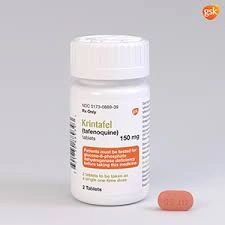
Krintafel 150 mg Tablet
Global Shipping : Reliable Global Distribution Network
Express Delivery : Priority Shipping for Every Order
Secure Payments : Trusted Payment Protection System
 Disclaimer

Secure Handling
24/7 Worldwide Support

Global Access
Worldwide Access to Health

Cold-Chain Expert
Excellence in Cold-Chain

Trusted Supply
Certified Medical Supply
Indications & Clinical Uses
- Krintafel 150 mg tablets contain tafenoquine, a long-acting 8-aminoquinoline antimalarial from GlaxoSmithKline.
- Krintafel is approved by the US Food and Drug Administration for the radical cure, meaning prevention of relapse, of Plasmodium vivax malaria in patients aged 16 years and older who are receiving chloroquine therapy.
- It works on the dormant liver forms of the parasite that cause later relapses, and it is explicitly not indicated for treating the acute malaria attack, which chloroquine treats.
- The dose is a single 300 mg dose taken as two 150 mg tablets together with food on the first or second day of the chloroquine course.
- Outside the United States the same GSK product is marketed as Kozenis.
- A separate tafenoquine product, Arakoda 100 mg, is licensed for preventing malaria and uses a completely different loading and weekly maintenance schedule; the two are not interchangeable.
Side Effects
- At least 5 percent of people report dizziness, nausea, vomiting, headache or a fall in haemoglobin.
- The most serious risk is haemolytic anaemia, which can be severe in people with glucose-6-phosphate dehydrogenase (G6PD) deficiency, and this is why G6PD testing before prescribing is mandatory.
- Asymptomatic rises in methaemoglobin have been seen, serious psychiatric reactions have been observed at higher doses, and serious hypersensitivity reactions including angioedema have been reported.
- The Krintafel label carries no boxed warning.
- Seek urgent medical attention if you develop dark or cola-coloured urine, unusual tiredness with pale or yellow skin or eyes, breathlessness or a racing heartbeat, blue-grey lips, fingertips or skin, or any sudden anxiety, strange dreams, sleeplessness, confusion or change in behaviour after the dose.
Precautions & Warnings
- All patients must be tested for G6PD deficiency before Krintafel is prescribed.
- It is contraindicated in anyone who is G6PD deficient or whose G6PD status is unknown, and it is contraindicated during breastfeeding when the infant is G6PD deficient or has not been tested, because tafenoquine passes into milk.
- It must not be used for the acute attack, and it will not prevent relapse if an antimalarial other than chloroquine is used for the acute infection.
- Watch for signs of haemolysis and methaemoglobinaemia after dosing, and use caution in anyone with a psychiatric history.
- Women should use effective contraception during treatment and for three months after the dose.
- Store the tablets at 20°C to 25°C, with short excursions between 15°C and 30°C permitted, in the original moisture-protective packaging.
Avoid Interactions
- Avoid giving Krintafel with medicines transported by OCT2 and MATE, such as metformin and dofetilide, because tafenoquine can increase their blood levels and the risk of toxicity; if they cannot be avoided, the prescriber should monitor for adverse effects.
- The main way to lose efficacy is to pair tafenoquine with an antimalarial other than chloroquine for the acute infection, or to stop the chloroquine course early, so finish chloroquine exactly as prescribed.
- Take both tablets with food, which improves absorption.
- Tell your prescriber about every prescription medicine, over-the-counter product and herbal supplement you use, and about any past episode of anaemia, jaundice or dark urine after taking a medicine, in you or a close relative, because that can point to undiagnosed G6PD deficiency.
References
Frequently Asked Questions
Krintafel (tafenoquine) is used to prevent relapse of Plasmodium vivax malaria, known as radical cure, in patients aged 16 and over who are also taking chloroquine. It kills the dormant liver forms that cause later attacks. It does not treat the acute malaria episode itself.
Krintafel is taken as one single 300 mg dose, which is two 150 mg tablets swallowed together with food, on the first or second day of your chloroquine course. Food helps absorption. That single dose completes the tafenoquine treatment, but you must still finish the full chloroquine course.
Dizziness, nausea, vomiting, headache and a drop in haemoglobin are the common side effects of Krintafel (tafenoquine). Get urgent help for dark or cola-coloured urine, pale or yellow skin, breathlessness, a racing heart, blue-grey lips, or sudden anxiety, strange dreams or confusion after the dose.
Avoid metformin, dofetilide and other OCT2 and MATE substrates with Krintafel, as tafenoquine can raise their levels and toxicity. Do not rely on it if your acute malaria was treated with an antimalarial other than chloroquine. Avoid pregnancy during treatment and for three months after the dose.
Yes. Every patient must be tested for glucose-6-phosphate dehydrogenase (G6PD) deficiency before Krintafel is prescribed. It is contraindicated if you are G6PD deficient or your status is unknown, because haemolytic anaemia can be severe. Store the tablets at 20°C to 25°C in their original moisture-protective pack.
Krintafel is contraindicated while breastfeeding an infant who is G6PD deficient or untested, because tafenoquine passes into breast milk and can cause haemolysis in the baby. The infant must be tested first. Krintafel is sold as Kozenis outside the United States, and is not the same as Arakoda.

Trusted & Reliable – Your Partner in Global Distribution.
We provide comprehensive lines of pharmaceutical products to support all your healthcare distribution needs.


