

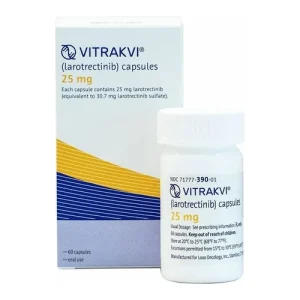
TM Owner Bayer
Larotrectinib 100mg Capsule
Global Shipping : Reliable Global Distribution Network
Express Delivery : Priority Shipping for Every Order
Secure Payments : Trusted Payment Protection System
 Disclaimer

Secure Handling
24/7 Worldwide Support

Global Access
Worldwide Access to Health

Cold-Chain Expert
Excellence in Cold-Chain

Trusted Supply
Certified Medical Supply
Indications & Clinical Uses
- Larotrectinib 100 mg capsules are sold under the approved brand name VITRAKVI; larotrectinib is the active substance name, not a brand, and no medicine is registered simply as Larotrectinib.
- VITRAKVI contains larotrectinib sulfate, a tropomyosin receptor kinase (TRK) inhibitor, and it is one of the few tumour-agnostic cancer medicines, prescribed according to the genetics of the tumour rather than the organ it started in.
- It is approved for adults and children with solid tumours that carry a neurotrophic tyrosine receptor kinase (NTRK) gene fusion without a known acquired resistance mutation, where the disease is metastatic or surgery would cause severe harm, and where there is no satisfactory alternative treatment or the cancer has progressed after treatment.
- A confirmed NTRK fusion test is required before treatment starts.
- In the European Union Bayer AG holds a conditional marketing authorisation, and the medicine is under additional monitoring.
Side Effects
- VITRAKVI has no boxed warning.
- Very common side effects and laboratory changes include raised liver enzymes AST (62%) and ALT (61%), anaemia (45%), low blood albumin (44%), muscle and joint pain (41%), raised alkaline phosphatase (40%), low white cells (37%), low lymphocytes (35%), low neutrophils (34%), low calcium (32%), tiredness (31%), vomiting (30%), cough (29%), constipation (27%), fever (26%), diarrhoea (26%), nausea (25%), abdominal pain (24%), dizziness (22%) and rash (21%).
- The most important warnings concern nervous system effects - dizziness, unsteadiness, confusion, memory or mood changes and disturbed sleep - along with liver injury and bone fractures, which occurred in about 7% of patients.
- Report sudden bone or joint pain, yellowing of the skin or eyes, or any change in thinking or balance without delay.
Precautions & Warnings
- Liver blood tests are done before treatment, every two weeks during the first month, monthly for the first three months and regularly afterwards; the dose is withheld or reduced if liver enzymes rise.
- Because larotrectinib can cause dizziness and confusion, do not drive or use machines until you know how it affects you.
- Tell your healthcare provider about new or worsening bone pain, as fractures have been reported in both adults and children.
- Larotrectinib can harm an unborn baby: women who can become pregnant should use effective contraception during treatment and for at least one month after the last dose, and men with partners who could become pregnant should do the same; breastfeeding is not advised during treatment or for a week afterwards.
- Capsules are swallowed whole with or without food, and the 20 mg/mL oral solution must be kept refrigerated at 2 to 8 degrees Celsius, unlike the capsules.
Avoid Interactions
- Blood levels of larotrectinib are increased by strong CYP3A4 inhibitors such as ketoconazole, itraconazole, clarithromycin and ritonavir, and by grapefruit and grapefruit juice, which must be avoided; if a strong inhibitor cannot be avoided the larotrectinib dose is halved, and moderate inhibitors call for closer monitoring for side effects.
- Levels are lowered, and the treatment made less effective, by strong CYP3A4 inducers including rifampicin, carbamazepine, phenytoin, phenobarbital and St John's wort; if one of these cannot be avoided the dose is doubled, and St John's wort should not be taken at all.
- Larotrectinib may also raise levels of sensitive CYP3A4 substrates such as midazolam.
- Give your healthcare provider a full list of your medicines, herbal products and supplements before starting and whenever anything changes, because dose adjustments are often needed.
References
Frequently Asked Questions
Larotrectinib, sold as VITRAKVI, treats solid tumours that carry an NTRK gene fusion, in adults and children. It is prescribed by tumour genetics rather than by the organ affected, when the cancer has spread, surgery would cause severe harm, or other treatments have stopped working.
VITRAKVI (larotrectinib) capsules are swallowed whole twice daily, with or without food, at a dose based on body surface area. The capsules and the 20 mg/mL oral solution may be used interchangeably at the same milligram dose, which helps children and anyone who cannot swallow capsules.
Raised liver enzymes, anaemia, low white blood cells, tiredness, muscle and joint pain, dizziness, nausea, vomiting and constipation are common with VITRAKVI (larotrectinib). Report yellowing of the skin or eyes, confusion, unsteadiness or sudden bone pain promptly; fractures occurred in about 7% of patients.
Avoid grapefruit, grapefruit juice and strong CYP3A4 inhibitors such as ketoconazole and clarithromycin with VITRAKVI (larotrectinib), because they raise drug levels. St John's wort, rifampicin and carbamazepine lower levels and reduce the effect. Do not drive until you know whether it makes you dizzy.
VITRAKVI (larotrectinib) capsules are stored at 20°C to 25°C, but the oral solution must be refrigerated at 2°C to 8°C. Liver blood tests are done before treatment, monthly for the first three months and regularly after that, because larotrectinib commonly raises liver enzymes.
Yes. VITRAKVI (larotrectinib) is approved for children as well as adults, and the oral solution allows accurate dosing in infants and young children. It can harm an unborn baby, so effective contraception is needed during treatment and for at least one month afterwards by both women and men.

Trusted & Reliable – Your Partner in Global Distribution.
We provide comprehensive lines of pharmaceutical products to support all your healthcare distribution needs.


