

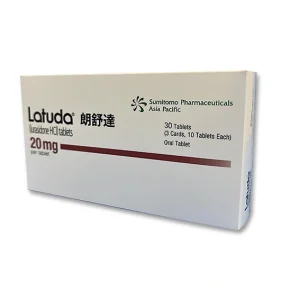
TM Owner Sumitomo Pharma
Latuda 40mg Tablet
Global Shipping : Reliable Global Distribution Network
Express Delivery : Priority Shipping for Every Order
Secure Payments : Trusted Payment Protection System
 Disclaimer

Secure Handling
24/7 Worldwide Support

Global Access
Worldwide Access to Health

Cold-Chain Expert
Excellence in Cold-Chain

Trusted Supply
Certified Medical Supply
Indications & Clinical Uses
- Latuda 40 mg film-coated tablets contain lurasidone hydrochloride, an atypical (second-generation) antipsychotic.
- Latuda is approved to treat schizophrenia in adults and in adolescents aged 13 to 17 years, and depressive episodes associated with bipolar I disorder (bipolar depression) in adults and in children aged 10 to 17 years, either on its own or added to lithium or valproate.
- Adult doses range from 40 mg to 160 mg once daily in schizophrenia and from 20 mg to 120 mg once daily in bipolar depression, always taken as a single daily dose.
- Latuda must be taken with food containing at least 350 calories, because food increases absorption about two- to three-fold; on an empty stomach roughly half as much medicine is absorbed and it may not work.
- In the European Union the authorisation covers schizophrenia and is held by Angelini in Italy.
Side Effects
- Latuda carries a BOXED WARNING with two parts: elderly patients with dementia-related psychosis treated with antipsychotic medicines are at an increased risk of death, and Latuda is not approved for that use; and antidepressant-class medicines increased the risk of suicidal thoughts and behaviour in children, adolescents and young adults, so anyone starting treatment must be watched closely for worsening mood, agitation or thoughts of self-harm.
- The most common side effects are sleepiness, restlessness and an urge to keep moving (akathisia), stiffness, tremor and other movement effects, and nausea.
- Serious reactions needing urgent help include neuroleptic malignant syndrome (high fever, rigid muscles, confusion), tardive dyskinesia (uncontrolled movements of the face or tongue, which may be permanent), seizures, fainting from low blood pressure, and signs of infection from a low white cell count.
- Weight, blood sugar and cholesterol can rise.
Precautions & Warnings
- Blood sugar, cholesterol, weight and blood counts are monitored during treatment, and blood pressure is checked because Latuda can cause dizziness or fainting on standing.
- Do not drive or use machines until you know how it affects you, as drowsiness is common.
- Tell your healthcare provider about diabetes, heart disease, seizures, low white cell counts, Parkinson's disease, dementia, kidney or liver problems, and any personal or family history of suicidal behaviour; the dose is reduced in moderate to severe kidney or liver impairment.
- Discuss pregnancy and breastfeeding, because babies exposed during the third trimester can have movement problems or withdrawal symptoms after birth.
- Do not stop Latuda suddenly without advice.
- The single most important practical rule is to take every dose with a meal or snack of at least 350 calories, at about the same time each day, or the medicine may not work.
Avoid Interactions
- Latuda is contraindicated with strong CYP3A4 inhibitors, including ketoconazole, itraconazole, clarithromycin, ritonavir and voriconazole, which raise lurasidone levels and the risk of side effects, and equally contraindicated with strong CYP3A4 inducers such as rifampicin, carbamazepine, phenytoin, phenobarbital and St John's wort, which lower levels so far that the medicine may stop working.
- Grapefruit and grapefruit juice must be avoided for the same reason as the inhibitors.
- With moderate inhibitors such as diltiazem the dose is halved, and with moderate inducers it may need to be raised.
- Alcohol and other sedating medicines, including opioids, benzodiazepines and antihistamines, add to drowsiness, and medicines that lower blood pressure increase the risk of fainting.
- Tell your healthcare provider about every prescription medicine, herbal product and supplement before starting Latuda.
References
Frequently Asked Questions
Latuda 40 mg (lurasidone) is an atypical antipsychotic that treats schizophrenia in adults and adolescents aged 13 to 17, and bipolar depression in adults and children aged 10 to 17. In bipolar depression it is used alone or added to lithium or valproate.
Take Latuda (lurasidone) once daily with food containing at least 350 calories, at about the same time each day. Food increases absorption two- to three-fold; taken on an empty stomach, roughly half as much is absorbed and the medicine may not work. Swallow the tablet whole.
Sleepiness, restlessness or an urge to keep moving (akathisia), stiffness, tremor and nausea are the most common side effects of Latuda (lurasidone). Get urgent help for high fever with rigid muscles, uncontrolled face or tongue movements, fainting or seizures. Weight, blood sugar and cholesterol can rise.
Avoid grapefruit and grapefruit juice with Latuda (lurasidone), and never combine it with strong CYP3A4 inhibitors such as ketoconazole or clarithromycin, or strong inducers such as rifampicin, carbamazepine and St John's wort; these are contraindicated. Alcohol and sedatives add to drowsiness, so do not drive until you know your response.
Latuda (lurasidone) carries a boxed warning that older people with dementia-related psychosis treated with antipsychotics have an increased risk of death, and that antidepressant-class medicines raise suicidal thoughts and behaviour in children and young adults. Latuda is not approved for dementia-related psychosis.
Take the missed Latuda (lurasidone) dose with food of at least 350 calories as soon as you remember, unless the next dose is nearly due; then skip it. Never take two doses at once. Taking a dose without enough food halves absorption, so always eat with it.

Trusted & Reliable – Your Partner in Global Distribution.
We provide comprehensive lines of pharmaceutical products to support all your healthcare distribution needs.


