

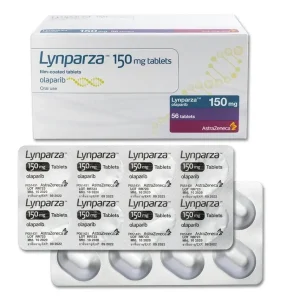
TM Owner AstraZeneca
Lynparza 150mg Tablet
Global Shipping : Reliable Global Distribution Network
Express Delivery : Priority Shipping for Every Order
Secure Payments : Trusted Payment Protection System
 Disclaimer

Secure Handling
24/7 Worldwide Support

Global Access
Worldwide Access to Health

Cold-Chain Expert
Excellence in Cold-Chain

Trusted Supply
Certified Medical Supply
Indications & Clinical Uses
- Lynparza 150 mg tablets contain olaparib, a PARP inhibitor made by AstraZeneca that blocks a DNA-repair enzyme in cancer cells, causing cells with certain DNA-repair defects, such as BRCA mutations, to die.
- It is approved for several BRCA- or HRR-mutation-related cancers, each requiring an FDA-approved companion diagnostic test to confirm eligibility: maintenance treatment of BRCA-mutated or HRD-positive advanced ovarian, fallopian tube, or primary peritoneal cancer that has responded to platinum chemotherapy; adjuvant and metastatic treatment of BRCA-mutated, HER2-negative breast cancer; first-line maintenance of BRCA-mutated metastatic pancreatic cancer after platinum chemotherapy; and treatment of BRCA- or HRR-mutated metastatic castration-resistant prostate cancer, including in combination with abiraterone.
- Because Lynparza treats several different cancers in both women and men, it is best described broadly as an oncology medicine rather than only a women's cancer treatment.
- The standard dose is 300 mg (two 150 mg tablets) twice daily, taken by the patient at home.
Side Effects
- The most common side effects of Lynparza as a single agent include nausea, fatigue, anemia, vomiting, diarrhea, reduced appetite, headache, altered taste, and low white blood cell or platelet counts; the pattern varies slightly when Lynparza is combined with bevacizumab or with abiraterone and prednisone.
- Lynparza has no boxed warning, but it carries an important risk of myelodysplastic syndrome (MDS) and acute myeloid leukemia (AML), occurring in about 1 in 85 patients across trials, usually after roughly two years of treatment, and more than half of these cases were fatal; blood counts are checked monthly and Lynparza is stopped if MDS or AML is confirmed.
- Lynparza can also cause pneumonitis (lung inflammation), so report any new or worsening cough, shortness of breath, or fever promptly.
- Seek urgent care for prolonged bleeding, unusual bruising, fever with signs of infection, or new breathlessness, since these can signal serious blood or lung problems.
Precautions & Warnings
- Blood counts (complete blood count) are checked before starting Lynparza and monthly during treatment, because of risks of anemia, low white cells, low platelets, and rarely MDS or AML; treatment is stopped if these are confirmed.
- Report new breathlessness, cough, or fever promptly, since pneumonitis has occurred.
- Lynparza can harm a developing baby, so effective, non-hormonal contraception is required during treatment and for specific periods afterward - at least 6 months for women, and men should avoid fathering a child for 3 months after their last dose - and it is not recommended during breastfeeding.
- Lynparza should be avoided with strong or moderate CYP3A inhibitors and inducers where possible, and the dose is reduced when a moderate or strong inhibitor cannot be avoided.
- No dose adjustment is generally needed for mild kidney or liver impairment, but closer monitoring is advised in moderate impairment; safety has not been established in severe organ impairment.
- Swallow tablets whole; do not chew, crush, or dissolve them.
Avoid Interactions
- Tell your healthcare provider and pharmacist about every medicine and supplement you take, since Lynparza is broken down mainly by the CYP3A liver enzyme.
- Avoid strong CYP3A inhibitors, such as itraconazole, certain HIV protease inhibitors, and clarithromycin; if one cannot be avoided, the Lynparza dose is usually reduced to 100 mg twice daily.
- With moderate CYP3A inhibitors, such as erythromycin or fluconazole, the dose is usually reduced to 150 mg twice daily.
- Strong and moderate CYP3A inducers, including rifampin, carbamazepine, phenytoin, and St John's Wort, should be avoided, as they can make Lynparza less effective; avoid grapefruit and grapefruit juice for the same reason.
- When Lynparza is combined with a GnRH agonist for prostate cancer, there is an increased risk of blood clots, so report leg swelling, pain, or breathlessness.
- Always confirm any new prescription or over-the-counter medicine with your healthcare provider before starting it.
References
Frequently Asked Questions
Lynparza (olaparib) treats several BRCA- or HRR-mutation-related cancers, including ovarian, breast, pancreatic, and prostate cancer, usually alongside or after chemotherapy. A genetic test confirms you have a mutation the drug targets before treatment starts. Because it treats cancers in both men and women, it is an oncology medicine, not only a women's cancer treatment.
Lynparza 150 mg tablets are usually taken as two tablets (300 mg) by mouth twice daily, about 12 hours apart, with or without food. Swallow tablets whole; do not crush or chew them. Your dose may be lower if you take certain other medicines or have side effects.
Common side effects include nausea, fatigue, anemia, vomiting, diarrhea, and reduced appetite. Lynparza also carries a risk of myelodysplastic syndrome or acute leukemia in about 1 in 85 patients, so blood counts are checked monthly. Report new cough or breathlessness promptly, since lung inflammation can occur.
Avoid strong CYP3A inhibitors like itraconazole and clarithromycin, and inducers like rifampin or St John's Wort, since they change olaparib levels. Avoid grapefruit and grapefruit juice. Effective non-hormonal contraception is essential during treatment, as Lynparza can harm a developing baby.
Yes. Your healthcare provider checks a complete blood count before starting Lynparza and monthly throughout treatment, because it can cause anemia, low white cells, low platelets, and rarely a blood cancer called MDS or AML. Treatment is stopped if any of these serious blood problems is confirmed.
Yes, Lynparza treats prostate cancer in men as well as ovarian, breast, and pancreatic cancers. It must not be used in pregnancy, since it can harm a developing baby, so effective contraception is required during and after treatment - 6 months for women, 3 months for men after their last dose.

Trusted & Reliable – Your Partner in Global Distribution.
We provide comprehensive lines of pharmaceutical products to support all your healthcare distribution needs.


