

TM Owner Sanofi
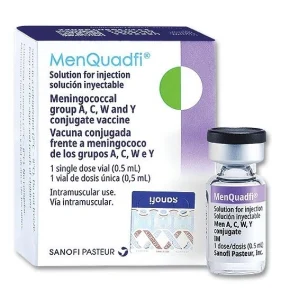
MenQuadfi 0.5ml Injection
Global Shipping : Reliable Global Distribution Network
Express Delivery : Priority Shipping for Every Order
Secure Payments : Trusted Payment Protection System
 Disclaimer

Secure Handling
24/7 Worldwide Support

Global Access
Worldwide Access to Health

Cold-Chain Expert
Excellence in Cold-Chain

Trusted Supply
Certified Medical Supply
Indications & Clinical Uses
- MenQuadfi (Meningococcal [Groups A, C, Y, W] Conjugate Vaccine), 0.5 mL per dose, made by Sanofi Pasteur, protects against invasive meningococcal disease caused by Neisseria meningitidis serogroups A, C, Y and W.
- In the US it is approved from 6 weeks of age through adulthood, with a multi-dose infant schedule for those under 2 years and a single dose for people aged 2 years and older, with a booster for those who remain at continued risk.
- MenQuadfi does not protect against serogroup B meningococcal disease, so a separate vaccine is needed for that protection.
- It is given only by a trained healthcare provider as an intramuscular injection, usually in the deltoid muscle of the upper arm or the thigh in infants.
Side Effects
- MenQuadfi has no boxed warning.
- The most common reactions in adults and adolescents are injection-site pain, myalgia (muscle ache), headache and malaise, each affecting more than 1 in 10 people; fatigue and nausea are also common.
- In infants and young children, irritability, drowsiness, loss of appetite, injection-site tenderness and redness, and fever are frequently reported, again affecting more than 1 in 10 recipients in the youngest age groups.
- Fainting (syncope) can occur around the time of vaccination, so patients may be observed for about 15 minutes afterwards.
- Seek urgent medical attention for a severe allergic reaction such as facial or throat swelling, breathing difficulty or hives shortly after the injection, or for unusual weakness or tingling in the weeks that follow, which could suggest Guillain-Barre syndrome.
Precautions & Warnings
- MenQuadfi must not be given to anyone who has had a severe allergic reaction to a previous dose, to any vaccine component, or to another tetanus toxoid-containing vaccine.
- People with a weakened immune system, including those on immunosuppressive treatment or with complement deficiencies, may have a reduced response and remain at higher risk of meningococcal disease even after vaccination.
- Guillain-Barre syndrome has been reported after other meningococcal conjugate vaccines, so any prior history should be discussed with the healthcare provider.
- MenQuadfi is given by intramuscular injection only and must never be injected into a blood vessel.
- It does not replace routine tetanus immunisation.
- Vaccination during pregnancy or breastfeeding should be discussed with a healthcare provider, and appropriate treatment for anaphylaxis must be available whenever the vaccine is given.
Avoid Interactions
- MenQuadfi can be given at the same visit as other routine vaccines, including DTaP/Tdap, inactivated polio, hepatitis A and B, Hib, pneumococcal conjugate, rotavirus, MMR and varicella vaccines, using separate syringes and injection sites.
- Tell the healthcare provider about all other vaccines and medicines being used, especially immunosuppressive therapy, chemotherapy or long-term corticosteroids, since these can reduce the immune response to MenQuadfi.
- People with complement deficiencies or those taking complement-inhibitor drugs such as eculizumab remain at increased risk of meningococcal disease despite vaccination and may need additional precautions.
- There is no specific food or alcohol interaction reported; always confirm the full vaccination schedule with the healthcare provider.
References
Frequently Asked Questions
MenQuadfi is a vaccine that protects against invasive meningococcal disease caused by Neisseria meningitidis serogroups A, C, Y and W. It is approved for people aged 6 weeks and older in the US. It does not protect against serogroup B meningococcal disease.
A healthcare provider gives MenQuadfi as a single intramuscular injection, usually in the thigh for infants or the upper arm for older children and adults. Adults and children aged 2 and over need only one dose; infants under 2 need a multi-dose schedule.
The most common side effects are pain, redness or swelling at the injection site, headache, muscle aches and tiredness, each affecting more than 1 in 10 people. Infants often become irritable, sleepy or feverish. Seek urgent help for facial swelling, breathing difficulty or hives.
Do not have MenQuadfi if you have had a severe allergic reaction to it, its ingredients, or another tetanus-containing vaccine before. Tell your healthcare provider about immune-suppressing medicines or conditions, since these can lower your response, and about any past Guillain-Barre syndrome.
Yes. MenQuadfi can be given at the same visit as routine vaccines such as DTaP, Tdap, MMR, hepatitis A and B, polio and pneumococcal vaccines, using a different injection site for each. Tell the provider about every vaccine and medicine you are currently using.
MenQuadfi can still be given, but people who are immunocompromised, have complement deficiencies, or take immune-suppressing treatment may develop weaker protection and remain at higher risk of meningococcal disease even after vaccination. Extra precautions may be recommended by the provider.

Trusted & Reliable – Your Partner in Global Distribution.
We provide comprehensive lines of pharmaceutical products to support all your healthcare distribution needs.


