

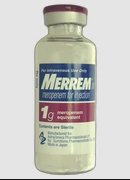
TM Owner Pfizer
Merrem 1g Injection
Global Shipping : Reliable Global Distribution Network
Express Delivery : Priority Shipping for Every Order
Secure Payments : Trusted Payment Protection System
 Disclaimer

Secure Handling
24/7 Worldwide Support

Global Access
Worldwide Access to Health

Cold-Chain Expert
Excellence in Cold-Chain

Trusted Supply
Certified Medical Supply
Indications & Clinical Uses
- Merrem 1 g is a brand of meropenem, a broad-spectrum carbapenem antibiotic, given by intravenous injection or infusion.
- In the United States it is approved for complicated skin and skin-structure infections in adults and children 3 months and older, complicated intra-abdominal infections in adults and all paediatric ages, and bacterial meningitis in patients 3 months and older; the same molecule is approved more broadly in the UK and EU, marketed as Meronem, for severe pneumonia, complicated urinary tract infections, intra- and post-partum infections and febrile neutropenia as well.
- Merrem is a hospital-administered medicine given by or under the supervision of a healthcare professional, not a medicine taken at home; the brand name differs by market — Merrem in the US, Meronem in the UK/EU — though the active ingredient is the same.
Side Effects
- The most common reactions to Merrem in clinical trials were diarrhea (about 5%), nausea and vomiting (about 4%), headache (about 2%) and rash (about 2%), plus injection-site inflammation or thrombophlebitis.
- Merrem carries no boxed warning on its current US or UK label.
- Serious but less common reactions include severe hypersensitivity or anaphylactic reactions, severe skin reactions such as Stevens-Johnson syndrome and toxic epidermal necrolysis, seizures — especially with existing CNS disorders or reduced kidney function — and rarely rhabdomyolysis (muscle breakdown).
- Prolonged use can lead to Clostridioides difficile-associated diarrhea, ranging from mild to severe.
- Report seizures, a spreading rash, severe or bloody diarrhea, or signs of a severe allergic reaction such as swelling or breathing difficulty to the treating team immediately.
Precautions & Warnings
- Merrem is contraindicated in anyone with known hypersensitivity to meropenem or a history of anaphylaxis to other beta-lactam antibiotics such as penicillins or cephalosporins, because of cross-reactivity risk.
- It should be used with caution in people with a history of seizures or CNS disorders, and the dose must be reduced in renal impairment according to kidney function.
- Combining Merrem with valproic acid or sodium valproate should be avoided, as it sharply lowers valproate levels and can trigger breakthrough seizures; an alternative antibiotic or anticonvulsant is usually chosen instead.
- Merrem is given only by intravenous injection or infusion by a healthcare professional in a hospital setting, never intramuscularly, orally or at home, and renal and hepatic function should be monitored during prolonged treatment.
Avoid Interactions
- Probenecid competes with meropenem for kidney excretion, raising meropenem blood levels and half-life; co-administration with Merrem is generally not recommended unless directed by the treating physician.
- Valproic acid, sodium valproate and valpromide should not be combined with Merrem, since meropenem can rapidly reduce valproate levels below the therapeutic range and provoke seizures; an alternative antibacterial or anticonvulsant is preferred.
- Meropenem can also reduce the effectiveness of some oral typhoid vaccines.
- Always ensure the treating team knows about every medicine the patient takes, including anticonvulsants, other antibiotics and any known beta-lactam allergy, before Merrem is started, and it must not be mixed in the same infusion line as other drugs.
References
Frequently Asked Questions
Merrem (meropenem) is a carbapenem antibiotic given for serious bacterial infections, including complicated skin, intra-abdominal infections and, in children, bacterial meningitis. It's given by IV in hospital. The same active ingredient is sold in the UK and EU under the brand name Meronem.
Merrem is given only in hospital, by intravenous injection or infusion, by or under the supervision of a healthcare professional. It's never taken by mouth or given at home. The dose and infusion length depend on the infection being treated and the patient's kidney function.
Common Merrem side effects include diarrhea, nausea, vomiting, headache, rash and injection-site irritation. Less common but serious reactions include severe allergic reactions, seizures, severe skin reactions and Clostridioides difficile diarrhea. Tell the treating team immediately about a seizure, spreading rash or severe diarrhea.
Merrem must not be combined with valproic acid or sodium valproate, since it can sharply lower valproate levels and trigger seizures. Probenecid raises Merrem levels and is generally avoided. Tell the treating team about any penicillin or cephalosporin allergy and every other medicine before treatment starts.
Kidney function is checked before and during Merrem treatment, since the dose must be lowered if it's reduced. If treatment continues for several days, the care team also watches for new or worsening diarrhea, which can signal Clostridioides difficile infection, and for any signs of a seizure or allergic reaction.
Meropenem, the active ingredient in Merrem, should be used with caution in anyone with a history of seizures or CNS disorders, and never combined with valproic acid or sodium valproate, which it can make less effective, risking breakthrough seizures. Tell the treating team about any seizure history beforehand.

Trusted & Reliable – Your Partner in Global Distribution.
We provide comprehensive lines of pharmaceutical products to support all your healthcare distribution needs.


