

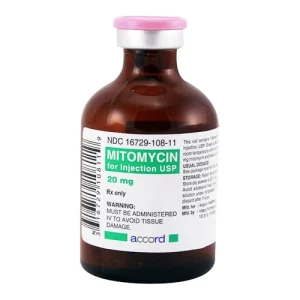
TM Owner Accord Healthcare
Mitomycin C 20mg Vial
Global Shipping : Reliable Global Distribution Network
Express Delivery : Priority Shipping for Every Order
Secure Payments : Trusted Payment Protection System
 Disclaimer

Secure Handling
24/7 Worldwide Support

Global Access
Worldwide Access to Health

Cold-Chain Expert
Excellence in Cold-Chain

Trusted Supply
Certified Medical Supply
Indications & Clinical Uses
- Mitomycin C 20 mg is a 20 mg vial of the cytotoxic antibiotic mitomycin, the same active substance sold generically as "Mitomycin" or under the originator name Mutamycin.
- This strength and presentation is used by specialists in two distinct ways that are NOT interchangeable: given intravenously in combination chemotherapy regimens for cancers such as advanced gastric, breast, non-small-cell lung, or pancreatic cancer; or, in a separate procedure, reconstituted and instilled directly into the bladder by a urologist to help prevent recurrence of superficial (non-muscle-invasive) bladder cancer after a tumour has been surgically removed (transurethral resection).
- Which route applies depends entirely on how the prescriber has ordered and prepared the dose for this patient - the vial itself does not determine the route.
- Mitomycin C is administered only in a hospital or specialist outpatient setting by trained staff; it is never self-administered.
Side Effects
- When given intravenously, the most common effects are bone marrow suppression (low white cells and platelets, affecting up to about two-thirds of patients), nausea, vomiting, and fatigue; interstitial lung disease with cough and breathlessness can also occur.
- When instilled into the bladder, the most common effects are local: cystitis (which may be blood-stained), pain or burning on passing urine, and passing urine more often; allergic skin rashes on the hands and feet have also been reported with intravesical use.
- Mitomycin carries important warnings rather than a single boxed statement: severe bone marrow suppression requiring specialist chemotherapy supervision, and hemolytic uremic syndrome (HUS) - a serious, sometimes fatal, complication of red cell breakdown, low platelets and kidney failure, occurring mainly with cumulative IV doses.
- Report bruising, bleeding, fever, breathlessness, or reduced urination urgently after IV use, and blood in the urine, severe bladder pain, or inability to pass urine urgently after a bladder instillation.
Precautions & Warnings
- Mitomycin C must be given strictly by the route the prescriber has ordered: IV injection must go into a free-flowing vein, avoiding any leakage into surrounding tissue, which can cause severe skin damage; intravesical instillation must be performed by a clinician trained in the procedure and must never be given if the bladder wall is perforated or the patient has active cystitis.
- It is contraindicated in patients with hypersensitivity to mitomycin, and IV use is contraindicated with significant thrombocytopenia, coagulation disorders, or bleeding tendency.
- Regular blood counts and kidney function monitoring are required with IV use because of bone marrow suppression and HUS risk; cumulative bladder toxicity, including reduced bladder capacity or bladder wall fibrosis, is monitored with repeated intravesical courses.
- Mitomycin is not recommended during breastfeeding, and safety in pregnancy and children has not been established.
- Contact of the reconstituted solution with skin or mucous membranes should be avoided, as mitomycin is mutagenic and potentially carcinogenic.
Avoid Interactions
- Tell the treating specialist about every medicine being used, since interactions differ by route.
- With IV use, giving mitomycin alongside vinca alkaloid chemotherapy (vincristine, vinblastine) can trigger acute shortness of breath and severe bronchospasm; combining it with other bone-marrow-suppressing drugs, radiotherapy, or agents linked to hemolytic uremic syndrome such as fluorouracil raises the risk of serious toxicity, and doxorubicin combinations may worsen heart toxicity.
- Live vaccines should be avoided during treatment because of immune suppression.
- With intravesical use, other myelotoxic or nephrotoxic medicines and concurrent bladder infections should be discussed with the urology team before instillation, and the bladder should be adequately emptied and free of active infection first.
- Mitomycin C must never be mixed with other drugs in the same syringe, catheter, or infusion line unless compatibility has been specifically confirmed by the pharmacy.
References
Frequently Asked Questions
Mitomycin C is a chemotherapy antibiotic used either intravenously, combined with other drugs for cancers such as stomach, breast, lung, or pancreatic cancer, or instilled into the bladder by a urologist to prevent early bladder cancer returning. Your prescriber decides which route applies to you.
Mitomycin C is given only by a trained clinician, either as an intravenous injection into a free-flowing drip for cancer chemotherapy, or as a bladder instillation left in place for one to two hours after bladder tumour surgery. You cannot give it to yourself.
Intravenous Mitomycin C commonly causes low blood counts, nausea, and fatigue, with hemolytic uremic syndrome a rare serious kidney risk at higher cumulative doses. Bladder instillation mainly causes local bladder irritation, burning on urination, and sometimes blood-stained urine after the procedure.
Tell your care team about all other medicines, since IV Mitomycin C combined with vinca alkaloid chemotherapy can cause sudden breathlessness and wheezing. Avoid live vaccines during treatment, and report any bladder infection to your urologist before an instillation is due.
With IV treatment you will have regular blood counts and kidney tests to check for bone marrow suppression and hemolytic uremic syndrome. With bladder instillations, your urine and bladder symptoms are checked at each visit, and cystoscopy follow-up is arranged by your urologist.
Mitomycin C and Mitomycin Intravesical both contain the drug mitomycin, but they are used for different purposes: this 20 mg vial may be given intravenously for systemic cancer chemotherapy or into the bladder, while a dedicated intravesical product is for bladder instillation only. Routes are never interchangeable.

Trusted & Reliable – Your Partner in Global Distribution.
We provide comprehensive lines of pharmaceutical products to support all your healthcare distribution needs.


