

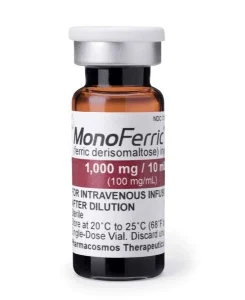
TM Owner Pharmacosmos
Monoferric 100mg/mL Injection
Global Shipping : Reliable Global Distribution Network
Express Delivery : Priority Shipping for Every Order
Secure Payments : Trusted Payment Protection System
 Disclaimer

Secure Handling
24/7 Worldwide Support

Global Access
Worldwide Access to Health

Cold-Chain Expert
Excellence in Cold-Chain

Trusted Supply
Certified Medical Supply
Indications & Clinical Uses
- Monoferric 100 mg/mL (ferric derisomaltose) is an intravenous iron replacement product used to treat iron deficiency anaemia in adults who cannot tolerate oral iron, have not responded well to oral iron, or have non-dialysis-dependent chronic kidney disease.
- It is not intended for iron deficiency without anaemia.
- Monoferric replenishes the body's iron stores directly into the bloodstream as a single infusion, avoiding the gastrointestinal side effects common with iron tablets; a repeat dose may be given later if anaemia recurs.
- Monoferric is given only in a hospital, clinic or infusion centre under the supervision of a healthcare provider trained to manage anaphylaxis, and is not a self-administered medicine.
- The same active ingredient is also marketed as Monofer in some countries outside the US.
Side Effects
- Monoferric's current label does not carry a boxed warning.
- The most commonly reported side effects in clinical trials were rash, occurring in about 1% of patients, and nausea in around 1% of patients.
- Serious hypersensitivity reactions, including rare anaphylactic-type reactions, occurred in about 0.3% of patients and can appear during or shortly after the infusion; symptoms include difficulty breathing, wheezing, swelling of the face or throat, rash, low blood pressure or chest tightness, and require immediate medical attention.
- You will be monitored in the clinic for at least 30 minutes after each infusion so any reaction can be treated promptly.
- Temporary changes in blood pressure can also occur.
- Tell staff immediately about any itching, flushing or breathing changes during the infusion.
Precautions & Warnings
- Monoferric must not be given to anyone with a known serious hypersensitivity to Monoferric or any of its ingredients, including people who have previously had an anaphylactic-type reaction to it.
- Because serious hypersensitivity reactions can occur, Monoferric is given only where resuscitation facilities and trained staff are available, and you are observed for at least 30 minutes after the infusion.
- Iron overload must be avoided, so Monoferric should not be used in people who already have excess iron stores, and haemoglobin and iron parameters are checked periodically.
- Use during pregnancy should be limited to when clearly needed, since animal studies showed some adverse effects at high doses and human pregnancy data are limited; discuss risks and benefits with your obstetric and haematology team.
- There is no specific route-of-administration alternative - Monoferric is given only by intravenous infusion or injection, never intramuscularly.
Avoid Interactions
- There is no established compatibility data for mixing Monoferric with other intravenous medicines, so it should not be combined with other drugs in the same infusion line or diluted with fluids other than the approved saline solution.
- Concurrent use of oral iron supplements is generally not needed and may reduce absorption of the oral iron while increasing the chance of gastrointestinal side effects, so oral iron is usually stopped before and during the course of treatment unless your provider advises otherwise.
- Tell your healthcare provider about all other medicines, including other injectable iron products, to avoid inadvertent iron overload.
- There are no specific food interactions with intravenous iron, but always inform your care team of all prescription and over-the-counter medicines and supplements you are taking before your infusion.
References
Frequently Asked Questions
Monoferric (ferric derisomaltose) treats iron deficiency anaemia in adults who cannot take oral iron, have not responded to it, or have chronic kidney disease. It refills the body's iron stores directly through an intravenous infusion, usually as a single dose.
Monoferric is given as an intravenous infusion in a clinic or hospital, diluted in saline and infused over at least 20 minutes. Dosing depends on your bodyweight: 1,000 mg for adults 50 kg or over, or 20 mg per kg if you weigh less.
The most common effects are rash and nausea, each affecting roughly 1% of patients. Serious hypersensitivity or anaphylactic-type reactions are uncommon (about 0.3%) but can happen during the infusion, so you are monitored for at least 30 minutes afterward.
Avoid taking oral iron supplements at the same time unless your provider says otherwise, since it is usually unnecessary and can increase stomach side effects. Monoferric should not be mixed with other drugs in the infusion line. Tell your provider about any other iron products you use.
Your healthcare provider checks haemoglobin and iron parameters, such as ferritin, before treatment and periodically afterward to confirm the anaemia has improved and to avoid giving too much iron. A repeat infusion may be needed later if anaemia returns.
Monoferric should be used in pregnancy only if clearly needed, as animal studies showed some effects at high doses and human data are limited. Discuss the benefits and risks with your obstetric and haematology team before treatment if you are or could become pregnant.

Trusted & Reliable – Your Partner in Global Distribution.
We provide comprehensive lines of pharmaceutical products to support all your healthcare distribution needs.


