

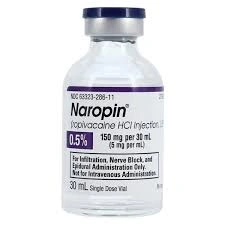
TM Owner Aspen Pharmacare
Naropin 0.50% Injection
Global Shipping : Reliable Global Distribution Network
Express Delivery : Priority Shipping for Every Order
Secure Payments : Trusted Payment Protection System
 Disclaimer

Secure Handling
24/7 Worldwide Support

Global Access
Worldwide Access to Health

Cold-Chain Expert
Excellence in Cold-Chain

Trusted Supply
Certified Medical Supply
Indications & Clinical Uses
- Naropin 0.5% (5 mg/mL ropivacaine hydrochloride) is a local anaesthetic of the amide class, supplied as a preservative-free injection solution for single use.
- At this concentration it is indicated for regional anaesthesia for surgery, including epidural block for surgery and for caesarean section, and for major nerve blocks and field blocks.
- Other Naropin concentrations are used for different purposes: 0.2% is reserved for continuous epidural infusion or intermittent bolus for postoperative and labour pain, while 0.75% and 1% are used where a faster onset or more profound surgical block is needed; these strengths are not interchangeable with 0.5%.
- Naropin must be given only by, or under the supervision of, a clinician experienced in regional anaesthesia, with resuscitation equipment immediately available, and is not for obstetrical paracervical block, retrobulbar block, spinal (subarachnoid) anaesthesia, or intravenous regional (Bier block) anaesthesia.
Side Effects
- Naropin has no boxed warning.
- The most common reactions, occurring in more than 1 in 10 people, are low blood pressure, nausea, vomiting, slow heart rate and fever; headache is also common.
- Naropin's most serious risk is local anaesthetic systemic toxicity from unintentional injection into a blood vessel or from high doses: early signs include restlessness, anxiety, ringing in the ears, blurred vision, tingling around the mouth and tremors, which can progress to convulsions and loss of consciousness.
- High plasma levels can also depress the heart, causing slow heart rate, heart block, low blood pressure, abnormal heart rhythms including ventricular fibrillation, and rare reports of cardiac arrest, most often after accidental injection into a vein.
- Naropin is therefore given slowly in incremental doses with frequent aspiration checks, and the patient is monitored throughout the procedure and afterward.
Precautions & Warnings
- Naropin must never be given by rapid intravenous injection; it is intended only for the routes specified for each concentration (epidural, peripheral nerve block, field block or local infiltration), and every dose should be preceded by careful aspiration to avoid intravascular injection.
- It should be used with caution in patients with impaired liver function, since ropivacaine is metabolised by the liver and repeat dosing can lead to accumulation, and in those with heart block, severe cardiac disease, or low blood volume, who are more sensitive to its cardiovascular effects.
- Certain patients, including infants under 6 months, people with G6PD deficiency, and those with existing heart or lung disease, have a higher risk of methemoglobinemia, a condition causing blue-grey skin discolouration that needs prompt treatment.
- Naropin should only be used in pregnancy if the benefits outweigh the risks, and continuous fetal heart monitoring is recommended when used for labour or delivery.
- It must not be used for spinal, retrobulbar or intravenous regional (Bier block) anaesthesia.
Avoid Interactions
- Tell the anaesthetist or healthcare team about all medicines being taken before Naropin is given.
- Ropivacaine levels can rise significantly with strong CYP1A2 inhibitors such as fluvoxamine, increasing the risk of local anaesthetic toxicity, so this combination is used with caution and close monitoring.
- In patients taking class III antiarrhythmic drugs such as amiodarone, ECG monitoring should be considered because both drugs affect heart conduction.
- Using Naropin together with other local anaesthetics or agents structurally related to amide-type local anaesthetics adds to the risk of toxic effects, as these effects are additive.
- Drugs that can trigger methemoglobinemia, including certain nitrates, other local anaesthetics, and some antibiotics and anticonvulsants, increase this risk when combined with Naropin.
- Because Naropin is a preservative-free, single-use solution, it should not be mixed or diluted with other drugs or solutions in the same syringe or infusion line unless specifically directed.
References
Frequently Asked Questions
Naropin (ropivacaine) 0.5% is a local anaesthetic injection used by clinicians to numb an area for surgery, including epidural blocks for surgery and caesarean section, and for major nerve or field blocks. Other Naropin strengths, like 0.2%, are used instead for ongoing pain relief after surgery or during labour.
Naropin is given only by a clinician trained in regional anaesthesia, as an epidural, nerve block or local infiltration injection, never as a rapid intravenous injection. It's injected slowly in small increments, with the clinician aspirating to confirm the needle isn't in a blood vessel before and during dosing.
Common Naropin effects include low blood pressure, nausea, vomiting, fever and slow heart rate. Its main serious risk is local anaesthetic systemic toxicity from accidental injection into a vein, causing dizziness, tremors, seizures or, rarely, heart rhythm problems and cardiac arrest. Resuscitation equipment is kept ready whenever Naropin is given.
Naropin should be used cautiously with other local anaesthetics, since their toxic effects add together, and with amiodarone or other heart-rhythm drugs, which need extra ECG monitoring. It should not be given by rapid IV injection, as a spinal block, or for Bier block anaesthesia. Tell the care team about liver disease.
Naropin can be used in pregnancy, including for caesarean section and labour epidurals, when the benefits outweigh the risks, and continuous fetal heart monitoring is recommended during use in labour. Ropivacaine crosses the placenta, and maternal blood pressure is monitored closely throughout.
Because accidental injection into a blood vessel can cause local anaesthetic systemic toxicity - dizziness, tremors, seizures and, rarely, dangerous heart rhythm problems or cardiac arrest. Clinicians inject Naropin slowly, in small increments, aspirating first to check needle placement, with resuscitation equipment ready throughout.

Trusted & Reliable – Your Partner in Global Distribution.
We provide comprehensive lines of pharmaceutical products to support all your healthcare distribution needs.


