

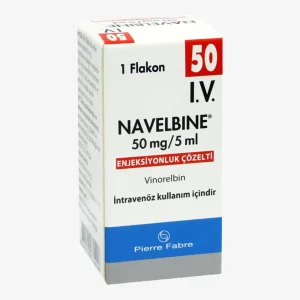
TM Owner Pierre Fabre
Navelbine 50mg/5ml Vial
Global Shipping : Reliable Global Distribution Network
Express Delivery : Priority Shipping for Every Order
Secure Payments : Trusted Payment Protection System
 Disclaimer

Secure Handling
24/7 Worldwide Support

Global Access
Worldwide Access to Health

Cold-Chain Expert
Excellence in Cold-Chain

Trusted Supply
Certified Medical Supply
Indications & Clinical Uses
- Navelbine 50 mg/5 mL is the intravenous formulation of vinorelbine, a vinca-alkaloid chemotherapy medicine, approved in combination with cisplatin as first-line treatment of locally advanced or metastatic non-small cell lung cancer (NSCLC) in adults, and as a single agent for first-line treatment of metastatic NSCLC.
- It is a hospital- and specialist-administered oncology medicine, never a self-injected product.
- In the United States, the branded Navelbine injection (Pierre Fabre) has been discontinued for commercial reasons, not for safety or effectiveness - Drugs@FDA records it as discontinued while the underlying molecule remains available as generic vinorelbine injection from other manufacturers.
- This vial (50 mg in 5 mL) is the intravenous concentrate only; vinorelbine is also sold in some countries as Navelbine oral soft capsules at entirely different strengths (20 mg, 30 mg, 80 mg) with different dosing - the oral and IV forms are not interchangeable and must never be substituted for one another.
Side Effects
- Navelbine carries a boxed warning for severe myelosuppression: it can lower white blood cell, red blood cell and platelet counts to dangerous levels, leading to serious infection, septic shock, hospitalisation and death, and blood counts must be checked before every dose.
- Very common effects (affecting more than 1 in 10 people) include nausea, vomiting, constipation, fatigue, hair thinning, and pain, redness or a burning sensation at or spreading from the injection site if the drug leaks outside the vein (extravasation), which can cause severe tissue damage.
- Numbness or tingling in the hands or feet (peripheral neuropathy), shortness of breath, and liver enzyme changes are also reported.
- Seek urgent medical attention for fever, signs of infection, severe shortness of breath, chest pain, or pain, swelling or leakage at the injection site during the infusion.
- Because it is given intravenously by a healthcare professional in a monitored setting, patients themselves do not manage injection-site care.
Precautions & Warnings
- Navelbine must only be given intravenously by a trained healthcare professional, with correct needle or catheter placement confirmed before each dose, since leakage outside the vein can cause severe tissue damage; it must never be given by any other route.
- It must not be confused with, or substituted for, oral vinorelbine capsules, which use completely different strengths and dosing under the Navelbine name outside the United States - moving between the two forms without a full dose recalculation by the oncologist is a serious dosing-error risk.
- Blood counts are required before each dose, with treatment delayed or the dose reduced if neutrophil or platelet counts are too low.
- Dose adjustment is needed in significant liver impairment.
- Navelbine can cause fetal harm, so effective contraception is required during treatment; it is not recommended in pregnancy or breastfeeding.
- Use with caution after prior chest radiotherapy, and avoid live vaccines during treatment because of immune suppression.
Avoid Interactions
- Tell the treating team about every medicine, herbal product and supplement being taken, since several combinations affect how Navelbine is broken down or increase toxicity.
- Strong CYP3A4 inhibitors - such as ketoconazole, itraconazole, clarithromycin, ritonavir and grapefruit juice - can raise vinorelbine levels and increase the risk of severe side effects, so combinations are avoided or used with extra monitoring.
- Conversely, strong CYP3A4 inducers, including rifampicin, phenytoin and St John's Wort, may lower vinorelbine levels and reduce how well it works.
- Combining Navelbine with other bone-marrow-suppressing chemotherapy or radiotherapy increases the risk of severe low blood counts.
- Live or live-attenuated vaccines should be avoided during and shortly after treatment because of a weakened immune response and infection risk.
- Navelbine must never be mixed or diluted with other medicines in the same syringe or infusion line unless specifically directed, and it must never be given by any non-intravenous route.
References
Frequently Asked Questions
Navelbine (vinorelbine) is an IV chemotherapy used with cisplatin, or alone, as first-line treatment for adults with locally advanced or metastatic non-small cell lung cancer. It is given only in a hospital or clinic by a specialist team. In the US the Navelbine brand is discontinued; generic vinorelbine injection is used instead.
Navelbine is given as a short intravenous infusion or injection, usually over 6 to 10 minutes, once weekly, directly into a correctly placed vein or catheter by a healthcare professional. You do not inject it yourself. Leakage outside the vein can cause serious tissue damage, so it is only ever given in a monitored clinical setting.
Navelbine carries a boxed warning for severe low blood cell counts, which can cause serious infection, septic shock and death, so blood tests are done before every dose. Common effects include nausea, fatigue, hair thinning, constipation and numbness or tingling in the hands or feet. Report fever or breathlessness urgently.
No. This vial (50 mg in 5 mL) is the intravenous form of vinorelbine. Navelbine oral capsules, sold in some countries at 20 mg, 30 mg or 80 mg, have completely different dosing. The IV and oral forms are not interchangeable and must never be substituted for each other.
A nurse checks your blood counts, confirms your vein or catheter is correctly placed, then gives Navelbine as a brief IV injection or infusion, usually weekly. You are monitored for any burning, swelling or leakage at the injection site, since this can indicate the drug has escaped the vein.
No. Navelbine can harm an unborn baby, so effective contraception is required during treatment for patients who could become pregnant or father a child. It is not recommended during pregnancy or breastfeeding. Avoid live vaccines while on treatment, as Navelbine weakens the immune system.

Trusted & Reliable – Your Partner in Global Distribution.
We provide comprehensive lines of pharmaceutical products to support all your healthcare distribution needs.


