

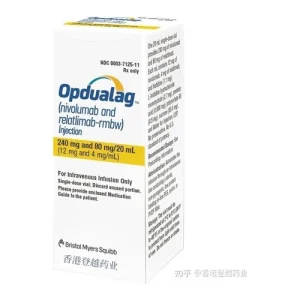
TM Owner Bristol Myers Squibb
Nivolumab/Relatlimab IV 240mg/80mg Injection
Global Shipping : Reliable Global Distribution Network
Express Delivery : Priority Shipping for Every Order
Secure Payments : Trusted Payment Protection System
 Disclaimer

Secure Handling
24/7 Worldwide Support

Global Access
Worldwide Access to Health

Cold-Chain Expert
Excellence in Cold-Chain

Trusted Supply
Certified Medical Supply
Indications & Clinical Uses
- Nivolumab/Relatlimab IV is the fixed-dose combination approved in the US under the brand name Opdualag (nivolumab and relatlimab-rmbw), and this information follows the Opdualag label.
- Each single-dose vial contains 240 mg of nivolumab and 80 mg of relatlimab in 20 mL (12 mg and 4 mg per mL).
- Nivolumab is a PD-1 blocking antibody and relatlimab is a LAG-3 blocking antibody.
- Opdualag is indicated for adults and paediatric patients aged 12 years and older with unresectable or metastatic melanoma.
- The recommended dose for patients weighing at least 40 kg is 480 mg nivolumab and 160 mg relatlimab (two vials) by intravenous infusion over 30 minutes every 4 weeks; dosing under 40 kg has not been established.
- It is given only by a healthcare provider in a clinic or hospital.
Side Effects
- The most common side effects (20% or more of patients) were musculoskeletal pain (45%), tiredness (39%), rash (28%), itching (25%) and diarrhoea (24%).
- Opdualag can cause severe, sometimes fatal immune-mediated reactions in any organ, including pneumonitis (3.7%), colitis (7%), hepatitis (6%), hormone gland problems such as adrenal insufficiency, hypophysitis, thyroid disorders and diabetes, nephritis (2%), serious skin reactions including Stevens-Johnson syndrome and toxic epidermal necrolysis, and myocarditis (1.7%).
- Infusion-related reactions occurred in 7% of patients.
- The label has no boxed warning.
- Report cough, breathlessness, chest pain, bloody stools, yellow skin or eyes, severe rash, reduced urination, ankle swelling or severe headache straight away.
Precautions & Warnings
- Opdualag has no contraindications on its label.
- Immune-mediated reactions can affect any organ and need early recognition, monitoring and treatment, and infusions may be interrupted, slowed or stopped for reactions.
- Tell your team about autoimmune disease (such as Crohn's disease, ulcerative colitis or lupus), organ transplant, planned allogeneic stem cell transplant, or nervous system conditions such as myasthenia gravis or Guillain-Barre syndrome, because serious complications can follow allogeneic transplant.
- Opdualag can harm an unborn baby: a pregnancy test is needed first, use effective contraception during treatment and for at least 5 months after the last dose, and do not breastfeed during treatment and for 5 months afterwards.
- Unopened vials are refrigerated at 2°C to 8°C in the carton, protected from light, and are not frozen or shaken.
- It is a fixed combination, so do not assume it is interchangeable with nivolumab alone (Opdivo); the label gives no substitution guidance.
Avoid Interactions
- The only interaction instruction on the US label is that no other drugs should be infused through the same intravenous line as Opdualag; the pharmacy dilutes it in sodium chloride or dextrose and uses a 0.2 to 1.2 micrometre filter.
- The label describes no medicines that specifically increase or reduce its effect.
- Tell your healthcare provider about all prescription and over-the-counter medicines, vitamins and herbal supplements you take, as the Medication Guide asks patients to do before treatment.
- Systemic corticosteroids are used to treat serious immune-mediated reactions, so report symptoms early rather than waiting for a scheduled visit.
References
Frequently Asked Questions
Opdualag (nivolumab and relatlimab-rmbw) treats melanoma that cannot be removed by surgery or has spread. It is approved in the US for adults and children aged 12 and over who weigh at least 40 kg. Nivolumab is a PD-1 blocking antibody and relatlimab a LAG-3 blocking antibody.
Opdualag (nivolumab and relatlimab-rmbw) is given by a healthcare provider as an intravenous infusion over 30 minutes, once every 4 weeks. The usual dose for patients weighing at least 40 kg is 480 mg of nivolumab with 160 mg of relatlimab, which uses two vials.
Common Opdualag side effects are muscle and bone pain, tiredness, rash, itching and diarrhoea. It can also cause serious immune reactions in the lungs, bowel, liver, hormone glands, kidneys, skin and heart. Report cough, bloody stools, yellow skin, severe rash or chest pain straight away. The label has no boxed warning.
Avoid pregnancy and breastfeeding with Opdualag (nivolumab and relatlimab-rmbw): use effective contraception during treatment and for at least 5 months after the last dose, and do not breastfeed during that time. Tell your team about all medicines, and about any planned stem cell transplant or autoimmune disease.
During an Opdualag infusion, a healthcare provider gives the medicine through an intravenous line over 30 minutes, usually every 4 weeks. Infusion reactions occurred in 7% of patients, so staff watch you and may slow, pause or stop the infusion. Tell staff if you feel unwell during or after it.
No. Opdualag is a fixed-dose combination of nivolumab and relatlimab-rmbw, while Opdivo contains nivolumab alone. The Opdualag label gives no guidance on substituting one for the other, so they should not be treated as interchangeable. Your oncology team chooses the right product.

Trusted & Reliable – Your Partner in Global Distribution.
We provide comprehensive lines of pharmaceutical products to support all your healthcare distribution needs.


