

TM Owner Ipsen
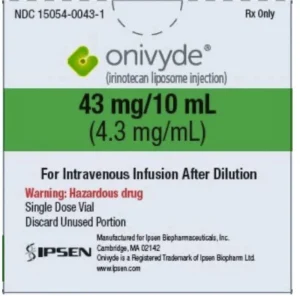
Onivyde 43mg/10ml Vial
Global Shipping : Reliable Global Distribution Network
Express Delivery : Priority Shipping for Every Order
Secure Payments : Trusted Payment Protection System
 Disclaimer

Secure Handling
24/7 Worldwide Support

Global Access
Worldwide Access to Health

Cold-Chain Expert
Excellence in Cold-Chain

Trusted Supply
Certified Medical Supply
Indications & Clinical Uses
- Onivyde 43 mg/10 mL is a brand of irinotecan liposome (nanoliposomal irinotecan), a topoisomerase I inhibitor chemotherapy medicine.
- In the United States it is approved, combined with oxaliplatin, fluorouracil and leucovorin, as first-line treatment for adults with metastatic adenocarcinoma of the pancreas, and, combined with fluorouracil and leucovorin, for adults whose pancreatic cancer has progressed after gemcitabine-based chemotherapy.
- It is not approved as a single agent.
- The same active medicine is sold in the European Union as Onivyde pegylated liposomal by a different marketing company, Servier, but the drug itself is chemically identical to the US product.
- Onivyde is given only in a hospital or specialist cancer centre, as an intravenous infusion prepared and administered by trained oncology staff; it is never a self-injected or take-home medicine.
Side Effects
- The most common side effects, affecting more than half of patients, are diarrhoea, tiredness, nausea, vomiting, reduced appetite and abdominal pain; inflammation of the mouth or gut lining is also common.
- Onivyde carries a boxed warning for severe, life-threatening neutropenia (very low white blood cell count), including fatal neutropenic sepsis, and for severe, life-threatening diarrhoea that can start within 24 hours of the infusion or appear later.
- Tell your healthcare provider immediately about fever, chills or diarrhoea, and start any prescribed anti-diarrhoeal or antibiotic treatment straight away rather than waiting it out.
- Routine blood counts are checked on the first and eighth day of every cycle to catch neutropenia early.
- Seek urgent help for signs of infection, severe vomiting, breathing difficulty, or an allergic reaction such as rash, swelling or wheeze during or shortly after the infusion.
Precautions & Warnings
- Onivyde must not be given to anyone who has had a severe allergic reaction to irinotecan or any component of the medicine, and it should be avoided in people with bowel obstruction.
- Liver function is checked before each cycle, since no safe dose has been established when bilirubin is above the normal range.
- Complete blood counts are required on day 1 and day 8 of every cycle.
- Onivyde can harm an unborn baby, so effective contraception is required during treatment and for 7 months after the last dose in women, and for 4 months after in men with female partners; breastfeeding should be avoided during treatment and for 1 month afterward.
- Onivyde is for intravenous infusion only, given over 90 minutes, and must never be given as a rapid injection or bolus.
Avoid Interactions
- Tell your healthcare provider about every prescription and over-the-counter medicine, herbal product and supplement you take, since several interactions change how much active drug reaches the bloodstream.
- Strong CYP3A4 inducers such as rifampin, phenytoin, carbamazepine and St John's wort can reduce Onivyde's effect and should be substituted with an alternative at least two weeks before treatment starts.
- Strong CYP3A4 or UGT1A1 inhibitors, including ketoconazole, clarithromycin, itraconazole and ritonavir, can raise levels of the active drug and the risk of severe side effects, and should be stopped at least one week beforehand.
- Live vaccines should be avoided during treatment because of the effect on the immune system.
- Loperamide for late-onset diarrhoea and atropine for early-onset diarrhoea and cramping are commonly used alongside Onivyde under medical supervision.
References
Frequently Asked Questions
Onivyde (irinotecan liposome) treats metastatic pancreatic cancer in adults. It is given first-line with oxaliplatin, fluorouracil and leucovorin, or after gemcitabine-based chemotherapy stops working, combined with fluorouracil and leucovorin. It is always used with other chemotherapy drugs, never alone.
Onivyde is given as an intravenous infusion by a cancer specialist in a hospital or clinic, over about 90 minutes, usually every 2 weeks alongside other chemotherapy drugs. You do not inject it yourself, and there is no tablet or home version.
Diarrhoea, tiredness, nausea, vomiting and low appetite are very common with Onivyde. It carries a boxed warning for severe, life-threatening neutropenia (low white blood cells) and severe diarrhoea. Report fever, chills or ongoing diarrhoea to your care team immediately.
Avoid strong CYP3A4 inducers like rifampin, carbamazepine and St John's wort, which weaken Onivyde, and strong inhibitors like ketoconazole and clarithromycin, which raise its levels and toxicity. Avoid live vaccines during treatment and tell your team about all other medicines.
Because of the boxed warning for severe neutropenia, complete blood counts are checked on day 1 and day 8 of every treatment cycle. Liver function is also checked before each cycle, since dosing has not been established with raised bilirubin.
No. Onivyde can harm an unborn baby, so effective contraception is required during treatment and for 7 months after the last dose in women, and 4 months after in men with female partners. Breastfeeding should be avoided during treatment and for 1 month after.

Trusted & Reliable – Your Partner in Global Distribution.
We provide comprehensive lines of pharmaceutical products to support all your healthcare distribution needs.


