

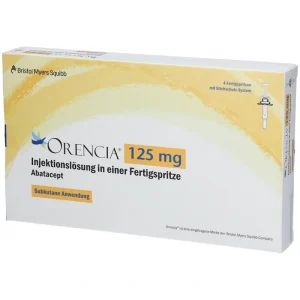
TM Owner Bristol Myers Squibb
Orencia 125mg/mL Injection
Global Shipping : Reliable Global Distribution Network
Express Delivery : Priority Shipping for Every Order
Secure Payments : Trusted Payment Protection System
 Disclaimer

Secure Handling
24/7 Worldwide Support

Global Access
Worldwide Access to Health

Cold-Chain Expert
Excellence in Cold-Chain

Trusted Supply
Certified Medical Supply
Indications & Clinical Uses
- Orencia 125 mg/mL solution for injection contains abatacept, a selective T-cell costimulation modulator that dampens the abnormal T-cell activation driving certain autoimmune joint diseases, given by prefilled syringe or autoinjector under the skin (subcutaneous injection); an intravenous powder-for-infusion form is also available for hospital or clinic use.
- Orencia is approved for adults with moderate to severe rheumatoid arthritis, either alone or with other disease-modifying antirheumatic drugs such as methotrexate, for adults with active psoriatic arthritis, and for children aged 2 years and older with moderate to severe polyarticular juvenile idiopathic arthritis.
- The intravenous form is also used, in the US, to help prevent acute graft-versus-host disease after certain bone marrow transplants.
- Subcutaneous Orencia is usually self-injected at home once the patient or carer has been trained, while the intravenous form is given by a healthcare provider.
Side Effects
- Very common side effects (affecting more than 1 in 10 people) include headache, upper respiratory tract infection, sore throat and runny nose (nasopharyngitis), and nausea.
- There is no boxed warning on this label.
- Because abatacept dampens part of the immune system, it can increase the risk of infections, some of them serious, including pneumonia, cellulitis, and sepsis, and rare cases of tuberculosis reactivation and lymphoma have been reported with this class of medicine.
- Injection-site reactions (redness, swelling, itching) can occur with the subcutaneous form, and infusion reactions (dizziness, headache, hives) can occur with the intravenous form, usually during or shortly after the infusion.
- Seek prompt medical advice for fever, persistent cough, unusual tiredness, or any sign of infection that does not improve.
Precautions & Warnings
- Before starting Orencia, patients are screened for latent tuberculosis and viral hepatitis, because reactivation has been reported.
- Orencia should not be started during an active, serious infection, and should be used with caution in people with chronic obstructive pulmonary disease (COPD), who have shown more frequent respiratory side effects, including worsening COPD and pneumonia.
- Live vaccines must not be given while using Orencia or within approximately 3 months of stopping it, because the weakened immune response may make the vaccine less safe or effective.
- Orencia should not be combined with TNF-alpha inhibitors (such as etanercept or adalimumab) or with other biologic therapies for rheumatoid arthritis, including anakinra, because of an increased risk of serious infection without added benefit.
- Discuss pregnancy and breastfeeding plans with your rheumatologist before starting or stopping treatment.
- Store prefilled syringes, autoinjectors and vials refrigerated at 2°C to 8°C, protected from light, and do not freeze.
Avoid Interactions
- Tell your healthcare provider about all medicines and supplements you use before starting Orencia.
- Combining Orencia with TNF-alpha inhibitors (etanercept, adalimumab, infliximab and similar biologics) or with other biologic disease-modifying antirheumatic drugs such as anakinra or rituximab is not recommended, because trials showed a higher rate of serious infection without extra benefit.
- Live vaccines (such as MMR, yellow fever, or live shingles vaccine) should be avoided while on Orencia and for about 3 months after stopping, due to reduced immune response and theoretical infection risk from the vaccine itself.
- The intravenous formulation contains maltose, which can cause falsely high readings on some blood glucose monitors that use glucose dehydrogenase pyrroloquinoline quinone (GDH-PQQ) test strips - tell your care team if you monitor blood sugar so an unaffected monitor type can be used on infusion days.
References
Frequently Asked Questions
Orencia (abatacept) treats moderate to severe rheumatoid arthritis, active psoriatic arthritis in adults, and polyarticular juvenile idiopathic arthritis in children aged 2 and older. It works by calming the T-cell activity that drives joint inflammation in these conditions.
Orencia is usually given as a once-weekly injection under the skin using a prefilled syringe or autoinjector, which you or a carer can learn to do at home. A hospital-given intravenous infusion form is also available, typically once a month after initial loading doses.
Common side effects include headache, sore throat, runny nose, and nausea. Because Orencia affects the immune system, it can raise the risk of infections, so report fever, persistent cough, or unusual tiredness to your doctor promptly.
Avoid live vaccines while on Orencia and for about 3 months after stopping. Do not combine Orencia with TNF inhibitors like etanercept or adalimumab, or with other biologic arthritis medicines, since this raises infection risk without added benefit.
Before starting, you are screened for tuberculosis and hepatitis, since Orencia can reactivate dormant infections. If you check your own blood sugar and receive intravenous Orencia, tell your team, because the infusion can falsely raise readings on some glucose meters.
Orencia can be used long-term as long as it continues to control symptoms and is well tolerated, with regular review by your rheumatologist. Discuss pregnancy or breastfeeding plans before starting or stopping, as the effect on an unborn baby is not fully established.

Trusted & Reliable – Your Partner in Global Distribution.
We provide comprehensive lines of pharmaceutical products to support all your healthcare distribution needs.


