

TM Owner Bristol Myers Squibb
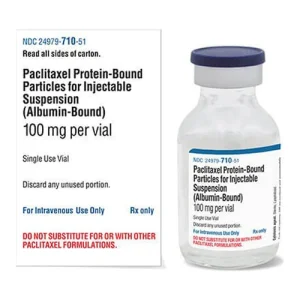
Paclitaxel Protein-Bound 100mg Injection
Global Shipping : Reliable Global Distribution Network
Express Delivery : Priority Shipping for Every Order
Secure Payments : Trusted Payment Protection System
 Disclaimer

Secure Handling
24/7 Worldwide Support

Global Access
Worldwide Access to Health

Cold-Chain Expert
Excellence in Cold-Chain

Trusted Supply
Certified Medical Supply
Indications & Clinical Uses
- Paclitaxel Protein-Bound Particles for Injectable Suspension (Albumin-Bound) 100 mg, marketed as Abraxane, is a nanoparticle albumin-bound (nab) formulation of the taxane chemotherapy paclitaxel, distinct from conventional solvent-based paclitaxel.
- It is a hospital-administered intravenous chemotherapy, never self-injected.
- It is approved for metastatic breast cancer after failure of combination chemotherapy for metastatic disease or relapse within 6 months of adjuvant chemotherapy, for locally advanced or metastatic non-small cell lung cancer as first-line treatment in combination with carboplatin in patients not candidates for curative surgery or radiation, and for metastatic adenocarcinoma of the pancreas as first-line treatment in combination with gemcitabine.
- Because this albumin-bound formulation has different pharmacokinetics, dosing and administration instructions from other paclitaxel products, the label states it must not be substituted for or with other paclitaxel formulations.
Side Effects
- Abraxane carries a boxed warning for severe myelosuppression: it must not be given to patients with a baseline neutrophil count below 1,500 cells/mm3, and complete blood counts must be checked frequently, as neutropenia can be severe and lead to infection or sepsis.
- Very common side effects include hair loss (up to 90%), low white cell counts, sensory neuropathy - numbness, tingling or pain in the hands and feet (up to around 70%), fatigue, low red blood cell and platelet counts, nausea and joint or muscle pain.
- Serious reactions include severe hypersensitivity (do not restart Abraxane if this occurs), pneumonitis (including fatal cases, mainly with gemcitabine), and sepsis.
- Seek urgent medical help for fever, signs of infection, breathing difficulty, or severe numbness or weakness affecting daily activities.
Precautions & Warnings
- Abraxane is contraindicated in patients with a baseline neutrophil count below 1,500 cells/mm3 and in those with a history of severe hypersensitivity to paclitaxel or its components.
- Dose reduction is required in moderate to severe liver impairment, as clearance is reduced and toxicity increased.
- Because Abraxane contains human albumin, there is a theoretical risk of viral transmission, although none has been documented.
- Sensory neuropathy may require dose interruption or reduction if severe.
- Abraxane can cause fetal harm; women and men of reproductive potential should use effective contraception during treatment and for at least 6 months (women) or 3 months (men) afterwards, and breastfeeding should be avoided during treatment.
- Pneumonitis must be treated urgently and the drug permanently stopped if diagnosed.
- Abraxane must never be substituted for or with conventional solvent-based paclitaxel or other taxane products - dosing and schedule are not interchangeable.
Avoid Interactions
- Paclitaxel in Abraxane is metabolised mainly by the liver enzymes CYP2C8 and CYP3A4, so caution is needed when it is given with inhibitors of these enzymes, such as ketoconazole, clarithromycin, ritonavir or gemfibrozil, which may raise paclitaxel exposure and toxicity, or with inducers such as rifampicin and carbamazepine, which may reduce its effect.
- When combined with carboplatin or gemcitabine as part of standard regimens, myelosuppression is more pronounced and blood counts are monitored closely between cycles.
- Tell your oncology team about all prescription medicines, herbal products and supplements you use, since many interact through the same liver enzymes.
- Abraxane must never be substituted for, mixed with, or diluted using the same equipment as conventional paclitaxel, because the two formulations are not interchangeable.
References
Frequently Asked Questions
Abraxane, also called paclitaxel protein-bound particles, treats metastatic breast cancer, non-small cell lung cancer (with carboplatin) and metastatic pancreatic cancer (with gemcitabine). It is an albumin-bound form of the chemotherapy drug paclitaxel, given as a hospital infusion, not by mouth or self-injection.
Abraxane is given as an intravenous infusion by a healthcare team, usually over about 30 minutes, on a cycle that depends on your type of cancer. Unlike conventional paclitaxel, routine steroid premedication is not usually required, because the albumin-bound formulation carries a lower risk of infusion reactions.
Abraxane commonly causes hair loss, numbness or tingling in the hands and feet, fatigue and low blood cell counts. It has a boxed warning for severe neutropenia (low white blood cells), so blood counts are checked often. Report fever, signs of infection, or breathing problems straight away.
No. Abraxane (paclitaxel protein-bound) has different dosing and administration than conventional, solvent-based paclitaxel injection, and the label states it must never be substituted for or with other paclitaxel formulations. Mixing them up can cause a serious dosing error.
You will have complete blood counts checked frequently before and during Abraxane treatment, because severe neutropenia is the main safety concern. Your oncologist may delay a cycle or lower the dose if your neutrophil count is too low or if nerve symptoms (neuropathy) become severe.
No. Abraxane can harm an unborn baby, so it should not be used in pregnancy. Women should use effective contraception during treatment and for 6 months afterwards, and men for 3 months. Breastfeeding should be avoided while receiving Abraxane.

Trusted & Reliable – Your Partner in Global Distribution.
We provide comprehensive lines of pharmaceutical products to support all your healthcare distribution needs.


