

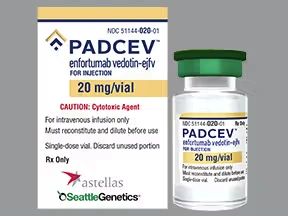
TM Owner Astellas Pharma
Padcev 20mg Injection
Global Shipping : Reliable Global Distribution Network
Express Delivery : Priority Shipping for Every Order
Secure Payments : Trusted Payment Protection System
 Disclaimer

Secure Handling
24/7 Worldwide Support

Global Access
Worldwide Access to Health

Cold-Chain Expert
Excellence in Cold-Chain

Trusted Supply
Certified Medical Supply
Indications & Clinical Uses
- Padcev 20 mg (enfortumab vedotin-ejfv) is an antibody-drug conjugate that combines an antibody targeting Nectin-4, a protein found on urothelial cancer cells, with the chemotherapy payload monomethyl auristatin E.
- It is given by intravenous infusion in a hospital or specialist oncology clinic only, and is never self-administered.
- Padcev is approved, in combination with the immunotherapy pembrolizumab, for adults with locally advanced or metastatic urothelial cancer (bladder and related urinary tract cancers), and as a single agent for adults with locally advanced or metastatic urothelial cancer who have previously received a PD-1 or PD-L1 inhibitor and platinum-based chemotherapy, or who are not eligible for cisplatin chemotherapy and have received at least one prior line of therapy.
- Padcev is jointly developed and marketed by Astellas Pharma and Seagen (a Pfizer company).
Side Effects
- Padcev carries a boxed warning for severe and sometimes fatal skin reactions, including Stevens-Johnson syndrome and toxic epidermal necrolysis, which occur most often during the first treatment cycle but can happen later; treatment is stopped immediately and specialist care sought if these are suspected.
- Very common side effects (affecting 1 in 5 or more patients) include raised blood sugar, abnormal liver tests, rash, raised creatinine, fatigue, itching, numbness or tingling (peripheral neuropathy), low sodium, diarrhoea, hair loss, altered taste, nausea, constipation and dry eyes.
- Seek urgent medical attention for a new or worsening skin rash or blistering, severe diarrhoea, signs of high blood sugar (extreme thirst, frequent urination), blurred vision, or shortness of breath, which could indicate lung inflammation (pneumonitis).
Precautions & Warnings
- Before starting Padcev, tell your healthcare provider if you have diabetes, eye problems, lung disease or nerve problems (neuropathy), because Padcev can worsen or cause hyperglycaemia (including diabetic ketoacidosis), dry eye and other eye disorders, peripheral neuropathy, and pneumonitis, which have caused fatalities.
- Skin reactions must be monitored closely from the first dose, as severe cases can be life-threatening.
- Blood glucose should be monitored regularly, especially in patients with diabetes or risk factors, and treatment withheld if glucose exceeds 250 mg/dL.
- Regular eye examinations are recommended.
- Padcev can cause fetal harm; effective contraception is required during treatment and for a period afterwards in both women and men, and Padcev should not be used during pregnancy.
- Padcev is for intravenous infusion only, under specialist supervision, and must never be given by any other route.
Avoid Interactions
- Padcev's active payload, monomethyl auristatin E, is affected by P-glycoprotein (P-gp) and CYP3A4, so combining Padcev with drugs that strongly inhibit both P-gp and CYP3A4 - such as certain antifungal medicines (itraconazole, ketoconazole), some antibiotics (clarithromycin) and some antivirals - may increase exposure and the risk of side effects, including neutropenia and peripheral neuropathy.
- Tell your oncology team about all prescription and over-the-counter medicines, herbal products and supplements you take, particularly antifungals, certain antibiotics and HIV medicines.
- There is no established food interaction, but any new medicine, including over-the-counter products, should be checked with your care team before starting or during Padcev treatment.
- Padcev must be diluted and administered exactly as directed by trained healthcare staff.
References
Frequently Asked Questions
Padcev (enfortumab vedotin) treats locally advanced or metastatic urothelial cancer, a cancer of the bladder and urinary tract, in adults. It's used with the immunotherapy pembrolizumab, or alone in people who've already had platinum chemotherapy and a PD-1/PD-L1 immunotherapy.
Padcev is given as an intravenous infusion by a cancer care team, typically on days 1 and 8 of a 3-week cycle (schedule may vary by combination). Each infusion takes about 30 minutes. It is never given as a tablet or self-injection.
Padcev commonly causes rash, high blood sugar, fatigue, tingling or numbness, hair loss, nausea and dry eyes. It has a boxed warning for severe skin reactions, including Stevens-Johnson syndrome, which can be fatal. Report any new or spreading rash, blistering or peeling skin immediately.
Avoid starting new medicines, particularly strong antifungals like ketoconazole or itraconazole and certain antibiotics, without telling your oncology team, as these can raise Padcev levels and side effect risk. Alcohol isn't specifically restricted, but always disclose all medicines and supplements you use.
Your care team will check your blood sugar, liver function and skin regularly during Padcev treatment, plus eye exams for dryness or vision changes. Peripheral neuropathy (numbness or tingling) is also monitored, since the dose may be reduced or paused if it becomes severe.
No. Padcev can harm an unborn baby, so it should not be used during pregnancy. Effective contraception is needed during treatment and for a period afterwards for both women and men. Tell your oncology team right away if you are or could be pregnant.

Trusted & Reliable – Your Partner in Global Distribution.
We provide comprehensive lines of pharmaceutical products to support all your healthcare distribution needs.


