

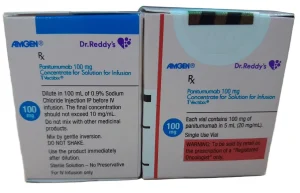
TM Owner Amgen
Panitumumab IV 100mg/5mL Injection
Global Shipping : Reliable Global Distribution Network
Express Delivery : Priority Shipping for Every Order
Secure Payments : Trusted Payment Protection System
 Disclaimer

Secure Handling
24/7 Worldwide Support

Global Access
Worldwide Access to Health

Cold-Chain Expert
Excellence in Cold-Chain

Trusted Supply
Certified Medical Supply
Indications & Clinical Uses
- 'Panitumumab IV' as listed here is not an approved trade name; panitumumab is the active substance's international non-proprietary name (INN), and the approved brand under which it is marketed is Vectibix (Amgen).
- Vectibix is a fully human monoclonal antibody that blocks the epidermal growth factor receptor (EGFR) and is approved for metastatic colorectal cancer.
- In the US it is used for RAS wild-type (KRAS and NRAS) tumours, either combined with FOLFOX chemotherapy as first-line treatment, or alone after prior fluoropyrimidine-, oxaliplatin- and irinotecan-containing chemotherapy, and, more recently, for KRAS G12C-mutated tumours in combination with sotorasib after prior chemotherapy.
- Vectibix is not effective, and is not indicated, in patients whose tumours carry RAS mutations.
- It is given only by intravenous infusion in a hospital or oncology infusion centre; it is never self-administered.
Side Effects
- BOXED WARNING: Vectibix (panitumumab) carries an FDA boxed warning for dermatologic toxicity - skin reactions occur in about 90% of patients on monotherapy and are severe in around 15%, including acneiform rash, skin fissures, paronychia (nail-fold infection) and skin infections that can become serious, sometimes requiring dose interruption or discontinuation.
- The most common additional reactions (occurring in 20% or more of patients) are fatigue, nausea, diarrhoea, and, when combined with chemotherapy, mouth sores (stomatitis) and low magnesium levels.
- Infusion reactions can occur during or shortly after the infusion, ranging from mild flushing to severe anaphylaxis.
- Other serious risks include worsening lung inflammation (pulmonary fibrosis), eye problems such as keratitis, and, rarely, severe diarrhoea with dehydration.
- Report new or worsening skin rash, nail infections, breathing difficulty, or severe diarrhoea to your care team promptly; skin reactions are managed with moisturisers, sun protection and, if needed, dose adjustment.
Precautions & Warnings
- Vectibix requires RAS mutation testing before use; treatment is given only to patients whose tumours are confirmed RAS wild-type, since RAS-mutant tumours do not respond and may even be harmed by treatment.
- Magnesium and calcium levels can fall progressively during treatment and for up to 8 weeks after the last dose, so electrolytes are checked regularly and replaced if needed.
- Vectibix can cause fetal harm and is not recommended in pregnancy; women of reproductive potential should use effective contraception during treatment and for 2 months after the last dose, and should not breastfeed during treatment and for 2 months afterward.
- Sun exposure should be minimised, with sunscreen and protective clothing used, because of the skin toxicity risk.
- Vectibix must be given by intravenous infusion only, diluted and administered as directed, and never given as an intravenous push or bolus.
- Patients receiving Vectibix with sotorasib require careful dose sequencing per the combination regimen.
Avoid Interactions
- There is no established pharmacokinetic drug-drug interaction between Vectibix and other cancer medicines, but combining it with chemotherapy known to worsen diarrhoea, mouth sores or low magnesium (such as oxaliplatin-based regimens) increases the risk of these effects and requires closer monitoring.
- Live or live-attenuated vaccines should generally be avoided during treatment, as their safety and effectiveness alongside an immune-modulating cancer therapy have not been established.
- Vectibix must never be mixed or co-infused with other drugs in the same intravenous line or bag; it is given as its own separate infusion.
- Because Vectibix increases skin sensitivity and dryness, other drugs or products that increase photosensitivity should be used cautiously, with sun protection maintained throughout treatment.
- Tell the oncology team about all other prescription and over-the-counter medicines, supplements and any other biologic therapies before each cycle of treatment.
References
Frequently Asked Questions
"Panitumumab IV" is not a brand name; the approved product is Vectibix (panitumumab), used for metastatic colorectal cancer with RAS wild-type tumours, either with FOLFOX chemotherapy or alone. It's also used with sotorasib for KRAS G12C-mutated tumours after prior chemotherapy.
Vectibix is given as an intravenous infusion in a hospital or cancer centre, usually every 2 weeks, over about 30 to 90 minutes depending on the dose. It's never injected as a quick push and is always given by a healthcare professional, not at home.
Vectibix carries a boxed warning for skin toxicity: about 90% of patients get skin reactions like acne-like rash, cracked skin or nail infections, severe in 15%. Other common effects include fatigue, nausea, diarrhoea and low magnesium. Report worsening rash, breathing trouble or severe diarrhoea straight away.
Avoid excess sun exposure, since Vectibix increases skin sensitivity and dryness; use sunscreen and protective clothing. Live vaccines should generally be avoided during treatment. Vectibix must never be mixed with other drugs in the same infusion line. Effective contraception is needed during and for 2 months after treatment.
Your RAS mutation status is tested before starting Vectibix, since it only works in RAS wild-type tumours. During treatment, magnesium and calcium are checked regularly, as levels can drop progressively and for up to 8 weeks after the last dose, sometimes needing replacement.
No. Vectibix (panitumumab) can cause fetal harm, so it is not recommended during pregnancy. Women who can become pregnant should use effective contraception during treatment and for 2 months after the last dose, and should not breastfeed during treatment or for 2 months afterward.

Trusted & Reliable – Your Partner in Global Distribution.
We provide comprehensive lines of pharmaceutical products to support all your healthcare distribution needs.


