

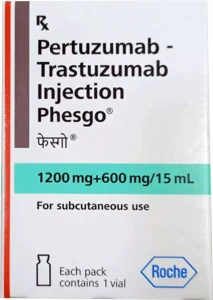
TM Owner Roche
Phesgo 1200mg + 600mg Injection
Global Shipping : Reliable Global Distribution Network
Express Delivery : Priority Shipping for Every Order
Secure Payments : Trusted Payment Protection System
 Disclaimer

Secure Handling
24/7 Worldwide Support

Global Access
Worldwide Access to Health

Cold-Chain Expert
Excellence in Cold-Chain

Trusted Supply
Certified Medical Supply
Indications & Clinical Uses
- Phesgo 1200 mg/600 mg is a fixed-dose combination of the HER2-targeted monoclonal antibodies pertuzumab and trastuzumab with recombinant human hyaluronidase, given as a single subcutaneous injection - it was specifically developed as the only approved subcutaneous alternative to the separate intravenous infusions of pertuzumab (Perjeta) and trastuzumab (Herceptin), so 'subcutaneous' is inherent to every dose of this brand, not a separate product line.
- It is approved in adults with HER2-positive breast cancer for: neoadjuvant treatment (before surgery) of locally advanced, inflammatory or early-stage disease with chemotherapy; adjuvant treatment (after surgery) of early breast cancer at high risk of recurrence; and, combined with docetaxel, first-line treatment of HER2-positive metastatic breast cancer.
- Phesgo is given only by, or under the supervision of, a healthcare professional in a clinic or hospital equipped to manage severe reactions - it is never self-injected.
- Note: the sheet's Drug field lists only 'Pertuzumab + Trastuzumab', but every approved dose of Phesgo also contains hyaluronidase-zzxf, the enzyme that enables subcutaneous (rather than intravenous) delivery.
Side Effects
- The most common Phesgo side effects (affecting 30% or more of patients) are hair loss, diarrhoea, nausea, fatigue, anaemia and administration-site reactions such as pain or redness (up to 15%).
- Phesgo carries THREE BOXED WARNINGS.
- Cardiomyopathy: it can cause subclinical and clinical heart failure, with the highest risk when combined with anthracycline chemotherapy - heart function is checked before treatment and monitored regularly throughout.
- Embryo-fetal toxicity: Phesgo can cause fetal harm or death, including oligohydramnios with lung and skeletal problems in the baby, if used during pregnancy.
- Infusion-related and pulmonary toxicity: severe, sometimes fatal reactions - including anaphylaxis and lung problems such as interstitial pneumonitis - can occur, and treatment is stopped immediately if they do.
- You are observed for 30 minutes after the first dose and 15 minutes after later doses; report breathlessness, chest pain or leg swelling to your care team at once.
Precautions & Warnings
- Before starting Phesgo and periodically during treatment, your heart function (left ventricular ejection fraction) is checked, especially if you have previously had anthracycline chemotherapy, because of the boxed warning on cardiomyopathy.
- Phesgo must be avoided in pregnancy: women of childbearing potential need a pregnancy test before starting and must use effective contraception during treatment and for 7 months after the last dose, reflecting the boxed embryo-fetal toxicity warning.
- Breastfeeding is not recommended during treatment and for 7 months afterward.
- Phesgo is given only as a subcutaneous injection into the thigh by a healthcare professional - it must never be given intravenously or by the patient at home.
- Treatment is stopped immediately for signs of anaphylaxis, angioedema, or severe pulmonary toxicity.
- Use with caution if you have pre-existing lung disease, and keep all scheduled cardiac-monitoring appointments.
Avoid Interactions
- No formal pharmacokinetic drug-interaction studies have been conducted with the pertuzumab and trastuzumab components of Phesgo.
- Combining Phesgo with anthracycline chemotherapy drugs such as doxorubicin substantially increases the cardiotoxicity risk described in the boxed warning, and this combination is generally avoided outside of clinical trials.
- Because Phesgo is usually given alongside other chemotherapy, and chemotherapy causes immunosuppression, discuss any live vaccines with your care team before receiving them during treatment.
- Tell your healthcare provider about every other medicine, chemotherapy agent, and supplement you are taking before each dose.
- Phesgo must not be mixed or diluted with other medicines, and is administered only by trained staff using the specific subcutaneous delivery device.
References
Frequently Asked Questions
Phesgo (pertuzumab and trastuzumab with hyaluronidase) treats HER2-positive breast cancer in adults - before surgery, after surgery, and in metastatic disease with chemotherapy. It targets the HER2 protein that drives this cancer subtype.
Phesgo is injected under the skin of the thigh by a healthcare professional: the first dose takes about 8 minutes, then a shorter maintenance dose is given every 3 weeks over about 5 minutes, always in a clinic setting.
Phesgo carries boxed warnings for heart failure risk, harm to an unborn baby if used in pregnancy, and severe infusion or lung reactions. Your heart function is checked before and during treatment because of the cardiac risk.
Avoid pregnancy during Phesgo treatment and for 7 months after the last dose, since it can seriously harm a developing baby. Combining Phesgo with anthracycline chemotherapy increases heart-failure risk and is generally avoided.
You're given the subcutaneous injection in your thigh, then watched for 30 minutes after your first dose (15 minutes after later ones) for signs of a severe reaction. Blood tests and heart-function checks are done at intervals.
No. Phesgo's boxed warning states it can cause fetal harm or death, so it must be avoided in pregnancy. Effective contraception is required during treatment and for 7 months after the last dose.

Trusted & Reliable – Your Partner in Global Distribution.
We provide comprehensive lines of pharmaceutical products to support all your healthcare distribution needs.


