

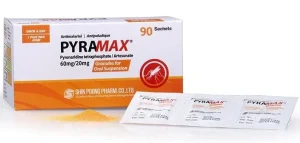
TM Owner Shin Poong Pharmaceutical
Pyramax 180 mg + 60 mg Tablet
Global Shipping : Reliable Global Distribution Network
Express Delivery : Priority Shipping for Every Order
Secure Payments : Trusted Payment Protection System
 Disclaimer

Secure Handling
24/7 Worldwide Support

Global Access
Worldwide Access to Health

Cold-Chain Expert
Excellence in Cold-Chain

Trusted Supply
Certified Medical Supply
Indications & Clinical Uses
- Pyramax 180 mg/60 mg tablets contain the antimalarial combination pyronaridine tetraphosphate and artesunate, a fixed-dose artemisinin-based combination therapy.
- It is indicated for the treatment of acute, uncomplicated malaria caused by Plasmodium falciparum or Plasmodium vivax in adults and children weighing 20 kg or more.
- Pyramax tablets have no DailyMed listing and are not marketed in the United States; the European Medicines Agency has given a positive scientific opinion for use outside the European Union, in malaria-endemic countries, in partnership with the World Health Organization and Medicines for Malaria Venture.
- Infants and children weighing 5 kg to under 20 kg should receive Pyramax Granules for oral suspension instead of the tablet, since the two presentations are dosed differently and are not interchangeable.
- Treatment is a once-daily course over 3 days and should be prescribed and supervised by a healthcare provider experienced in malaria management.
Side Effects
- The most commonly reported side effects of Pyramax, each affecting more than 1 in 100 but fewer than 1 in 10 people, include headache, eosinophilia, low neutrophil counts, anaemia, raised platelet counts, vomiting, abdominal pain, slow heart rate, raised liver enzymes and low blood sugar.
- Pyramax has been associated with transient increases in liver enzymes in some patients; seek urgent medical attention for fatigue, nausea, abdominal pain, dark urine, or yellowing of the skin or eyes, especially within the first two weeks of treatment, since this can signal liver injury.
- The current label carries no boxed warning, but caution is advised because a dedicated QT-interval study has not been performed, so tell your healthcare provider about any history of irregular heart rhythm.
- Contact your healthcare provider promptly if fever and malaria symptoms fail to improve or worsen after treatment, as this may indicate treatment failure or a different illness.
Precautions & Warnings
- Pyramax must not be given to anyone with known hypersensitivity to pyronaridine, artesunate or any tablet ingredient, or to patients with severe liver disease, clinical signs of hepatic injury, or severe kidney impairment.
- Liver function should be monitored, particularly in anyone with pre-existing liver disease.
- Use caution in patients with congenital prolongation of the QTc interval, low blood potassium, dehydration, other heart rhythm disorders or heart failure, since the cardiac safety of pyronaridine has not been fully characterised.
- Pyramax should be used in pregnancy only when the expected benefit to the mother outweighs the risk to the foetus, and specialist advice is recommended during breastfeeding.
- Adults and children weighing 20 kg or more take the tablet; infants and children weighing 5 kg to under 20 kg must instead use Pyramax Granules, as the two formulations are dosed differently and are not interchangeable.
- Store tablets below 30°C in the original package, and complete the full 3-day course even if symptoms improve early.
Avoid Interactions
- Tell your healthcare provider about all medicines and herbal products you take before starting Pyramax.
- Pyronaridine inhibits CYP2D6, so caution and possible dose adjustment are needed with metoprolol, flecainide and propafenone.
- It also inhibits P-glycoprotein, which can raise blood levels of digoxin and dabigatran, so monitoring is advised.
- Because of the risk of liver injury, avoid or closely monitor use with other hepatotoxic medicines such as valproate, rifampicin, carbamazepine, isoniazid and high-dose paracetamol.
- Artesunate is partly metabolised through CYP1A2, so caution is advised with theophylline.
- Strong enzyme inducers such as rifampicin, phenytoin and St John's wort may reduce artesunate exposure and reduce effectiveness, so combined use should be avoided where possible.
- Do not take other antimalarial medicines alongside Pyramax unless directed by a healthcare provider, and avoid alcohol while unwell.
References
- Pyramax - Summary of Product Characteristics, Shin Poong Pharmaceutical
- Pyramax - Annex I Summary of Product Characteristics, European Medicines Agency (opinion for use outside the EU)
- Pyramax - opinion on medicine for use outside EU, European Medicines Agency
- Pyramax Granules becomes first paediatric antimalarial to receive EMA Article 58 positive scientific opinion, Medicines for Malaria Venture
Frequently Asked Questions
Pyramax (pyronaridine-artesunate) tablets treat acute, uncomplicated malaria from Plasmodium falciparum or Plasmodium vivax. They are approved for adults and children weighing 20 kg or more. Pyramax is not sold in the United States; it is used mainly in malaria-endemic countries outside the EU under an EMA scientific opinion.
Pyramax tablets are swallowed whole with water once daily for 3 days, at about the same time each day, with or without food. Children weighing 5 kg to under 20 kg cannot use the tablet and need Pyramax Granules instead. Finish the full 3-day course even if you feel better sooner.
Common Pyramax side effects include headache, vomiting, abdominal pain, low neutrophil counts, anaemia, slow heart rate and raised liver enzymes. Get urgent care for dark urine, yellowing skin or eyes, or ongoing nausea and fatigue, as these can signal liver injury, especially in the first two weeks.
Avoid other liver-affecting medicines such as high-dose paracetamol, rifampicin and valproate, since Pyramax can also affect the liver. Tell your healthcare provider about metoprolol, flecainide, digoxin or dabigatran, as levels may rise. St John's wort and rifampicin can reduce effectiveness. Avoid other antimalarials unless directed.
Pyramax tablets are for adults and children weighing 20 kg or more. Pyramax Granules are a separate oral-suspension formulation for infants and children weighing 5 kg to under 20 kg. The two products are dosed differently and are not interchangeable, so check the weight band before use.
Pyramax should only be used in pregnancy if the expected benefit outweighs the risk to the unborn baby, since pyronaridine-artesunate has not been extensively studied in pregnant women. Discuss malaria treatment options with a healthcare provider if pregnant or breastfeeding; untreated malaria itself carries serious risks.

Trusted & Reliable – Your Partner in Global Distribution.
We provide comprehensive lines of pharmaceutical products to support all your healthcare distribution needs.


