

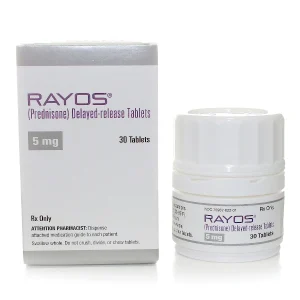
TM Owner Horizon Therapeutics
Rayos 5mg DR Tablet
Global Shipping : Reliable Global Distribution Network
Express Delivery : Priority Shipping for Every Order
Secure Payments : Trusted Payment Protection System
 Disclaimer

Secure Handling
24/7 Worldwide Support

Global Access
Worldwide Access to Health

Cold-Chain Expert
Excellence in Cold-Chain

Trusted Supply
Certified Medical Supply
Indications & Clinical Uses
- Rayos (prednisone) delayed-release tablets 1 mg, 2 mg and 5 mg are a specially formulated corticosteroid designed to release prednisone about 4 hours after an evening dose, timing peak drug levels to coincide with the early-morning surge of inflammatory cytokines seen in conditions such as rheumatoid arthritis.
- Rayos is FDA-approved as an anti-inflammatory and immunosuppressive agent across a broad range of conditions, including rheumatoid and other inflammatory arthritis, polymyalgia rheumatica, severe allergic and dermatologic conditions, asthma and COPD exacerbations, inflammatory bowel disease flares, certain blood, kidney and eye disorders, and adjunctive use in organ transplant rejection and some cancers - the sheet's 'Transplant Medicine' category describes only one of these many uses, and Rayos is most widely used for rheumatology and other chronic inflammatory conditions, not primarily transplant medicine (see qc_note).
- It is a self-administered oral tablet for long-term or short-course outpatient use.
Side Effects
- Common reactions with prednisone, including delayed-release Rayos, include fluid retention and swelling, raised blood sugar, raised blood pressure, mood or behavioural changes, increased appetite and weight gain, indigestion and trouble sleeping.
- Rayos carries no boxed warning, but corticosteroids as a class carry serious risks: increased susceptibility to infection (including reactivation of tuberculosis) and masking of infection signs, osteoporosis and bone fracture with long-term use, muscle weakness, and psychiatric effects such as depression, mood swings or, rarely, psychosis.
- Report fever, unusual bruising or bleeding, severe mood changes, vision changes, or black/tarry stools promptly.
- Never stop Rayos suddenly after prolonged use - the dose must be tapered gradually under medical supervision to avoid adrenal insufficiency.
Precautions & Warnings
- Rayos is contraindicated in known hypersensitivity to prednisone or its excipients, and in patients with systemic fungal infection.
- Long-term use suppresses the hypothalamic-pituitary-adrenal (HPA) axis, so the dose must be tapered rather than stopped abruptly, and patients should carry steroid treatment identification.
- Live or live-attenuated vaccines should be avoided during immunosuppressive doses.
- Rayos increases the risk of gastrointestinal perforation, especially with NSAIDs, and can reactivate latent tuberculosis or worsen exposure to chickenpox or measles in non-immune patients.
- It can raise blood pressure, blood glucose and cause bone loss, particularly in postmenopausal women and the elderly; bone density and blood glucose monitoring is recommended with prolonged use.
- Use in pregnancy requires an individual risk-benefit assessment, as corticosteroids may slightly increase the risk of orofacial clefts if used in the first trimester.
- Tablets must be swallowed whole, not crushed, divided or chewed.
Avoid Interactions
- CYP3A4 inducers such as rifampin and phenytoin can speed up prednisone breakdown and reduce its effect, while CYP3A4 inhibitors such as ketoconazole can raise prednisone levels and side effects.
- Rayos reduces the anticoagulant response to warfarin, so clotting tests need closer monitoring, and it raises the risk of stomach bleeding when combined with NSAIDs or aspirin.
- Combining Rayos with other potassium-depleting medicines, such as diuretics, can cause low potassium, which increases the risk of irregular heart rhythms, especially with digoxin.
- Live vaccines should be avoided during treatment with immunosuppressive doses.
- Tell the healthcare provider about all other medicines, including over-the-counter pain relievers and supplements, before starting or stopping Rayos.
References
Frequently Asked Questions
Rayos (prednisone) is a delayed-release corticosteroid tablet used for many inflammatory and autoimmune conditions, including rheumatoid arthritis, polymyalgia rheumatica, severe allergies, asthma flares and inflammatory bowel disease, and as adjunct therapy in organ transplant rejection. It is not limited to transplant use.
Rayos is taken as a whole tablet in the evening, usually at bedtime; the special coating delays release for about 4 hours, so the prednisone reaches your blood overnight, timed to ease morning stiffness and symptoms. Never crush, split or chew the tablets.
Common Rayos side effects include fluid retention, raised blood sugar and blood pressure, mood changes, increased appetite and trouble sleeping. Longer use raises infection risk and can weaken bones. Report fever, severe mood change, vision problems or black stools to your healthcare provider.
Avoid live vaccines and limit NSAID or aspirin use, which raises stomach bleeding risk, while on Rayos. It reduces warfarin's effect and can cause low potassium with diuretics. Never stop Rayos suddenly after prolonged use - the dose must be tapered under medical supervision.
If you miss a Rayos dose, take it as soon as you remember that evening; if it is nearly time for the next dose, skip the missed one rather than doubling up. Do not stop Rayos abruptly after long-term use without your healthcare provider's guidance.
Store Rayos at 25°C (room temperature), with brief excursions to 15-30°C allowed, in its original tight, light-resistant, child-resistant container, protected from light and moisture. Keep it out of reach of children, since accidental ingestion of corticosteroids can be harmful.

Trusted & Reliable – Your Partner in Global Distribution.
We provide comprehensive lines of pharmaceutical products to support all your healthcare distribution needs.


