

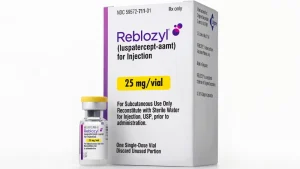
TM Owner Bristol Myers Squibb
Reblozyl 25mg Vial
Global Shipping : Reliable Global Distribution Network
Express Delivery : Priority Shipping for Every Order
Secure Payments : Trusted Payment Protection System
 Disclaimer

Secure Handling
24/7 Worldwide Support

Global Access
Worldwide Access to Health

Cold-Chain Expert
Excellence in Cold-Chain

Trusted Supply
Certified Medical Supply
Indications & Clinical Uses
- Reblozyl 25 mg (luspatercept-aamt) is a first-in-class erythroid maturation agent supplied as a single-dose vial of powder for reconstitution, given by subcutaneous injection once every 3 weeks.
- It is approved in adults for anaemia associated with beta thalassaemia who require regular red blood cell transfusions, and for anaemia in myelodysplastic syndromes (MDS) -- either as first-line treatment in patients who have not previously needed erythropoiesis-stimulating agents (ESAs) and require transfusions, or after an ESA has failed, in MDS with ring sideroblasts or MDS/MPN-RS-T who need two or more red cell units over 8 weeks.
- Reblozyl is also authorised in the EU for similar indications.
- It is not a substitute for immediate correction of anaemia by transfusion, is not approved for other causes of anaemia such as iron deficiency, and is not approved for children.
Side Effects
- Very common side effects of Reblozyl (affecting more than 1 in 10 people) include fatigue, headache, musculoskeletal pain, joint pain, dizziness, nausea, diarrhoea, cough, stomach pain, shortness of breath and swelling of the legs or feet.
- Reblozyl's current label carries no boxed warning, but several serious risks require attention: raised blood pressure (hypertension), which should be checked before each dose; blood clots (thromboembolism), more likely in people with beta thalassaemia who have had their spleen removed; and extramedullary haematopoietic masses (abnormal blood-forming tissue growths outside the bone marrow), which can occur especially in thalassaemia and may need urgent evaluation if new pain, swelling or nerve symptoms appear.
- Report severe headache, leg swelling and pain, sudden breathlessness, or chest pain to your care team promptly.
Precautions & Warnings
- Blood pressure should be checked before every Reblozyl injection and treated if raised.
- In beta thalassaemia, particularly in people who have had a splenectomy, there is an increased risk of blood clots (deep vein thrombosis, pulmonary embolism, portal vein thrombosis); your healthcare provider will weigh this risk before starting.
- Reblozyl can harm a developing baby, so it must not be used in pregnancy, and females of reproductive potential should use effective contraception during treatment and for at least 3 months after the last dose; it is not recommended while breastfeeding.
- Full blood counts should be checked before each dose, with dose adjustments or delays for excessive haemoglobin rise.
- Reblozyl is given only by subcutaneous injection by a healthcare professional in a clinic or hospital setting -- it is not for intravenous use and not self-administered at home.
Avoid Interactions
- No clinically significant pharmacokinetic drug-drug interactions have been identified for Reblozyl, including with iron-chelating agents commonly used alongside it in beta thalassaemia.
- Because Reblozyl can raise blood pressure and affect clotting risk, caution is advised when combining it with other medicines that raise blood pressure or increase clot risk, such as hormonal contraceptives or hormone replacement therapy, and your care team will monitor accordingly.
- Live or live-attenuated vaccines should be discussed with your healthcare provider before use during treatment, as with other medicines affecting blood cell production.
- Tell your healthcare provider and pharmacist about all other medicines, supplements and any hormonal treatments you use, and about any personal or family history of blood clots, so your Reblozyl treatment and monitoring can be planned safely.
References
Frequently Asked Questions
Reblozyl (luspatercept) treats anaemia in adults with beta thalassaemia who need regular blood transfusions, and anaemia in certain myelodysplastic syndromes (MDS), including after an ESA medicine has failed. It works by helping red blood cells mature. It is not approved for children.
Reblozyl is given as a subcutaneous injection by a healthcare professional once every 3 weeks, in a clinic or hospital -- it is not a tablet or a home injection. Your blood pressure and blood counts are checked before each dose to guide dosing.
Very common Reblozyl side effects include fatigue, headache, joint and muscle pain, dizziness, nausea and swelling of the legs. Seek urgent help for sudden breathlessness, chest pain, or leg swelling and pain, as these can signal a blood clot -- a known risk, especially after spleen removal.
Avoid combining Reblozyl with other medicines that raise blood pressure or clotting risk, such as hormonal contraceptives, without discussing it with your care team. Tell them about any history of blood clots. Reblozyl must not be used in pregnancy; use effective contraception during and for 3 months after treatment.
Before each Reblozyl injection, your healthcare provider checks your blood pressure and blood counts, then gives the dose under the skin -- usually in the abdomen, thigh or upper arm. Appointments happen every 3 weeks; dosing may be adjusted or delayed if your haemoglobin rises too fast.
No. Reblozyl can harm a developing baby, so it must not be used in pregnancy. Anyone who could become pregnant should use effective contraception during treatment and for at least 3 months after the last dose. It is also not recommended while breastfeeding.

Trusted & Reliable – Your Partner in Global Distribution.
We provide comprehensive lines of pharmaceutical products to support all your healthcare distribution needs.


