

TM Owner Bayer
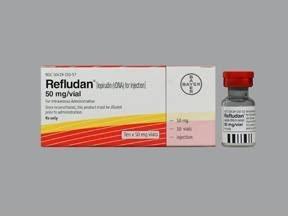
Refludan 50mg Injection
Global Shipping : Reliable Global Distribution Network
Express Delivery : Priority Shipping for Every Order
Secure Payments : Trusted Payment Protection System
 Disclaimer

Secure Handling
24/7 Worldwide Support

Global Access
Worldwide Access to Health

Cold-Chain Expert
Excellence in Cold-Chain

Trusted Supply
Certified Medical Supply
Indications & Clinical Uses
- Refludan (lepirudin) is no longer approved or marketed: its US FDA approval was formally withdrawn on 22 February 2018 (Federal Register 83 FR 7738), and its European marketing authorisation was voluntarily withdrawn on 24 April 2012 for commercial reasons; it must not be supplied or administered.
- When it was available, Refludan was a recombinant hirudin, a direct thrombin inhibitor, indicated for anticoagulation in adult patients with heparin-induced thrombocytopenia (HIT) type II and associated thromboembolic disease, to prevent further blood clots after heparin was stopped.
- It was given only in hospital, by continuous intravenous infusion after an initial slow IV bolus, with dosing based on body weight and renal function.
- Patients who need anticoagulation for HIT today are managed with an alternative agent such as argatroban, bivalirudin or a factor Xa inhibitor, under specialist supervision; this content is retained for reference only and describes a medicine no longer on the market anywhere.
Side Effects
- When Refludan was marketed, the most common effects were bleeding at any site, easy bruising, and injection-site reactions; nausea, vomiting, headache and insomnia were also reported.
- The most serious risks were haemorrhage, which could occur anywhere in the body and was more likely with concurrent thrombolytic therapy (such as alteplase or streptokinase) or after recent invasive procedures, and anaphylactic and other hypersensitivity reactions, which could occur on first exposure or, more severely, on re-exposure to lepirudin, and had resulted in shock and death.
- Patients on Refludan were watched for unexplained falls in haemoglobin or blood pressure, blood in urine or stool, and for signs of an allergic reaction such as rash, breathing difficulty or facial swelling.
- There is no boxed warning on the label reviewed (2006, pre-dating current FDA boxed-warning-format labelling), although haemorrhage and anaphylaxis were highlighted as key warnings.
Precautions & Warnings
- Refludan is withdrawn and this section is retained for reference only.
- It was contraindicated in patients with known hypersensitivity to hirudins or to any component of the product, and was used with particular caution alongside other anticoagulants or thrombolytics because of the added bleeding risk.
- Renal function was checked before and during treatment, since lepirudin is cleared by the kidneys and doses had to be reduced substantially in renal impairment, where it could accumulate and prolong its effect for days.
- Coagulation status (activated partial thromboplastin time) was monitored closely throughout the infusion to guide dosing.
- Repeat courses carried a higher risk of severe allergic reaction than a first course, because antibodies could form after initial exposure.
- It was for intravenous use only, given in hospital under specialist supervision; it was never a self-administered or take-home medicine.
Avoid Interactions
- Historically, Refludan (lepirudin) carried an increased bleeding risk when combined with other anticoagulants (heparin, warfarin and other coumarins) and with antiplatelet agents.
- Combining it with thrombolytic drugs such as alteplase (rt-PA) or streptokinase substantially raised the risk of serious, including intracranial, bleeding.
- When switching a patient from Refludan to warfarin, the two were typically overlapped and the lepirudin dose tapered, because starting warfarin alone in a patient who still had HIT antibodies could itself cause harm.
- Because Refludan is withdrawn from every market, no patient today should be taking it, so there is no current interaction advice to follow; if you have questions about a historical treatment, ask your healthcare provider to review your records.
References
- Refludan (lepirudin) - Overview and withdrawal information, European Medicines Agency
- REFLUDAN (lepirudin (rDNA) for injection) - US Prescribing Information, FDA
- List of Withdrawn Applications for Biological Products - FDA
- Refludan (Lepirudin): Side Effects, Uses, Dosage, Interactions, Warnings - RxList
Frequently Asked Questions
No. Refludan (lepirudin) is withdrawn everywhere. The European authorisation was voluntarily withdrawn on 24 April 2012, and the US FDA approval was formally withdrawn in February 2018. It cannot legally be prescribed or supplied in any market today; alternative anticoagulants are used instead.
Refludan (lepirudin) was used in hospital to prevent blood clots in adults with heparin-induced thrombocytopenia (HIT), a serious reaction to heparin. It was given only by continuous intravenous infusion after an initial slow injection, with the dose based on body weight and kidney function.
Refludan (lepirudin) most commonly caused bleeding, bruising and injection-site reactions. Serious risks included severe haemorrhage, especially with clot-dissolving drugs, and anaphylactic reactions that could be more severe on a second exposure, sometimes causing shock or death. These were treated as emergencies.
The EU authorisation was withdrawn in 2012 for commercial, not safety, reasons after the manufacturer discontinued supply. The US FDA formally withdrew its approval in 2018 once the product was no longer marketed. Alternative direct thrombin inhibitors and other anticoagulants are used for HIT instead.
Since Refludan (lepirudin) is withdrawn, heparin-induced thrombocytopenia is now managed with other non-heparin anticoagulants such as argatroban, bivalirudin or a factor Xa inhibitor, chosen by a specialist based on kidney and liver function. Ask your healthcare provider which option applies to you.
Yes. Combining Refludan (lepirudin) with heparin, warfarin or clot-dissolving drugs like alteplase raised bleeding risk substantially, including serious internal bleeding. When switching patients to warfarin, doctors overlapped and tapered the lepirudin dose carefully. This is retained for reference, as the drug is no longer used.

Trusted & Reliable – Your Partner in Global Distribution.
We provide comprehensive lines of pharmaceutical products to support all your healthcare distribution needs.


