

TM Owner Pfizer
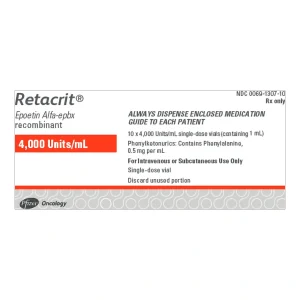
Retacrit 4000IU Injection
Global Shipping : Reliable Global Distribution Network
Express Delivery : Priority Shipping for Every Order
Secure Payments : Trusted Payment Protection System
 Disclaimer

Secure Handling
24/7 Worldwide Support

Global Access
Worldwide Access to Health

Cold-Chain Expert
Excellence in Cold-Chain

Trusted Supply
Certified Medical Supply
Indications & Clinical Uses
- Retacrit 4000 IU/0.4 mL (epoetin zeta) is a recombinant human erythropoietin biosimilar, authorised in the EU and other international markets and held by Pfizer Europe MA EEIG.
- It is used to treat symptomatic anaemia associated with chronic kidney disease in adults and children, both on dialysis and pre-dialysis; anaemia in adults receiving chemotherapy for solid tumours, malignant lymphoma or multiple myeloma; to increase the yield of autologous blood for pre-donation programmes; and, alongside iron, to reduce the need for allogeneic blood transfusion in adults undergoing major elective orthopaedic surgery, and for certain low- or intermediate-1-risk myelodysplastic syndromes meeting specific erythropoietin criteria.
- Important brand-name note: in the United States, the trade name 'Retacrit' identifies a different biosimilar, epoetin alfa-epbx, which carries its own FDA boxed warning; that US product is not the epoetin zeta product described here, and the two must not be assumed interchangeable.
Side Effects
- Common side effects of Retacrit (epoetin zeta), each affecting more than 1 in 10 people depending on indication, include diarrhoea, nausea, vomiting, fever (pyrexia) and headache; dose-dependent high blood pressure (hypertension) is also common and should be checked regularly.
- The current EU product information for this epoetin zeta presentation does not carry a formal boxed warning, but it does carry a strong warning that, like all erythropoiesis-stimulating agents, Retacrit can increase the risk of death, heart attack, stroke, blood clots (including clots at the vascular access site) and tumour progression or recurrence when haemoglobin is raised above the target range, so haemoglobin must be monitored and kept within the range advised by the prescriber.
- Report severe headache, confusion, seizures, swelling, chest pain or breathlessness immediately.
Precautions & Warnings
- Retacrit must not be given to anyone hypersensitive to epoetin zeta or its excipients, anyone with pure red cell aplasia (PRCA) following any previous erythropoietin treatment, or those with uncontrolled high blood pressure.
- In patients scheduled for elective orthopaedic surgery, it should not be used if there is severe coronary, peripheral, carotid or cerebral vascular disease, a recent heart attack or stroke, or an inability to receive adequate blood-clot prevention.
- Blood pressure and haemoglobin must be monitored regularly throughout treatment, and iron status should be checked and supplemented if needed for the treatment to work properly.
- Retacrit can be given by intravenous or subcutaneous injection depending on the indication - the route matters, so follow the prescriber's specific instruction rather than switching routes.
- Use in pregnancy and breastfeeding only if the expected benefit outweighs any risk, as data are limited.
Avoid Interactions
- Retacrit is not known to interact with common oral medicines, but drugs that reduce red blood cell production (such as certain chemotherapy agents) may reduce the response to treatment and can require dose adjustment.
- Because a rising red blood cell count (haematocrit) increases red-cell binding of ciclosporin, patients taking ciclosporin alongside Retacrit need their ciclosporin blood levels monitored and the dose adjusted as haemoglobin rises.
- Tell the prescriber about all other medicines, including chemotherapy, immunosuppressants and blood-pressure medicines, since these can change how Retacrit works or how well its effects are tolerated.
- Retacrit must never be mixed with any other medicinal product in the same syringe or infusion; it should be given as supplied.
References
Frequently Asked Questions
Retacrit (epoetin zeta) is a biosimilar erythropoietin used to treat anaemia from chronic kidney disease, cancer chemotherapy, or to boost blood collected before elective surgery. It's also used with iron before major orthopaedic surgery to reduce transfusion need, and in some myelodysplastic syndromes.
Retacrit is given by injection - either into a vein (intravenous) or under the skin (subcutaneous) - with the route and dose set by your prescriber based on your condition and body weight. Never switch the injection route yourself; follow your care team's instructions exactly.
Common Retacrit side effects include headache, nausea, vomiting, diarrhoea, fever and raised blood pressure, which needs regular checking. Like all erythropoietin medicines, Retacrit can raise the risk of blood clots, stroke, heart attack and tumour growth if haemoglobin rises too high, so blood tests are essential.
Avoid Retacrit if you've ever had pure red cell aplasia after erythropoietin treatment, or if your blood pressure is uncontrolled. Tell your doctor about ciclosporin or chemotherapy you're taking, since doses may need adjusting. Never mix Retacrit with other medicines in the same syringe.
Yes. Haemoglobin, blood pressure and iron levels are checked regularly during Retacrit treatment to keep your response within a safe target range. Raising haemoglobin too high or too fast increases the risk of serious heart and clotting problems, so dose changes are based on these results.
Not exactly. This Retacrit contains epoetin zeta. In the United States, the same brand name 'Retacrit' is used for a different biosimilar, epoetin alfa-epbx, which carries its own FDA boxed warning. The two are not interchangeable, so always check which active substance your prescription contains.

Trusted & Reliable – Your Partner in Global Distribution.
We provide comprehensive lines of pharmaceutical products to support all your healthcare distribution needs.


