

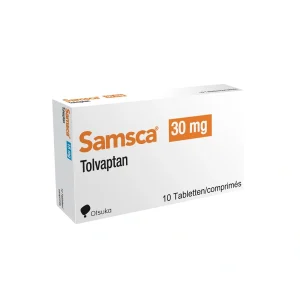
TM Owner Otsuka
Samsca 30mg Tablet
Global Shipping : Reliable Global Distribution Network
Express Delivery : Priority Shipping for Every Order
Secure Payments : Trusted Payment Protection System
 Disclaimer

Secure Handling
24/7 Worldwide Support

Global Access
Worldwide Access to Health

Cold-Chain Expert
Excellence in Cold-Chain

Trusted Supply
Certified Medical Supply
Indications & Clinical Uses
- Samsca 30 mg (tolvaptan) is a vasopressin V2-receptor antagonist ('aquaretic') tablet used to treat clinically significant hypervolaemic and euvolaemic hyponatraemia (low blood sodium), including in patients with heart failure, cirrhosis, or the syndrome of inappropriate antidiuretic hormone (SIADH), when the sodium level is very low or symptoms persist despite fluid restriction.
- It works by helping the kidneys excrete excess free water without losing sodium, raising blood sodium levels toward normal.
- Samsca is not indicated for patients who urgently need rapid correction of hyponatraemia, or for hyponatraemia caused by an inability to sense or respond to thirst.
- Treatment with Samsca must be started, and restarted if stopped, in a hospital setting where blood sodium can be monitored closely; it may be continued at a lower dose outside hospital under specialist supervision once sodium levels have stabilised, and treatment is generally limited to 30 days.
Side Effects
- Samsca carries a boxed warning: too-rapid correction of low blood sodium can cause osmotic demyelination syndrome, a serious and potentially fatal neurological injury causing symptoms such as slurred speech, difficulty swallowing, lethargy, mood changes, muscle stiffness, seizures or coma; the risk is higher in people who are malnourished, have alcohol use disorder, or advanced liver disease, which is why treatment must start in hospital with frequent sodium checks.
- The most common reactions, occurring in more than 1 in 10 people above placebo rates, are thirst, dry mouth, and increased or frequent urination; weakness, constipation and high blood sugar are also common.
- Report any confusion, difficulty speaking or swallowing, unusual weakness, or signs of dehydration such as dizziness or a very dry mouth to your healthcare provider or the ward staff immediately.
Precautions & Warnings
- Samsca must not be used together with strong CYP3A inhibitors such as ketoconazole, clarithromycin, itraconazole or ritonavir, because these can raise tolvaptan levels roughly fivefold; it is also contraindicated in patients who cannot sense or respond to thirst, in hypovolaemic hyponatraemia, in anuria, and in those needing urgent sodium correction.
- Because of a risk of liver injury with longer use, Samsca courses are generally limited to 30 days, and liver function is checked before and during treatment; stop the medicine and seek urgent care for symptoms such as fatigue, nausea, right upper abdominal pain, dark urine, or yellowing of the skin or eyes.
- Patients must have free access to water while taking Samsca to avoid dehydration, and potassium levels should also be monitored.
- Discuss use in pregnancy and breastfeeding with your healthcare provider.
Avoid Interactions
- Strong CYP3A4 inhibitors, including ketoconazole, itraconazole, clarithromycin, ritonavir, indinavir, nelfinavir, saquinavir, telithromycin and nefazodone, are contraindicated with Samsca because they substantially increase tolvaptan exposure; grapefruit juice has a similar, moderate effect and should be avoided.
- Moderate CYP3A inhibitors should also generally be avoided.
- Strong CYP3A inducers, such as rifampicin, can reduce tolvaptan's effect by around 85 percent, potentially making Samsca ineffective.
- Samsca can raise levels of digoxin and other P-glycoprotein substrate drugs, sometimes requiring a dose reduction of those medicines.
- Do not combine Samsca with hypertonic saline.
- Tell your healthcare provider and pharmacist about every medicine and supplement you take, since many common antibiotics, antifungals and heart medicines interact with tolvaptan.
References
Frequently Asked Questions
Samsca (tolvaptan) 30 mg tablets treat low blood sodium (hyponatraemia) linked to heart failure, liver cirrhosis or SIADH, when levels are very low or fluid restriction hasn't helped. It helps your kidneys remove extra water while keeping sodium, raising blood sodium levels gradually and safely under monitoring.
Samsca is a once-daily tablet, taken with or without food. Treatment must always start, or restart after a break, in hospital, where staff check your blood sodium closely for at least the first day or two before you may continue at home at a lower, specialist-adjusted dose.
Samsca carries a boxed warning: correcting sodium too fast can cause osmotic demyelination syndrome, a serious brain injury causing confusion, slurred speech, trouble swallowing or seizures. This is why treatment starts in hospital with frequent blood tests, and why you shouldn't restrict water intake while taking it.
Avoid grapefruit juice and medicines like ketoconazole, clarithromycin or certain HIV medicines (strong CYP3A4 inhibitors), which raise Samsca levels and are not allowed together. Don't restrict fluids, and tell your healthcare provider about every medicine you take, since many antibiotics and antifungals interact with tolvaptan.
Samsca courses are usually limited to about 30 days because of a risk of liver injury with longer use. Your healthcare provider will check liver function before and during treatment, and you should report fatigue, nausea, dark urine, or yellowing of the skin or eyes right away.
You'll need regular blood tests to check sodium, potassium and liver function, more often when treatment starts or the dose changes. Drink water freely rather than restricting fluids, and report thirst, dizziness, confusion or reduced urination to your healthcare provider between visits.

Trusted & Reliable – Your Partner in Global Distribution.
We provide comprehensive lines of pharmaceutical products to support all your healthcare distribution needs.


