

TM Owner Recordati
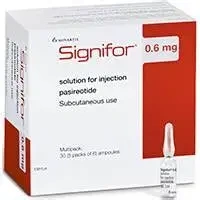
Signifor 0.6mg Injection
Global Shipping : Reliable Global Distribution Network
Express Delivery : Priority Shipping for Every Order
Secure Payments : Trusted Payment Protection System
 Disclaimer

Secure Handling
24/7 Worldwide Support

Global Access
Worldwide Access to Health

Cold-Chain Expert
Excellence in Cold-Chain

Trusted Supply
Certified Medical Supply
Indications & Clinical Uses
- Signifor 0.6mg injection contains pasireotide (as pasireotide diaspartate), a somatostatin analogue given by subcutaneous injection.
- Signifor is approved for the treatment of adult patients with Cushing's disease for whom pituitary surgery is not an option or has not been curative.
- It is not the same product as Signifor LAR: Signifor is an immediate-release formulation given twice daily by the patient or carer, self-injected into the thigh or abdomen, whereas Signifor LAR is a long-acting depot given once monthly by intramuscular injection by a healthcare professional and is approved for acromegaly as well as Cushing's disease; the two formulations must never be substituted for each other.
- Signifor is manufactured and marketed by Recordati Rare Diseases, which acquired the pasireotide franchise from Novartis.
Side Effects
- Very common effects, each reported in more than 1 in 5 patients, include diarrhoea, nausea, high blood sugar (hyperglycaemia), gallstones (cholelithiasis), headache, abdominal pain and fatigue; new-onset diabetes has also been common.
- Signifor carries no boxed warning.
- Blood sugar can rise significantly, sometimes requiring new or adjusted diabetes medicine, so glucose should be monitored before starting and regularly during treatment.
- Signifor can also slow the heart rate and prolong the QT interval on an ECG, which can rarely lead to a serious heart rhythm problem, so an ECG is usually done before treatment starts.
- Patients should seek urgent care for chest pain, palpitations, severe abdominal pain suggesting gallstones, or signs of very high blood sugar such as extreme thirst or confusion.
Precautions & Warnings
- Before starting Signifor, blood glucose, liver function, gallbladder status, heart rhythm (ECG) and electrolytes should be checked, and monitored regularly during treatment, because of the risks of hyperglycaemia, gallstones, liver enzyme changes and QT prolongation.
- Signifor should be used cautiously, at a reduced starting dose, in patients with moderate hepatic impairment and should be avoided in severe hepatic impairment.
- Caution is needed with other QT-prolonging medicines and in patients with bradycardia, electrolyte disturbances or congenital long QT syndrome.
- Signifor is for subcutaneous injection only, into the thigh or abdomen with rotating sites, and must never be given intravenously.
- Contraception should be used by women of childbearing potential during treatment, as pasireotide's effects on pregnancy have not been established.
Avoid Interactions
- Signifor should be used cautiously with other medicines that prolong the QT interval, such as certain antiarrhythmics, some antipsychotics and antibiotics, because the combined effect on heart rhythm can be additive.
- Ciclosporin blood levels may fall when taken with Signifor, so its dose may need to be increased and monitored closely.
- Bromocriptine levels can rise with Signifor, so a lower bromocriptine dose may be needed.
- Because Signifor can affect blood sugar control, doses of insulin or oral antidiabetic medicines often need adjustment when Signifor is started or stopped.
- Tell the prescriber about all heart medicines, diabetes medicines and any other prescription or over-the-counter drugs before starting Signifor.
References
Frequently Asked Questions
Signifor (pasireotide) treats Cushing's disease in adults when pituitary surgery hasn't worked or isn't possible. It's a somatostatin analogue that lowers cortisol levels. Signifor is different from Signifor LAR, a once-monthly depot injection also used for acromegaly; the two are not interchangeable.
Signifor is given as a subcutaneous injection twice daily, usually self-injected into the thigh or abdomen after training from a healthcare provider. Rotate injection sites each time. It's stored and injected at room temperature; do not refrigerate it before use.
More than 1 in 5 people get diarrhoea, nausea, high blood sugar, gallstones or headache. Signifor can also slow the heart and affect its rhythm (QT prolongation), so an ECG is checked before treatment. Get urgent help for chest pain, palpitations, or symptoms of very high blood sugar.
Avoid other medicines that affect heart rhythm (QT-prolonging drugs) unless your prescriber has reviewed them. Signifor can raise or lower the levels of some other drugs, including bromocriptine and ciclosporin, and it often changes insulin or diabetes tablet requirements.
Store Signifor at room temperature, around 25C (excursions of 15C to 30C are allowed), protected from light; do not refrigerate or freeze it. Check you have the correct product: Signifor LAR, a different once-monthly formulation, is stored refrigerated, so the two must not be confused.
Safety in pregnancy hasn't been established, so women of childbearing potential should use effective contraception while taking Signifor. Tell your prescriber if you're pregnant, planning pregnancy, or breastfeeding. Treatment length is individualised based on how your cortisol levels respond.

Trusted & Reliable – Your Partner in Global Distribution.
We provide comprehensive lines of pharmaceutical products to support all your healthcare distribution needs.


