

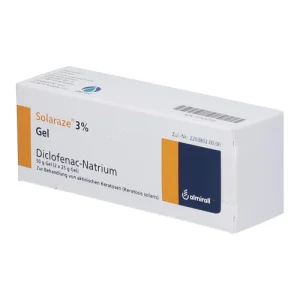
TM Owner PharmaDerm
Solaraze 3% Gel
Global Shipping : Reliable Global Distribution Network
Express Delivery : Priority Shipping for Every Order
Secure Payments : Trusted Payment Protection System
 Disclaimer

Secure Handling
24/7 Worldwide Support

Global Access
Worldwide Access to Health

Cold-Chain Expert
Excellence in Cold-Chain

Trusted Supply
Certified Medical Supply
Indications & Clinical Uses
- Solaraze (diclofenac sodium 3% gel, equivalent to 30 mg diclofenac per gram) is a topical nonsteroidal anti-inflammatory drug (NSAID) approved by the FDA for the topical treatment of actinic keratoses (AK) - rough, scaly, sun-damaged skin patches that can occasionally progress to skin cancer if untreated.
- It is applied directly to individual AK lesions on the face, scalp, forearms or hands in adults, usually for 60 to 90 days, alongside strict sun avoidance.
- Solaraze is for dermatologic use on the skin only and must never be used near or in the eyes.
- It does not treat skin cancer itself and is not a substitute for surgical removal or biopsy of a suspicious lesion; your healthcare provider will confirm the diagnosis before starting treatment.
- The same active ingredient at the same 3% strength is also marketed generically as diclofenac sodium topical gel.
Side Effects
- Most side effects occur where the gel is applied: rash affects roughly 4 in 10 people, itching (pruritus) around one third to one half, dry skin about a quarter, contact dermatitis around one fifth to one third, and skin peeling or scaling in some patients; the great majority of these local reactions are mild to moderate, though about 1 in 6 people stop treatment because of skin irritation.
- Solaraze has no boxed warning, but because diclofenac is an NSAID that can be absorbed through the skin, it should not be used in the setting of coronary artery bypass graft (CABG) surgery, and rare but serious NSAID-type reactions - unusual bruising or bleeding, black or bloody stools, chest pain, shortness of breath, swelling of the legs, or signs of an allergic reaction such as facial swelling, hives or difficulty breathing - need urgent medical attention.
- Stop treatment and contact your healthcare provider if the treated area becomes very painful, blistered or infected.
Precautions & Warnings
- Do not use Solaraze if you have had an allergic reaction to diclofenac, aspirin or other NSAIDs, or to benzyl alcohol, polyethylene glycol or hyaluronate sodium, and never use it in patients undergoing coronary artery bypass graft (CABG) surgery.
- Because diclofenac can be absorbed into the bloodstream, use it with caution if you have a history of stomach ulcers or bleeding, heart failure, high blood pressure, or kidney or liver impairment, and avoid it in late pregnancy (from around 20 weeks) because of the risk of premature closure of a blood vessel in the fetal heart (the ductus arteriosus).
- Do not apply Solaraze to open wounds, infected skin, exfoliative dermatitis or areas with cuts, and keep it away from the eyes and mucous membranes - rinse thoroughly with water if accidental contact occurs.
- Avoid sun and sunlamp exposure on treated areas, as this can worsen irritation.
- Safety and effectiveness in children have not been established.
Avoid Interactions
- Tell your healthcare provider about all medicines you take, especially other NSAIDs.
- Using oral NSAIDs or aspirin at the same time as Solaraze can increase the total NSAID-related side effects, such as stomach irritation, bleeding risk or effects on the kidneys, because some diclofenac is absorbed through the skin into the bloodstream; discuss any regular pain-relief medicines with your healthcare provider before combining them with Solaraze.
- Specific interaction studies with other topical products, cosmetics or sunscreens applied to the same area have not been done, so avoid layering other skin treatments over Solaraze-treated lesions unless your healthcare provider approves.
- Do not apply Solaraze at the same time as other topical medicated products, moisturisers or exfoliants on the treated spots.
References
Frequently Asked Questions
Solaraze (diclofenac sodium 3% gel) is a topical anti-inflammatory medicine used on actinic keratoses - rough, scaly, sun-damaged skin patches that can occasionally turn into skin cancer. It's applied to individual lesions on the face, scalp, hands or forearms, usually for 60 to 90 days.
Apply a thin layer of Solaraze gel to each actinic keratosis lesion twice daily, rubbing it in gently, for a course of 60 to 90 days as directed. Use it on the skin only - never near the eyes - and avoid sun exposure on treated areas.
Local skin reactions are common with Solaraze (diclofenac): rash, itching, dryness and contact dermatitis affect a large proportion of users, and about 1 in 6 people stop because of irritation. There's no boxed warning, but seek urgent help for unusual bruising, bleeding, chest pain or an allergic reaction.
Avoid taking oral NSAIDs or aspirin regularly while using Solaraze, since diclofenac absorbed through the skin adds to their effects and side effects. Never use Solaraze around coronary artery bypass graft (CABG) surgery, on broken or infected skin, or near the eyes.
A typical Solaraze course for actinic keratosis lasts 60 to 90 days of twice-daily application. Lesions may not fully clear until around a month after finishing treatment, so your healthcare provider will review the treated areas at a follow-up visit.
Solaraze should be avoided from around 20 weeks of pregnancy onward, because absorbed diclofenac can cause a blood vessel in the baby's heart (the ductus arteriosus) to close too early. Tell your healthcare provider if you are, or could become, pregnant before starting treatment.

Trusted & Reliable – Your Partner in Global Distribution.
We provide comprehensive lines of pharmaceutical products to support all your healthcare distribution needs.


