

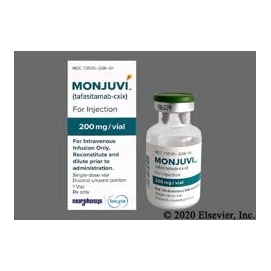
TM Owner Incyte / MorphoSys
Tafasitamab Infusion 200mg Vial
Global Shipping : Reliable Global Distribution Network
Express Delivery : Priority Shipping for Every Order
Secure Payments : Trusted Payment Protection System
 Disclaimer

Secure Handling
24/7 Worldwide Support

Global Access
Worldwide Access to Health

Cold-Chain Expert
Excellence in Cold-Chain

Trusted Supply
Certified Medical Supply
Indications & Clinical Uses
- Tafasitamab is marketed as Monjuvi in the United States and as Minjuvi in the European Union; 'Tafasitamab Infusion' is a molecule-level description, not a registered trade name, so this content is based on the Monjuvi US prescribing information, cross-checked against the Minjuvi EU product information.
- It is supplied as a 200 mg single-use vial of lyophilised powder for intravenous infusion after reconstitution and dilution by a healthcare professional; it is never self-administered.
- Tafasitamab, combined with lenalidomide, is approved for adults with relapsed or refractory diffuse large B-cell lymphoma (DLBCL) who are not eligible for autologous stem-cell transplant, given as tafasitamab plus lenalidomide followed by tafasitamab alone.
- Since 2025, both the US and EU approvals have been extended to relapsed or refractory follicular lymphoma, where tafasitamab is combined with lenalidomide and rituximab.
Side Effects
- The most common side effects of tafasitamab (Monjuvi/Minjuvi), when combined with lenalidomide, include low neutrophil counts, tiredness, low red blood cell count (anaemia), diarrhoea, low platelet counts, cough, fever, swelling of the arms or legs, respiratory infections and reduced appetite.
- Tafasitamab carries no boxed warning, but infusion-related reactions occur in around 1 in 20 patients, usually during the first or second infusion, with fever, chills, flushing or breathing difficulty; your infusion team monitors you closely and can slow or stop the infusion if this happens.
- Serious infections occur commonly in clinical trials, so report fever, cough or chills to your care team promptly.
Precautions & Warnings
- Before and during treatment your care team checks full blood counts, since tafasitamab combined with lenalidomide commonly causes low neutrophils, platelets and red cells, which may need dose delay, dose reduction of lenalidomide, or growth-factor support.
- You will usually be given premedication (such as an antihistamine, paracetamol/acetaminophen and a corticosteroid) before infusions to reduce the risk of infusion reactions.
- Tafasitamab combined with lenalidomide can seriously harm an unborn baby, so effective contraception is required during treatment and for a period afterwards for patients and partners who could become pregnant, following the lenalidomide pregnancy-prevention programme.
- Live vaccines should be discussed with your care team first.
- Because it is a hospital/clinic-administered infusion, there is no missed-dose or home-storage guidance for the patient.
Avoid Interactions
- Tafasitamab is a monoclonal antibody with no known cytochrome P450 drug interactions of its own, but it is prescribed together with lenalidomide (and, for follicular lymphoma, rituximab), which have their own significant interactions and pregnancy-prevention requirements that your care team will explain in detail.
- Tell your healthcare provider about every other medicine, supplement or vaccine you are using, including any recent or planned vaccinations, since immunosuppressive combination treatment can affect vaccine response and infection risk.
- Do not mix tafasitamab with other medicines in the same infusion bag or line.
References
Frequently Asked Questions
Tafasitamab is sold as Monjuvi in the US and Minjuvi in Europe. Combined with lenalidomide, it treats adults with relapsed or refractory diffuse large B-cell lymphoma who can't have a stem cell transplant. Since 2025 it's also approved with lenalidomide and rituximab for relapsed follicular lymphoma.
Tafasitamab (Monjuvi/Minjuvi) is given only as an intravenous infusion in a hospital or clinic, never at home. In a 28-day cycle it's given weekly at first, then every two weeks from cycle 4 onward, alongside oral lenalidomide capsules that you take yourself.
Common effects of Tafasitamab (Monjuvi/Minjuvi) with lenalidomide include low neutrophil and platelet counts, tiredness, anaemia, diarrhoea and swelling. Infusion reactions - fever, chills or breathing difficulty - can happen during the first infusions, so your team monitors you closely. Infections are common; report fever or cough right away.
Because Tafasitamab is combined with lenalidomide, effective contraception is essential during and after treatment for anyone who could become pregnant or father a child, as the combination can seriously harm an unborn baby. Discuss any live vaccines with your care team, and report all other medicines you take.
You'll usually get premedication such as an antihistamine and paracetamol before each Tafasitamab infusion to lower the chance of a reaction. The infusion itself takes place in a monitored clinic setting, with your vital signs checked, especially during the first two cycles when reactions are most likely.
No. Tafasitamab given with lenalidomide can cause serious harm to an unborn baby, so it's contraindicated in pregnancy. Both female and male patients need effective contraception during treatment and for a period afterwards, following the lenalidomide pregnancy-prevention programme your care team will explain.

Trusted & Reliable – Your Partner in Global Distribution.
We provide comprehensive lines of pharmaceutical products to support all your healthcare distribution needs.


