

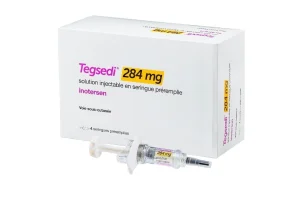
TM Owner Sobi, Inc.
Tegsedi 284mg/1.5mL Injection
Global Shipping : Reliable Global Distribution Network
Express Delivery : Priority Shipping for Every Order
Secure Payments : Trusted Payment Protection System
 Disclaimer

Secure Handling
24/7 Worldwide Support

Global Access
Worldwide Access to Health

Cold-Chain Expert
Excellence in Cold-Chain

Trusted Supply
Certified Medical Supply
Indications & Clinical Uses
- Tegsedi 284mg/1.5mL injection contains inotersen, an antisense oligonucleotide originally developed by Ionis/Akcea and now distributed by Sobi, given once weekly by subcutaneous injection.
- Tegsedi is indicated for the treatment of the polyneuropathy of hereditary transthyretin-mediated (hATTR) amyloidosis in adults - a rare genetic disease in which misfolded transthyretin protein damages peripheral nerves.
- It is important not to confuse this indication with hATTR CARDIOMYOPATHY (heart-muscle disease from the same underlying condition), which is treated with different medicines such as tafamidis; Tegsedi is approved for the nerve-damage (polyneuropathy) manifestation, not the cardiac one.
- Tegsedi is available only through a restricted REMS program because of its safety profile.
Side Effects
- Boxed warning: Tegsedi can cause sudden and unpredictable, life-threatening thrombocytopenia (low platelet count) and glomerulonephritis, which may require immunosuppressive treatment and can lead to dialysis-dependent kidney failure - both require scheduled blood and urine monitoring throughout treatment.
- Very common reactions include injection-site redness or swelling (about half of patients), nausea, headache, fatigue and fever; roughly a quarter of patients develop thrombocytopenia.
- Seek urgent medical attention for unusual bruising or bleeding, gum bleeding, blood in urine, sudden severe headache, weakness on one side, or swelling with reduced urination.
Precautions & Warnings
- Tegsedi is contraindicated with a platelet count below 100 x 10^9/L, a history of glomerulonephritis caused by Tegsedi, or hypersensitivity to inotersen.
- It is dispensed only through a certified REMS program requiring weekly platelet counts (initially), renal function tests every two weeks, and monthly liver enzyme checks.
- There is a risk of stroke or arterial dissection within about two days of the first dose in some patients, and daily vitamin A supplementation is required because Tegsedi lowers vitamin A transport protein levels.
- Use in pregnancy should be discussed with your healthcare provider, as data are limited.
Avoid Interactions
- Use antiplatelet drugs, anticoagulants (such as warfarin, aspirin or clopidogrel) and NSAIDs with caution, since Tegsedi's platelet-lowering effect raises bleeding risk when combined with these medicines, and blood counts should be checked more closely if they are used together.
- Other nephrotoxic drugs, including some antibiotics and contrast agents, should be used carefully because of the added glomerulonephritis risk.
- Do not take extra vitamin A supplements beyond the dose your healthcare provider prescribes alongside Tegsedi, since the required supplementation combined with additional vitamin A can cause toxicity.
- Tell your prescriber and REMS-certified pharmacy about every medicine, herbal product and supplement you take before and during the full course of treatment.
Frequently Asked Questions
Tegsedi (inotersen) treats the polyneuropathy - nerve damage - caused by hereditary transthyretin (hATTR) amyloidosis in adults. It is not approved for the cardiac form of hATTR amyloidosis (cardiomyopathy), which is a distinct manifestation of the same disease treated with different medicines.
Tegsedi is injected under the skin once a week, usually in the abdomen or thigh, after training from a healthcare provider. It is dispensed only through a certified REMS pharmacy program because of its safety monitoring requirements.
Injection-site reactions, nausea, headache, fatigue and fever are common with Tegsedi. It carries a boxed warning for sudden, unpredictable thrombocytopenia and for glomerulonephritis that can cause kidney failure, so regular blood and urine tests are required throughout treatment.
Tegsedi requires platelet counts checked weekly at first, kidney function tests every two weeks, and monthly liver tests, all through a certified REMS program. Daily vitamin A supplementation is also needed, since Tegsedi lowers your body's vitamin A transport protein.
If you miss a Tegsedi injection, take it as soon as possible and then resume your usual weekly schedule; do not give two doses close together. Contact your healthcare provider if you are unsure, since missed monitoring visits also need to be rescheduled.
Avoid extra vitamin A beyond your prescribed supplement, and use caution with aspirin, anticoagulants or NSAIDs, since Tegsedi lowers platelets and raises bleeding risk. Tell your prescriber about every medicine you take, and discuss pregnancy plans, since safety data in pregnancy are limited.

Trusted & Reliable – Your Partner in Global Distribution.
We provide comprehensive lines of pharmaceutical products to support all your healthcare distribution needs.


