

TM Owner Pfizer
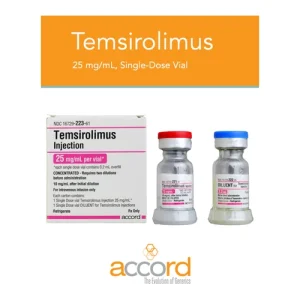
Temsirolimus IV 25mg/mL Injection
Global Shipping : Reliable Global Distribution Network
Express Delivery : Priority Shipping for Every Order
Secure Payments : Trusted Payment Protection System
 Disclaimer

Secure Handling
24/7 Worldwide Support

Global Access
Worldwide Access to Health

Cold-Chain Expert
Excellence in Cold-Chain

Trusted Supply
Certified Medical Supply
Indications & Clinical Uses
- Temsirolimus IV refers to the intravenous temsirolimus formulation marketed as Torisel by Wyeth Pharmaceuticals, a subsidiary of Pfizer; "Temsirolimus IV" itself is not a registered brand name, so this information is based on the Torisel label.
- Torisel is an mTOR-inhibitor anticancer medicine indicated for the treatment of advanced renal cell carcinoma (a type of kidney cancer) in adults.
- It is given only in a hospital or specialist infusion clinic, as a 25 mg intravenous infusion over 30 to 60 minutes once a week, continued until the disease progresses or side effects become unacceptable.
- Temsirolimus is chemically related to sirolimus (Rapamune) and everolimus (Afinitor), but these are distinct oral medicines with different doses and uses - they are not interchangeable with intravenous temsirolimus.
Side Effects
- Torisel (temsirolimus) has no boxed warning on its current US label.
- The most frequent side effects, each affecting around 3 in 10 patients, are rash, weakness, mouth sores, nausea, swelling and loss of appetite, together with raised blood sugar, raised cholesterol and triglycerides, and low blood counts.
- Serious reactions include severe, sometimes fatal, hypersensitivity or infusion reactions (antihistamine premedication is given beforehand but does not remove the risk), interstitial lung disease, bowel perforation, kidney failure, protein in the urine, bleeding in the brain, and poor wound healing.
- Tell your care team immediately if you develop new breathlessness or cough, severe abdominal pain, unusual bleeding, or a rash, hives or swelling during or shortly after the infusion.
Precautions & Warnings
- Torisel must not be given to patients with a bilirubin level above 1.5 times the upper limit of normal.
- Blood counts, blood sugar, cholesterol and triglycerides, and kidney function are checked regularly throughout treatment, and the dose may be reduced or delayed for significant abnormalities.
- Live vaccines should be avoided during treatment because the immune response may be reduced.
- Because temsirolimus can affect wound healing, treatment is usually paused around surgery.
- It is not recommended in pregnancy, as it may cause fetal harm; both men and women of reproductive potential must use effective contraception during treatment and for 3 months after the last dose.
- Temsirolimus is given only by intravenous infusion - it must never be given as a rapid injection or by any other route.
Avoid Interactions
- Strong CYP3A4 inhibitors such as ketoconazole, clarithromycin and ritonavir raise temsirolimus levels and increase side-effect risk; avoid them where possible or expect a dose adjustment.
- Strong CYP3A4 inducers such as rifampin, phenytoin and carbamazepine lower temsirolimus levels and may reduce its effect.
- Avoid grapefruit and grapefruit juice, which can raise drug levels similarly to CYP3A4 inhibitors.
- Temsirolimus should not be combined with sunitinib because of overlapping toxicity.
- Avoid live vaccines during treatment.
- Tell your care team about every medicine, herbal product and supplement you take, since many drugs interact with temsirolimus through the same liver enzyme pathway.
References
Frequently Asked Questions
Temsirolimus IV is the intravenous form of temsirolimus, marketed as Torisel. It treats advanced renal cell carcinoma, a type of kidney cancer, in adults. Torisel works by blocking mTOR, a protein that helps cancer cells grow and get blood supply, and is given by a cancer specialist.
Temsirolimus IV (Torisel) is given as a 25 mg infusion into a vein over 30 to 60 minutes, once every week, in a hospital or specialist clinic. A healthcare provider gives each dose, so there's no 'missed dose' to manage yourself - your team will reschedule if needed.
Common effects include rash, weakness, mouth sores, nausea, swelling, and raised blood sugar or cholesterol. Torisel has no boxed warning, but it can cause serious allergic reactions during the infusion, lung problems, bowel perforation, or kidney failure. Tell your care team at once about breathlessness, severe stomach pain, or unusual bleeding.
Avoid grapefruit and grapefruit juice, and tell your care team about every medicine you take, since strong CYP3A4 drugs like ketoconazole or rifampin change temsirolimus levels. Live vaccines should be avoided during treatment. Effective contraception is needed during treatment and for 3 months after the last dose.
You'll have regular blood tests to check blood counts, blood sugar, cholesterol, triglycerides and kidney function throughout Torisel treatment. You're also premedicated with an antihistamine before each infusion to reduce (not eliminate) the risk of an allergic reaction, and you'll be monitored during and after each dose.
No. Temsirolimus (Torisel) is chemically related to sirolimus (Rapamune) and everolimus (Afinitor), but all three are different medicines with different doses, routes and approved uses. Temsirolimus is given only as a weekly IV infusion for kidney cancer - it cannot be swapped for the oral drugs.

Trusted & Reliable – Your Partner in Global Distribution.
We provide comprehensive lines of pharmaceutical products to support all your healthcare distribution needs.


