

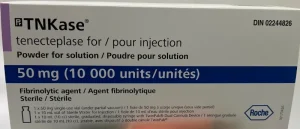
TM Owner Roche / Genentech
TNKase 50mg Injection
Global Shipping : Reliable Global Distribution Network
Express Delivery : Priority Shipping for Every Order
Secure Payments : Trusted Payment Protection System
 Disclaimer

Secure Handling
24/7 Worldwide Support

Global Access
Worldwide Access to Health

Cold-Chain Expert
Excellence in Cold-Chain

Trusted Supply
Certified Medical Supply
Indications & Clinical Uses
- TNKase 50 mg (tenecteplase) is a genetically engineered tissue plasminogen activator, a clot-dissolving (thrombolytic) enzyme, given as a single intravenous bolus by a hospital emergency or stroke team.
- In the United States it is indicated to reduce the risk of death in adults with acute ST-elevation myocardial infarction (STEMI), and since March 2025 it is also approved for the treatment of acute ischaemic stroke in adults when given within 3 hours of symptom onset.
- The stroke dose is lower and weight-based, up to a maximum of 25 mg, while the heart-attack dose is weight-based up to a maximum of 50 mg from the same vial.
- In Europe the same molecule, tenecteplase, is marketed under the different brand name Metalyse by Boehringer Ingelheim.
- TNKase is only ever given by trained clinical staff, never self-administered.
Side Effects
- TNKase does not carry a boxed warning.
- The main risk is bleeding, including serious or fatal intracranial haemorrhage, since TNKase works by dissolving blood clots throughout the body, not only the one causing the heart attack or stroke.
- Other reported reactions include allergic or hypersensitivity reactions, low blood pressure, and heart rhythm disturbances (reperfusion arrhythmias) as blocked blood vessels reopen, which is why heart monitoring and anti-arrhythmic treatment are kept ready during and after the injection.
- Bruising or oozing at needle and catheter sites is common.
- Because TNKase is given only in hospital under continuous monitoring, staff watch closely for signs of bleeding such as sudden severe headache, confusion, vomiting, unusual bruising, blood in urine or stool, or falling blood pressure, and act immediately if these occur.
Precautions & Warnings
- TNKase must never be given to anyone with active internal bleeding, a history of stroke, recent brain or spinal surgery or trauma within 2 months, a brain tumour, aneurysm or arteriovenous malformation, a bleeding disorder, or severe uncontrolled high blood pressure; for the stroke indication, active bleeding in the brain is an additional contraindication.
- It is given only as a rapid intravenous bolus over about 5 seconds into a dedicated line; intramuscular injections and unnecessary handling of the patient are avoided during and after treatment to reduce bruising and bleeding risk.
- Coagulation blood tests may be temporarily unreliable after TNKase, so results are interpreted with this in mind.
- Because TNKase is used only in an emergency hospital setting, there are no missed-dose, storage-at-home or self-injection instructions for patients or carers.
Avoid Interactions
- Because TNKase is given once, in hospital, under close supervision, formal outpatient drug-interaction checking does not apply in the way it would for a tablet taken at home; the clinical team already reviews your other medicines before giving it.
- Combining TNKase with other blood thinners such as heparin, warfarin, aspirin or other antiplatelet drugs increases the risk of bleeding, so these are used cautiously and bleeding is watched for closely afterwards.
- TNKase should not be mixed in the same intravenous line as other medicines.
- If you take regular blood thinners, tell paramedics or hospital staff as soon as possible, since this affects how quickly and safely TNKase can be given.
References
Frequently Asked Questions
TNKase (tenecteplase) is a clot-busting drug given in hospital for acute heart attack (STEMI), to reduce the risk of death, and since March 2025 also for acute ischaemic stroke within 3 hours of symptoms starting. In Europe the same drug is sold as Metalyse.
TNKase is given once, as a single intravenous injection over about 5 seconds, only by hospital or emergency medical staff. The dose is based on your body weight and on whether you are being treated for a heart attack or a stroke.
The main risk with TNKase is bleeding, including possible bleeding inside the brain, because it dissolves clots throughout the body. Staff also watch for allergic reactions and heart rhythm changes as blocked arteries reopen; report headache, confusion or unusual bruising at once.
TNKase is not given if you have active internal bleeding, a past stroke, recent brain or spinal surgery, a brain aneurysm or tumour, a bleeding disorder, or severely uncontrolled blood pressure. For stroke treatment, any current bleeding in the brain also rules it out.
After TNKase you are watched closely in hospital for bleeding, blood pressure changes and heart rhythm problems as blood flow returns. Needle sites are checked for bruising, and blood tests may be temporarily less reliable, so staff interpret them with this in mind.
Yes. TNKase and Metalyse both contain tenecteplase, the same clot-dissolving enzyme; TNKase is the Genentech/Roche brand used in the United States, while Metalyse is the Boehringer Ingelheim brand used in Europe and other markets.

Trusted & Reliable – Your Partner in Global Distribution.
We provide comprehensive lines of pharmaceutical products to support all your healthcare distribution needs.


