

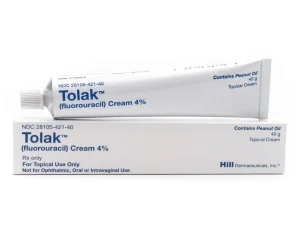
TM Owner Hill Dermaceuticals
Tolak 4% Cream
Global Shipping : Reliable Global Distribution Network
Express Delivery : Priority Shipping for Every Order
Secure Payments : Trusted Payment Protection System
 Disclaimer

Secure Handling
24/7 Worldwide Support

Global Access
Worldwide Access to Health

Cold-Chain Expert
Excellence in Cold-Chain

Trusted Supply
Certified Medical Supply
Indications & Clinical Uses
- Tolak (fluorouracil) Cream, 4%, contains the topical antimetabolite fluorouracil and is approved in the US for the treatment of actinic keratosis - sun-damage-related, pre-cancerous skin lesions - on the face, ears and scalp in adults.
- It works by interfering with DNA synthesis in rapidly dividing, abnormal skin cells, causing treated lesions to become inflamed, crust and shed before healing.
- It is applied once daily for 4 weeks to the affected area after washing and drying the skin, using a thin film massaged in with the fingertips; treated skin typically looks worse before it improves, and clearing is usually assessed some weeks after the course finishes.
- Tolak is for topical, self-applied home use and is not a chemotherapy injection or infusion - it treats a pre-cancerous skin condition, not skin cancer itself, and is not interchangeable with prescription oral or injectable fluorouracil.
Side Effects
- Application-site reactions occur in almost all patients using Tolak and are an expected part of treatment: redness, scaling, crusting, burning, itching and dryness at the treated site, usually peaking partway through the 4-week course.
- Tolak has no boxed warning, but it can cause marked photosensitivity, so treated skin sunburns more easily during and for some time after treatment, and sun exposure should be minimized with protective clothing and sunscreen.
- Contact dermatitis and, rarely, more severe skin reactions can occur.
- Avoid contact with the eyes, eyelids, nostrils and mouth, as fluorouracil can cause significant irritation or corneal damage if it gets into the eyes - rinse thoroughly with water and seek medical advice if this happens.
- Contact your healthcare provider if a treated area becomes very painful, blistered, or shows signs of infection.
Precautions & Warnings
- Tolak must not be used during pregnancy - fluorouracil can cause fetal harm - and effective contraception is advised for people who could become pregnant during treatment.
- It is contraindicated in people with dihydropyrimidine dehydrogenase (DPD) enzyme deficiency, who are at risk of severe, prolonged toxicity from fluorouracil absorption.
- The cream contains peanut oil, so it must not be used by anyone with a peanut allergy.
- Avoid applying Tolak to open wounds, mucous membranes, or skin affected by other conditions unless directed, and do not use other topical products on the treated area without medical advice.
- Wash hands thoroughly after application unless they are being treated.
- Because it is a self-applied topical cream, no special monitoring visits are usually required during the 4-week course, but your healthcare provider will want to review the skin afterward.
Avoid Interactions
- There are no established significant drug-drug interactions with Tolak because it is applied to the skin rather than absorbed in meaningful systemic amounts when used as directed.
- However, in clinical studies, people using systemic steroids, immunosuppressants, oral or topical retinoids, or topical corticosteroids on the treatment area were excluded, so combining Tolak with these has not been studied and should be discussed with your healthcare provider first.
- Do not apply other topical medicines, cosmetics, or sun-care products to the treated skin at the same time unless your healthcare provider says it is safe, since this could increase irritation or affect absorption.
- Tell your healthcare provider and pharmacist about any other creams, oral retinoids or immune-suppressing medicines you use.
References
Frequently Asked Questions
Tolak (fluorouracil) 4% cream treats actinic keratosis - rough, sun-damaged skin patches - on the face, ears and scalp in adults. It works by targeting the abnormal, rapidly dividing skin cells in these pre-cancerous lesions. It treats the lesions directly; it is not a cancer chemotherapy infusion.
Wash and dry the area, then apply a thin film of Tolak once daily for 4 weeks, gently massaging it into the lesions with your fingertips. Wash your hands afterward unless they're being treated. The skin will usually look redder and more irritated before it heals.
Nearly everyone using Tolak gets redness, scaling, crusting, burning or itching at the treated site - this is expected and shows it's working. Tolak has no boxed warning, but treated skin sunburns more easily, so use sunscreen and cover up. Tell your provider if a spot becomes very painful or infected.
Avoid getting Tolak in your eyes, nose or mouth, and avoid strong sun exposure on treated skin because of increased photosensitivity. Don't use it if you're pregnant or allergic to peanuts, since the cream contains peanut oil. Check with your provider before combining it with other topical acne or retinoid products.
A standard course is once-daily application for 4 weeks. Your healthcare provider will usually check your skin some weeks after finishing to see how well the actinic keratosis lesions have cleared, since the treated area often needs time to fully heal after the redness and crusting settle.
No. Tolak is contraindicated in pregnancy because fluorouracil can harm the developing baby, even when applied to the skin. Use effective contraception during treatment if you could become pregnant, and tell your healthcare provider immediately if you are or might be pregnant before starting Tolak.

Trusted & Reliable – Your Partner in Global Distribution.
We provide comprehensive lines of pharmaceutical products to support all your healthcare distribution needs.


