

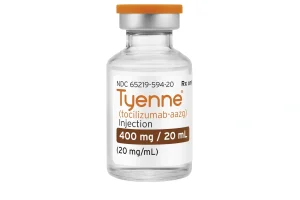
TM Owner Fresenius Kabi
Tyenne 20mg/ml Vial
Global Shipping : Reliable Global Distribution Network
Express Delivery : Priority Shipping for Every Order
Secure Payments : Trusted Payment Protection System
 Disclaimer

Secure Handling
24/7 Worldwide Support

Global Access
Worldwide Access to Health

Cold-Chain Expert
Excellence in Cold-Chain

Trusted Supply
Certified Medical Supply
Indications & Clinical Uses
- Tyenne (tocilizumab) 20 mg/mL is a monoclonal antibody that blocks the interleukin-6 (IL-6) receptor, reducing inflammation.
- It is used to treat moderate to severe rheumatoid arthritis in adults who have had an inadequate response to disease-modifying antirheumatic drugs (DMARDs) like methotrexate.
- Tyenne can be used alone or in combination with methotrexate or other traditional DMARDs.
- It is also approved for systemic juvenile idiopathic arthritis, polyarticular juvenile idiopathic arthritis, and giant cell arteritis in adults.
- Tyenne may be given intravenously or subcutaneously depending on the indication and patient factors.
- The medication significantly reduces joint pain, swelling, and improves function and quality of life in rheumatoid arthritis patients.
Side Effects
- Increased infections are the most important safety concern; upper respiratory infections, bronchitis, and other bacterial infections occur frequently.
- Gastrointestinal disturbances including abdominal pain, gastritis, and mouth ulcers may develop.
- Laboratory abnormalities include elevated liver enzymes, decreased platelet counts, and elevated lipid levels (cholesterol and triglycerides).
- Headache, dizziness, and injection site reactions (for subcutaneous injection) are common.
- Serious adverse events include opportunistic infections (tuberculosis, pneumocystis), hepatic impairment with potential liver failure, perforation of the gastrointestinal tract (rare), stroke and myocardial infarction in patients with cardiovascular risk factors, and malignancy.
- Report fever, severe fatigue, abdominal pain, or respiratory symptoms immediately.
Precautions & Warnings
- Screen all patients for tuberculosis before initiating tocilizumab; prophylaxis may be needed if latent TB is found.
- Avoid live vaccines during treatment; inactivated vaccines have reduced effectiveness.
- Monitor liver function tests, platelet counts, and lipid panels regularly, especially in the first weeks of treatment and then periodically.
- Tocilizumab is contraindicated in patients with active severe infections or sepsis.
- Patients with a history of tuberculosis, demyelinating disease, diverticulitis, or GI perforation should be managed carefully.
- Pregnancy category C; discuss risks and benefits with healthcare providers.
- Breastfeeding safety is not established.
- Do not use in patients with severe hepatic or renal impairment without careful consideration and monitoring.
Avoid Interactions
- CYP450 enzyme induction by tocilizumab can reduce levels of drugs metabolized by CYP3A4, CYP2C19, and CYP2D6, including certain statins (atorvastatin), warfarin, oral contraceptives, and theophylline; dose adjustments may be needed.
- Live vaccines should be avoided; inactivated vaccines have reduced response.
- NSAIDs and corticosteroids, often used with tocilizumab, increase GI perforation risk when combined.
- TNF inhibitors and other biologic DMARDs should not be used concurrently due to increased infection risk.
- Methotrexate, cyclophosphamide, and azathioprine require close monitoring and may need dose adjustment when combined with tocilizumab.
- Avoid high-dose systemic corticosteroids without clinical justification.
- Tell your healthcare provider about all medications, supplements, and recent vaccinations.
References
Frequently Asked Questions
Tyenne (tocilizumab) is used to treat moderate to severe rheumatoid arthritis in adults who have not responded well to other treatments. It works by blocking IL-6, a protein that causes inflammation and joint damage. Tyenne can be combined with methotrexate or used alone. It is also used for systemic juvenile arthritis and giant cell arteritis.
Tyenne is given by intravenous infusion or subcutaneous injection. Intravenous doses are typically given every 4 weeks. Subcutaneous injections are given once weekly. The route and frequency depend on your condition and body weight. Your healthcare provider determines the best administration method for you.
Increased infections are the most important side effect; upper respiratory and skin infections occur commonly. Elevated cholesterol, liver enzyme changes, and low platelet counts may occur. Serious effects include tuberculosis reactivation, opportunistic infections, and bowel perforation. Report fever, unusual fatigue, severe abdominal pain, or persistent cough immediately.
Avoid live vaccines during treatment as they may not work well and could cause disease. Avoid concurrent use of other biologic therapies like TNF inhibitors. Be cautious with NSAIDs and corticosteroids as they increase bowel perforation risk. Tell your doctor about all medications, as tocilizumab can affect how certain drugs work.
Yes, regular blood tests are essential. Your doctor will check liver function, platelet counts, and cholesterol levels before starting and periodically during treatment. These tests help detect problems early and guide dose adjustments. Testing is especially important in the first weeks of treatment.
Limited safety data exists for tocilizumab in pregnancy. Discuss risks and benefits with your rheumatologist and obstetrician before conception and during pregnancy. Animal studies show potential risk. Breastfeeding safety is uncertain; alternative options may be recommended if nursing is planned.

Trusted & Reliable – Your Partner in Global Distribution.
We provide comprehensive lines of pharmaceutical products to support all your healthcare distribution needs.


