

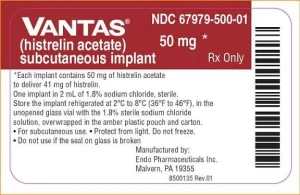
TM Owner Endo Pharmaceuticals
Vantas 50mg Implant
Global Shipping : Reliable Global Distribution Network
Express Delivery : Priority Shipping for Every Order
Secure Payments : Trusted Payment Protection System
 Disclaimer

Secure Handling
24/7 Worldwide Support

Global Access
Worldwide Access to Health

Cold-Chain Expert
Excellence in Cold-Chain

Trusted Supply
Certified Medical Supply
Indications & Clinical Uses
- Vantas (histrelin acetate) 50 mg implant is indicated for the palliative treatment of advanced prostate cancer in men.
- Histrelin is a gonadotropin-releasing hormone (GnRH) agonist that suppresses luteinizing hormone (LH) and follicle-stimulating hormone (FSH), leading to profound suppression of testosterone production.
- It is administered as a single implant placed subdermally (under the skin) in the upper arm, where it releases medication continuously for 12 months.
- Vantas is used for advanced or metastatic prostate cancer, often as first-line hormonal therapy or in combination with other hormonal agents.
- The implant does not require daily oral medication, improving patient adherence.
- Clinical response is typically observed within 4 weeks of implantation.
Side Effects
- Hot flashes (vasomotor flushing) are the most common side effect, occurring in up to 50% of patients in the first months of treatment as testosterone levels drop.
- Sexual dysfunction including erectile dysfunction and loss of libido are expected pharmacological effects.
- Gynecomastia (breast tissue enlargement) and nipple tenderness occur in 5 to 15% of patients.
- Other reactions include fatigue, mood changes, weight gain, and headache.
- Transient tumor flare with worsening bone pain may occur within the first 2 weeks due to initial testosterone surge; concurrent antiandrogens can mitigate this.
- Implant site reactions (bruising, swelling, discomfort) are generally mild and resolve spontaneously.
Precautions & Warnings
- Vantas implant is clinician-administered via minor surgical procedure under local anesthesia.
- Baseline testosterone and PSA (prostate-specific antigen) levels should be documented.
- Monitor PSA and testosterone levels periodically; suppression to castration levels (under 50 ng/dL) is expected.
- In patients with bone metastases, monitor for tumor flare reaction and bone pain, particularly in the first 2 weeks.
- Spinal cord compression or ureteral obstruction may occur in patients with metastatic disease and require immediate intervention.
- Histrelin may prolong the QTc interval; use caution in patients with cardiac arrhythmia history.
- The implant should be removed or replaced at 12 months for continued treatment.
- Do not use in women or children.
Avoid Interactions
- Vantas implant has minimal systemic absorption variation with medications since the release is controlled.
- However, other GnRH agonists or antiandrogens should not be used concurrently without medical oversight, as they provide redundant suppression.
- Androgen-replacement therapies (testosterone, DHT products) would antagonize the intended effect and should be avoided.
- Certain medications may exacerbate QTc prolongation; discuss all cardiac medications with the prescribing physician.
- Estrogens and progestins may interact; discuss any hormonal therapies.
- Because Vantas is an implant with controlled release, most drug interactions are minimal, but inform all healthcare providers about the implant.
References
Frequently Asked Questions
Vantas (histrelin) 50 mg implant treats advanced prostate cancer by suppressing testosterone production for 12 months. A healthcare provider places the implant under the skin of your upper arm during a brief outpatient procedure. Vantas reduces PSA levels and helps slow cancer progression in men with advanced or metastatic prostate cancer.
A doctor places the Vantas implant under the skin of your upper arm under local anesthesia. The minor surgical procedure takes 15-30 minutes. The implant continuously releases histrelin for 12 months, eliminating the need for daily oral medication. After 12 months, your doctor will remove and replace the implant if continued treatment is needed.
Hot flashes are the most common side effect, especially in the first months of treatment. Sexual dysfunction, including erectile dysfunction, is expected. Other side effects include gynecomastia (breast enlargement), fatigue, mood changes, and weight gain. Implant site may have mild bruising or swelling that resolves within days.
Do not take other GnRH agonists or antiandrogens without your doctor's approval, as they cause redundant suppression. Avoid testosterone replacement therapy, which opposes Vantas action. Tell your doctor about all medications and supplements. Discuss any medications for heart arrhythmias, as Vantas may affect heart rhythm.
Your doctor will monitor PSA and testosterone levels periodically to ensure proper suppression. In the first 2 weeks, watch for increased bone pain (tumor flare), which is usually temporary but may require additional medication. Blood pressure and mood should be monitored, as these can change during treatment.
Vantas carries warning regarding spinal cord compression and ureteral obstruction risk in men with bone metastases—these are medical emergencies requiring immediate treatment. Additionally, worsening of bone pain may occur initially due to tumor flare within the first 1-2 weeks of implant placement.

Trusted & Reliable – Your Partner in Global Distribution.
We provide comprehensive lines of pharmaceutical products to support all your healthcare distribution needs.


