

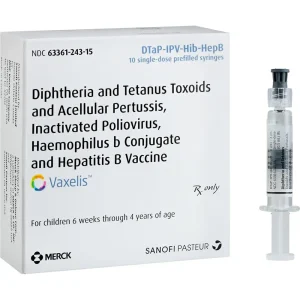
TM Owner MSP Vaccine Company (US); MCM Vaccine B.V. (EU)
Vaxelis 0.5ml Injection
Global Shipping : Reliable Global Distribution Network
Express Delivery : Priority Shipping for Every Order
Secure Payments : Trusted Payment Protection System
 Disclaimer

Secure Handling
24/7 Worldwide Support

Global Access
Worldwide Access to Health

Cold-Chain Expert
Excellence in Cold-Chain

Trusted Supply
Certified Medical Supply
Indications & Clinical Uses
- Vaxelis 0.5 mL is a combined (hexavalent) vaccine that protects infants and young children against diphtheria, tetanus, pertussis (whooping cough), poliomyelitis, hepatitis B and Haemophilus influenzae type b (Hib) disease.
- In the US it is approved for children from 6 weeks through 4 years of age (before the fifth birthday), given as three 0.5 mL intramuscular injections at 2, 4 and 6 months of age.
- In the EU it is authorised for primary and booster vaccination from 6 weeks of age.
- It is given only by a healthcare professional, in the thigh for infants under one year.
- In the US it is labelled by MSP Vaccine Company and in the EU by MCM Vaccine B.V., both partnerships involving Sanofi and Merck.
Side Effects
- The most common reactions within 0 to 5 days after a dose were irritability (55% or more), crying (45% or more), injection-site pain (44% or more), sleepiness (40% or more), fever of 38.0°C or higher (19% or more), injection-site swelling (18% or more) and vomiting (9% or more).
- Decreased appetite is also listed in the EU label.
- Serious reactions are uncommon but include severe allergic reactions, convulsions, hypotonic-hyporesponsive episodes (a floppy, unresponsive spell), and, in some premature infants, pauses in breathing (apnoea).
- The label carries no boxed warning.
- Seek urgent medical help for a high fever, persistent crying, seizures, difficulty breathing or allergic signs.
Precautions & Warnings
- Vaxelis must not be given after a severe allergic reaction to a previous dose or any component, after encephalopathy within 7 days of a previous pertussis-containing vaccine that has no other cause, or in progressive neurological disorders until stabilised.
- The EU label also lists trace residues of neomycin, streptomycin, polymyxin B, glutaraldehyde and formaldehyde.
- Talk with the doctor if a child developed Guillain-Barre syndrome within 6 weeks of a tetanus toxoid vaccine, or had a fever of 40.5°C or higher, a hypotonic-hyporesponsive episode or seizures after a pertussis vaccine.
- Apnoea has been seen in some premature infants, and the EU label advises respiratory monitoring for 48 to 72 hours in very premature infants (28 weeks or less).
- Give by intramuscular injection only.
- Store at 2°C to 8°C; do not freeze.
Avoid Interactions
- Immunosuppressive therapy may reduce the immune response to Vaxelis, so tell the doctor if the child is receiving any.
- Other routine childhood vaccines, such as pneumococcal, rotavirus, measles-mumps-rubella, varicella and meningococcal vaccines, can be given at the same visit at separate injection sites according to the EU label, although higher fever rates were seen when a booster was given with PCV13.
- Urine antigen detection tests may be unreliable after vaccination.
- The US label highlights only immunosuppressive therapy and urine antigen testing, while the EU label adds the co-administration information above.
- The label lists no food or alcohol restrictions.
- Tell the healthcare provider about the child's other medicines, prior vaccine reactions and any immune problems.
References
Frequently Asked Questions
Vaxelis is a six-in-one vaccine that protects babies and young children against diphtheria, tetanus, whooping cough (pertussis), polio, hepatitis B and Hib disease. In the US it is for children aged 6 weeks through 4 years; in the EU it is used for primary and booster vaccination from 6 weeks of age.
Vaxelis is given by a healthcare professional as a 0.5 mL injection into a muscle, usually the thigh in infants. In the US, babies get three doses at 2, 4 and 6 months of age. In the EU, primary vaccination is 2 or 3 doses at least one month apart, plus a booster.
Common Vaxelis side effects in the days after a dose are irritability, crying, pain and swelling where the injection was given, sleepiness, fever of 38°C or more and vomiting. Seek urgent help for seizures, difficulty breathing, a floppy unresponsive spell, or signs of severe allergy.
Children should not have Vaxelis if they had a severe allergic reaction to a previous dose or ingredient, encephalopathy within 7 days of an earlier pertussis-containing vaccine with no other cause, or a progressive neurological disorder that has not stabilised. Tell the doctor about any prior reaction to a vaccine.
Yes. In the EU, Vaxelis may be given at the same visit as pneumococcal, rotavirus, MMR, varicella and meningococcal vaccines, using separate injection sites. Higher fever rates were seen when a booster was given with PCV13. Immunosuppressive treatment can lower the response to Vaxelis, so tell the doctor about any.
Premature babies can be vaccinated, but pauses in breathing (apnoea) have been seen after injections in some premature infants. The EU label advises respiratory monitoring for 48 to 72 hours in very premature infants (28 weeks or less). The doctor weighs the risks and benefits for each baby.

Trusted & Reliable – Your Partner in Global Distribution.
We provide comprehensive lines of pharmaceutical products to support all your healthcare distribution needs.


