

TM Owner Exela Pharma Sciences, LLC
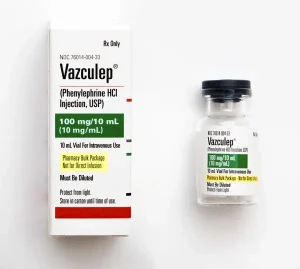
Vazculep 10mg/mL Injection
Global Shipping : Reliable Global Distribution Network
Express Delivery : Priority Shipping for Every Order
Secure Payments : Trusted Payment Protection System
 Disclaimer

Secure Handling
24/7 Worldwide Support

Global Access
Worldwide Access to Health

Cold-Chain Expert
Excellence in Cold-Chain

Trusted Supply
Certified Medical Supply
Indications & Clinical Uses
- Vazculep's FDA approval was withdrawn as of 8 April 2026 (Federal Register notice of 9 March 2026), so it is no longer approved for marketing in the United States, though FDA has determined it was not withdrawn for safety or effectiveness reasons.
- Vazculep 10 mg/mL contains phenylephrine hydrochloride, an alpha-1 adrenergic receptor agonist (vasopressor) used to treat clinically important low blood pressure caused mainly by widening of blood vessels during anaesthesia.
- It is a concentrate that must be diluted before use, in 1 mL single-dose vials (10 mg) and 5 mL or 10 mL pharmacy bulk packages (50 mg or 100 mg), and is given only by an anaesthesia team or hospital clinician as an intravenous bolus or infusion.
- It is not ready-to-use and not for undiluted injection.
Side Effects
- The most common side effects are nausea, vomiting and headache.
- Because phenylephrine narrows blood vessels, it can cause a severe slowing of the heart rate with reduced heart output, worsen angina, heart failure or pulmonary hypertension, and reduce blood flow to the limbs and organs.
- If the drug leaks outside the vein, it can cause tissue damage and skin death (necrosis).
- Vazculep contains sodium metabisulfite, a sulfite that can cause allergic-type reactions in some people.
- Your anaesthesia team monitors blood pressure and heart rate continuously and adjusts the dose.
- The label has no boxed warning.
- Report chest pain, breathlessness or pain at the drip site.
Precautions & Warnings
- Vazculep 10 mg/mL must be diluted before it is given, and doses are adjusted by response to blood pressure: usually small bolus doses of 40 to 100 micrograms every 1 to 2 minutes (up to 200 micrograms), or an infusion of 10 to 35 micrograms per minute (up to 200 micrograms per minute).
- There are no listed contraindications.
- Take special care in patients with existing angina, heart failure, pulmonary hypertension, severe bradycardia, and in those with sulfite sensitivity.
- Blood pressure and heart rate are monitored continuously, and the infusion site is watched for extravasation.
- Published trials in caesarean delivery found no adverse maternal or infant outcomes at recommended doses; other pregnancy data are limited.
- Store the vial at 20°C to 25°C, protected from light, and keep in the carton.
- Diluted solution can be kept 4 hours at room temperature or 24 hours refrigerated.
Avoid Interactions
- Medicines that increase the effect of phenylephrine, and so raise the risk of high blood pressure or dangerous heart rhythms, include monoamine oxidase inhibitors, tricyclic antidepressants and ergot alkaloids.
- Medicines that reduce the effect include alpha-adrenergic blockers, calcium channel blockers and ACE inhibitors, which can blunt the rise in blood pressure.
- Do not give the concentrate undiluted, and check the concentration carefully, because other phenylephrine products come in different strengths.
- Tell your anaesthetist about all prescription medicines, over-the-counter products and supplements you take, particularly antidepressants, blood pressure or heart medicines, and any sulfite allergy.
References
- VAZCULEP (phenylephrine hydrochloride) injection - Prescribing Information (revised 4/2026), Exela Pharma Sciences, DailyMed
- VAZCULEP (phenylephrine hydrochloride) Label (2014), FDA Drugs@FDA
- Federal Register, 9 March 2026 - Withdrawal of approval of NDAs (incl. NDA 204300 Vazculep)
- Federal Register public inspection 2026-11429 - Determination that products were not withdrawn for safety or effectiveness (incl. Vazculep)
- Vazculep package insert (Avadel Legacy Pharmaceuticals, 2019), Drugs.com
Frequently Asked Questions
Vazculep contains phenylephrine hydrochloride and treats clinically important low blood pressure caused mainly by widened blood vessels during anaesthesia. Only hospital anaesthesia staff give it. Its FDA approval was withdrawn as of 8 April 2026, so it is no longer marketed in the US.
Vazculep is given only by hospital staff into a vein, as small bolus doses or a continuous infusion, after the 10 mg/mL concentrate has been diluted. Your anaesthetist adjusts the dose to your blood pressure. It must never be given undiluted.
Vazculep most commonly causes nausea, vomiting and headache. Serious effects include a very slow heart rate, worse angina or heart failure, reduced blood flow to organs and limbs, and tissue damage if it leaks from the vein. It contains a sulfite that may trigger allergic reactions. There is no boxed warning.
Vazculep effects are increased by MAO inhibitors, tricyclic antidepressants and ergot alkaloids. They are reduced by alpha-blockers, calcium channel blockers and ACE inhibitors. Tell your anaesthetist about every medicine you take, including antidepressants, heart and blood pressure medicines, and any sulfite allergy.
While you are under anaesthesia, your anaesthetist gives Vazculep through a vein and watches your blood pressure and heart rate continuously. Small doses are repeated every 1 to 2 minutes, or an infusion is run, until pressure returns to a safe level. The drip site is checked for leakage.
Published trials in caesarean delivery found no harmful effects on mothers or babies at recommended Vazculep doses. Data from early pregnancy are limited, and animal studies showed harm at high doses. Your anaesthesia team will weigh benefits and risks and monitor you and your baby.

Trusted & Reliable – Your Partner in Global Distribution.
We provide comprehensive lines of pharmaceutical products to support all your healthcare distribution needs.


