

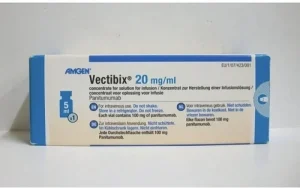
TM Owner Amgen
Vectibix 100mg/5ml Vial
Global Shipping : Reliable Global Distribution Network
Express Delivery : Priority Shipping for Every Order
Secure Payments : Trusted Payment Protection System
 Disclaimer

Secure Handling
24/7 Worldwide Support

Global Access
Worldwide Access to Health

Cold-Chain Expert
Excellence in Cold-Chain

Trusted Supply
Certified Medical Supply
Indications & Clinical Uses
- Vectibix 100 mg/5 mL (20 mg/mL) is a single-dose vial of panitumumab, a monoclonal antibody that blocks the epidermal growth factor receptor (EGFR), used to treat metastatic colorectal cancer in adults.
- In the US label it is approved for wild-type RAS tumours, either as first-line treatment with FOLFOX chemotherapy or as a single agent after earlier chemotherapy, and, together with sotorasib, for KRAS G12C-mutated tumours after prior treatment.
- Vectibix is given only by a healthcare provider, in a clinic or hospital, as an intravenous infusion of 6 mg/kg every 14 days, over 60 minutes for doses up to 1000 mg and over 90 minutes for larger doses.
- A 400 mg/20 mL vial of the same 20 mg/mL concentration also exists, so the dose is calculated by bodyweight, not by vial.
- Vectibix is marketed by Amgen Inc.
Side Effects
- BOXED WARNING: dermatologic toxicity.
- Skin reactions occurred in about 90% of patients and were severe (grade 3 or higher) in 15% of those receiving Vectibix alone.
- Common effects (20% or more) of Vectibix alone are rash, paronychia (nail-fold infection), fatigue, nausea and diarrhoea.
- With FOLFOX, diarrhoea (62%), mouth sores, mucosal inflammation, weakness, poor appetite, low magnesium and potassium, and acne-like rash are common; with sotorasib, rash (87%), dry skin, diarrhoea, mouth sores, fatigue and musculoskeletal pain.
- Infusion reactions occurred in 4% of patients (1% severe).
- Serious effects include lung inflammation or scarring (interstitial lung disease), low magnesium and potassium (in 38 to 76%), and eye problems such as keratitis and corneal perforation.
- Tell your care team at once about worsening rash, cough or breathlessness, eye pain or redness, or any reaction during the infusion.
Precautions & Warnings
- Vectibix has a boxed warning for dermatologic toxicity: your skin will be checked, and treatment may be paused, reduced or permanently stopped for severe (grade 3 or 4) reactions.
- Blood magnesium and potassium are monitored and replaced when low.
- The infusion rate is reduced by 50% for mild to moderate infusion reactions and the infusion is stopped for severe ones.
- Treatment is discontinued if interstitial lung disease is confirmed, and eye symptoms need prompt review.
- Vectibix can cause fetal harm: use effective contraception during treatment and for 2 months after the last dose, and avoid breastfeeding for the same period.
- Use sun protection during treatment and for 2 months afterwards because of photosensitivity.
- No contraindications are listed in the US label.
- Vials are kept by the pharmacy at 2°C to 8°C, in the carton, protected from light, never frozen or shaken.
Avoid Interactions
- Increase effect or toxicity: do not combine Vectibix with bevacizumab plus chemotherapy, because this increased mortality and grade 3 to 5 toxicity (87% versus 72%) in trials.
- Sun exposure raises the risk of photosensitivity skin reactions.
- When Vectibix is given with sotorasib, dose interruptions are coordinated between the two medicines, and with FOLFOX chemotherapy the side effects of both apply.
- Reduce efficacy: the sections of the label reviewed did not identify specific interacting drugs that reduce its effect.
- Tell your oncology team about all prescription medicines, over-the-counter products, herbal remedies and supplements.
- Vectibix must not be frozen or shaken, and unused vial contents are discarded.
References
Frequently Asked Questions
Vectibix (panitumumab) treats metastatic colorectal cancer in adults. In the US it is used for wild-type RAS tumours, with FOLFOX chemotherapy first or alone after earlier chemotherapy, and with sotorasib for KRAS G12C-mutated tumours after prior treatment. A healthcare provider gives it by infusion.
Vectibix (panitumumab) is given by a healthcare provider as an intravenous infusion of 6 mg/kg every 14 days. Each infusion lasts 60 minutes for doses up to 1000 mg and 90 minutes for larger doses. Treatment is given in a clinic or hospital.
Vectibix (panitumumab) has a boxed warning: skin reactions occur in about 90% of patients and are severe in 15% on Vectibix alone. Rash, nail infections, fatigue, nausea and diarrhoea are common. Report worsening rash, breathlessness, eye pain or infusion reactions immediately.
Do not combine Vectibix (panitumumab) with bevacizumab plus chemotherapy, which increased deaths in trials. Avoid sun exposure: use sun protection during treatment and for 2 months after the last dose. Tell your oncology team about every medicine and supplement you take, including any planned use of sotorasib.
During a Vectibix (panitumumab) infusion, a nurse gives the medicine into a vein over 60 or 90 minutes and watches for infusion reactions, which occur in about 4% of patients. If a reaction occurs, the rate is slowed by 50% or stopped if severe.
Vectibix (panitumumab) can harm an unborn baby. Use effective contraception during treatment and for 2 months after your last dose, and avoid breastfeeding for the same 2 months. Tell your care team straight away if you become pregnant or think you might be.

Trusted & Reliable – Your Partner in Global Distribution.
We provide comprehensive lines of pharmaceutical products to support all your healthcare distribution needs.


