

TM Owner Roche / Genentech
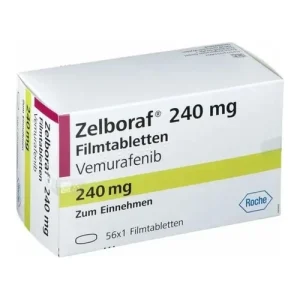
Vemurafenib 240mg Tablet
Global Shipping : Reliable Global Distribution Network
Express Delivery : Priority Shipping for Every Order
Secure Payments : Trusted Payment Protection System
 Disclaimer

Secure Handling
24/7 Worldwide Support

Global Access
Worldwide Access to Health

Cold-Chain Expert
Excellence in Cold-Chain

Trusted Supply
Certified Medical Supply
Indications & Clinical Uses
- Vemurafenib 240 mg film-coated tablets are the kinase inhibitor sold by Roche/Genentech as Zelboraf; the generic name is not itself a brand, and the information here comes from the Zelboraf label.
- In the US, vemurafenib is indicated for unresectable or metastatic melanoma with a BRAF V600E mutation (detected by an FDA-approved test) and for Erdheim-Chester disease with a BRAF V600 mutation.
- In the EU it is authorised for adults with BRAF V600 mutation-positive unresectable or metastatic melanoma.
- It is not indicated for wild-type BRAF melanoma.
- The dose is 960 mg (four 240 mg tablets) by mouth twice daily, about 12 hours apart, with or without a meal.
- It is prescribed and supervised by a cancer specialist.
Side Effects
- The most common side effects in melanoma studies include joint pain (arthralgia, 53%), hair loss (45%), tiredness (38%), rash (37%), nausea (35%), sun sensitivity (photosensitivity, 33%), itching (23%) and skin papilloma (21%).
- Serious effects include new skin cancers (cutaneous squamous cell carcinoma in about 24%), severe skin reactions including Stevens-Johnson syndrome and toxic epidermal necrolysis, QT prolongation (a heart rhythm change), liver injury, kidney problems, worsening of radiation reactions, and eye problems such as uveitis and retinal vein occlusion (EU label).
- Report new or changing skin lesions, severe rash or blistering, fainting or palpitations, yellow skin or eyes, or vision changes at once.
- Zelboraf has no boxed warning.
Precautions & Warnings
- Skin examination is needed before starting, every 2 months during treatment and for up to 6 months after stopping.
- Your provider will check ECG and electrolytes (treatment is withheld if QTc exceeds 500 ms), and liver enzymes, bilirubin and creatinine, in the US label monthly for the liver.
- Avoid sun exposure and use sunscreen SPF 30 or higher with protective clothing.
- Vemurafenib can harm an unborn baby; use effective contraception during treatment and for 2 weeks after the last dose (US label) or 6 months after (EU label).
- It may reduce the effect of hormonal contraceptives (EU label).
- Take care around radiation therapy.
- Hypersensitivity to vemurafenib or any excipient is a contraindication in the EU label.
- Store at 20 to 25 degrees C in the original container, protected from moisture.
Avoid Interactions
- Medicines that increase toxicity or levels: strong CYP3A4 inhibitors should be avoided; substrates of CYP1A2 and P-glycoprotein (for example digoxin, dabigatran) may reach higher levels and may need dose reduction or monitoring; warfarin needs closer INR monitoring (EU label).
- Ipilimumab: safety and efficacy of combined use are not established, and liver toxicity has been reported.
- Medicines that reduce efficacy: strong CYP3A4 inducers should be avoided as they can lower vemurafenib exposure.
- Avoid strong CYP3A4 inhibitors or inducers wherever possible, and your prescriber will decide if a substitute medicine is needed.
- Tell your healthcare provider about all prescription medicines, over-the-counter products, herbal remedies and supplements.
References
Frequently Asked Questions
Vemurafenib (Zelboraf) treats melanoma that has spread or cannot be removed by surgery and carries a BRAF V600 mutation confirmed by a test. In the US it is also approved for BRAF V600 Erdheim-Chester disease. It is not for melanoma without the BRAF mutation.
Take vemurafenib as four 240 mg tablets (960 mg) by mouth twice daily, about 12 hours apart, with or without food. Swallow as directed by your cancer specialist and keep the tablets in the original container. A BRAF V600 test must confirm you are suitable.
Vemurafenib often causes joint pain, hair loss, tiredness, rash, nausea, sun sensitivity and itching. It can cause new skin cancers, severe skin reactions, QT prolongation and liver problems. Report new skin lesions, blistering, fainting or yellow skin. It has no boxed warning.
Avoid strong sun exposure and use SPF 30 or higher, as vemurafenib (Zelboraf) causes photosensitivity. Avoid strong CYP3A4 inhibitors and inducers, and ask before taking digoxin, dabigatran or warfarin. Take care with radiation treatment, because vemurafenib can worsen radiation reactions, and ask before starting any new medicine.
Vemurafenib (Zelboraf) needs skin checks before starting, every 2 months during treatment and for up to 6 months after stopping. You also need ECG and electrolyte checks for QT prolongation, and regular liver and kidney blood tests. Report any new skin lesion promptly.
No. Vemurafenib can cause fetal harm, so it should not be taken in pregnancy. Use effective contraception during treatment and for 2 weeks after the last dose in the US label (6 months in the EU label). It may also reduce the effect of hormonal contraceptives.

Trusted & Reliable – Your Partner in Global Distribution.
We provide comprehensive lines of pharmaceutical products to support all your healthcare distribution needs.


