

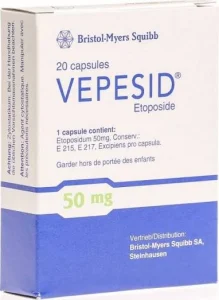
TM Owner Amneal Pharmaceuticals NY LLC
Vepesid 50mg Capsule
Global Shipping : Reliable Global Distribution Network
Express Delivery : Priority Shipping for Every Order
Secure Payments : Trusted Payment Protection System
 Disclaimer

Secure Handling
24/7 Worldwide Support

Global Access
Worldwide Access to Health

Cold-Chain Expert
Excellence in Cold-Chain

Trusted Supply
Certified Medical Supply
Indications & Clinical Uses
- Vepesid 50 mg capsules: the Vepesid brand is listed as discontinued by Drugs.com, although DailyMed still carries a label under the VePesid name, packaged by Amneal Pharmaceuticals NY LLC (effective 15 May 2026) and not naming Bristol Myers Squibb; this is a commercial status and no formal revocation of approval was found in the sources checked.
- Each capsule contains etoposide, a topoisomerase II inhibitor chemotherapy medicine, approved in the US in combination with other approved chemotherapy as first-line treatment of small cell lung cancer.
- It is prescribed under supervision of a physician experienced in cancer chemotherapy.
- The oral dose is twice the intravenous dose, rounded to the nearest 50 mg, so capsules must not be confused with etoposide injection.
- Safety and effectiveness in children have not been established.
Side Effects
- BOXED WARNING: severe myelosuppression with resulting infection or bleeding may occur.
- Low white blood cells (below 4,000 per mm3) occur in 60% to 91% of patients and low platelets (below 100,000 per mm3) in 22% to 41%.
- Nausea and vomiting affect 31% to 43%, hair loss 8% to 66%, sometimes progressing to total baldness but reversible, loss of appetite 10% to 13% and diarrhoea 1% to 13%.
- Allergic or anaphylactic-like reactions occur in roughly 1% to 2% overall (under 1% with the oral form).
- Acute leukaemia has been reported rarely and etoposide is considered a potential carcinogen.
- Report fever, chills, unusual bruising or bleeding, or breathing difficulty immediately.
Precautions & Warnings
- Frequent blood counts are required because bone marrow suppression is dose-limiting; doses may need to be modified after prior radiation or chemotherapy, or if serum albumin is low.
- Etoposide is contraindicated in people with previous hypersensitivity to it or to any component.
- It can cause fetal harm (Pregnancy Category D) and women of childbearing potential should avoid becoming pregnant.
- It is not known whether etoposide passes into breast milk, and a decision must be made whether to stop nursing or the drug.
- The dose is reduced to 75% when creatinine clearance is 15 to 50 mL/min.
- Safety and effectiveness in children have not been established.
- Store capsules in a refrigerator at 2°C to 8°C and do not freeze; they are stable for 24 months refrigerated.
Avoid Interactions
- Cyclosporin A at high concentrations (above 2,000 ng/mL) taken with oral etoposide increased etoposide exposure by 80% and reduced its clearance by 38%, which raises the risk of toxicity, so this combination needs specialist supervision.
- Other medicines that suppress the bone marrow, and previous radiation therapy or chemotherapy, can add to the blood-count effects, and doses are adjusted for them.
- The label reviewed does not list food or alcohol restrictions or medicines that reduce etoposide's effect.
- Tell your oncology team and pharmacist about every prescription medicine, over-the-counter product and supplement you take, and do not start any new one without checking first.
References
Frequently Asked Questions
Vepesid (etoposide) capsules are used with other approved chemotherapy as first-line treatment of small cell lung cancer. The brand is listed as discontinued by Drugs.com, though a VePesid label remains on DailyMed. Treatment must be supervised by a doctor experienced in cancer chemotherapy.
Vepesid (etoposide) 50 mg capsules are swallowed by mouth. The oral dose is twice the intravenous etoposide dose, rounded to the nearest 50 mg, so your oncology team sets the number of capsules for you. Never swap them for etoposide injection or change the dose yourself.
Vepesid (etoposide) carries a boxed warning for severe myelosuppression, which can cause serious infection or bleeding. Nausea, vomiting and hair loss are common. Report fever, chills, unusual bruising or bleeding, or trouble breathing to your care team immediately, without waiting for your next visit.
Avoid pregnancy and breastfeeding during Vepesid (etoposide) treatment, because it can harm an unborn baby. High-dose cyclosporin A raises etoposide levels by about 80%. Tell your oncology team about every other medicine, over-the-counter product and supplement you use, before you start.
Store Vepesid (etoposide) capsules in a refrigerator at 2°C to 8°C and do not freeze them. The label states they are stable for 24 months when kept refrigerated. Do not keep them at room temperature, and keep them out of reach of children.
Vepesid (etoposide) causes severe bone marrow suppression, so frequent blood counts are needed to check white cells and platelets. Your doctor may lower the dose if counts fall, if kidney function is reduced, or after earlier chemotherapy or radiation therapy.

Trusted & Reliable – Your Partner in Global Distribution.
We provide comprehensive lines of pharmaceutical products to support all your healthcare distribution needs.


